← On a small screen, scroll the diagram horizontally. →
01 /
Players and cards
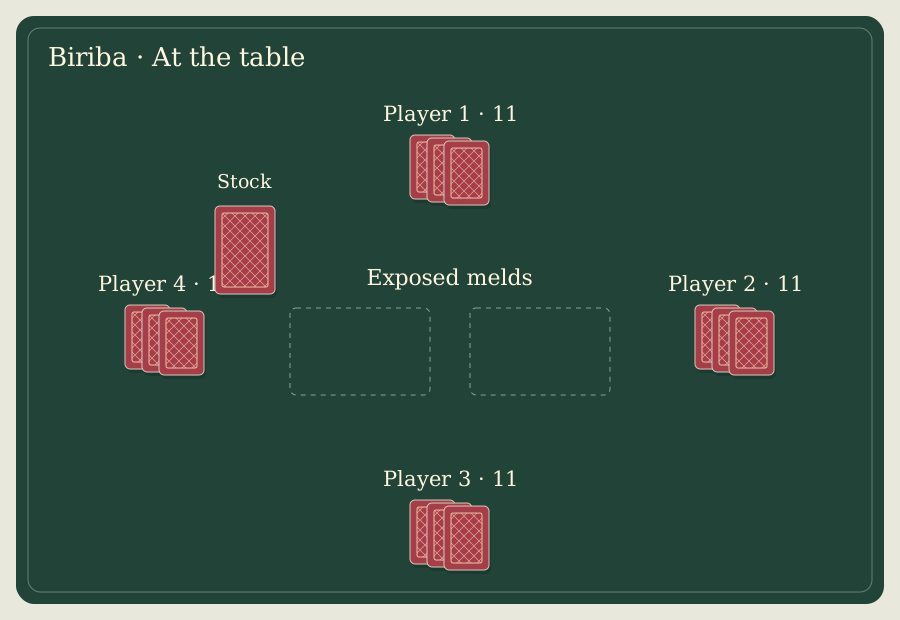
4 play, partners opposite. Combine 2 ordinary packs and 4 jokers: 108 cards. Select the documented no-kózi bonus-suit variant; the starter discard creates no premium suit. Twos and jokers substitute for cards. Red threes are ordinary cards, not Canasta bonuses. There is no minimum initial-meld value.
02 /
Deal and opening
Choose dealer randomly; deal and play anticlockwise, rotating deal right. Cut on the left, deal 11 each singly, then prepare 2 face-down biribaki packets of 11, crossed. The remainder is stock; expose its top card to start discards. This leaves 41 closed stock cards. Dealer’s right plays first.
03 /
Sets, runs and wild cards
A meld starts with at least 3 cards: equal-rank set or consecutive same-suit run. Identical copies are allowed in sets. In runs ace is below 2 or above K, never K–A–2 and never two aces. Maximum run length is 13. A meld allows at most 1 substitute; a same-suit two occupying rank 2 is natural and does not use that allowance.
At least 7 cards make a biriba: clean without a substitute, dirty with one. Add only to your team’s melds. Do not split, combine or recover melded cards. Reposition a substitute within its own run by inserting its natural card and moving the substitute to an end. Never introduce a second substitute temporarily, even to make the first a natural two.
04 /
Playing a turn
First draw 1 from stock or take the entire discard pile. Discards may be inspected and need not be immediately melded. Optionally make new melds and add to old ones. Finish by discarding 1. After taking a single-card discard pile, do not discard that card or an identical copy back; a stock draw may be discarded.
Normally keep at least 2 cards after melding: one to discard, another to retain. Exceptions are a permitted reserve pickup or legal closure below. Never empty by melding without a qualifying reserve.
05 /
Taking the biribaki
Once a team has a biriba and has not taken its reserve, a player may empty their hand and collect the top packet of 11. Emptying by melding lets that player immediately continue melding the new packet, without another draw, then discard. Emptying by the final discard gives the reserve now but ends the turn; use it on the next personal turn after the normal draw.
The other packet belongs to the other team. The first reserve-taker’s partner cannot take a second. A team needs a biriba and its reserve already collected to close.
06 /
Scoring
Team score is all melded card values minus both remaining hands: joker 20, A 15, 2 and 8–K 10, 3–7 5. Add clean/dirty bonuses: run of 7–12 cards 200/100; set of at least 7, 300/150; full run of 13, 1000/500. Card values and bonuses both count. No suit premium applies because kózi is excluded.
Going out adds 100. An untaken reserve costs 100, without counting its individual cards. A reserve taken after a final discard but never activated by its owner’s next turn also costs 100 instead of its unplayed card values if the deal ends. Otherwise cards from an activated reserve remaining in hand are penalised normally.
07 /
Ending the game
After taking reserve, finish only by discarding the last card, never by melding it. The deal ends immediately and partner’s leftovers are also penalised. With stock empty, take the whole discard or pass. After 4 consecutive passes end without going-out bonus; never recycle discards.
End the match after a complete deal when a team strictly exceeds 5000: exactly 5000 is insufficient. Higher total wins; equal totals require another deal.
08 /
History and selected variant
Biriba is a Greek rummy-family game also played in Cyprus and related to Burraco. Sources document many living conventions without establishing one inventor or exact date. This partnership profile has sets and runs but no bonus suit. Runs-only play, entry thresholds and reserve access without a biriba are excluded.
09 /
Worked example
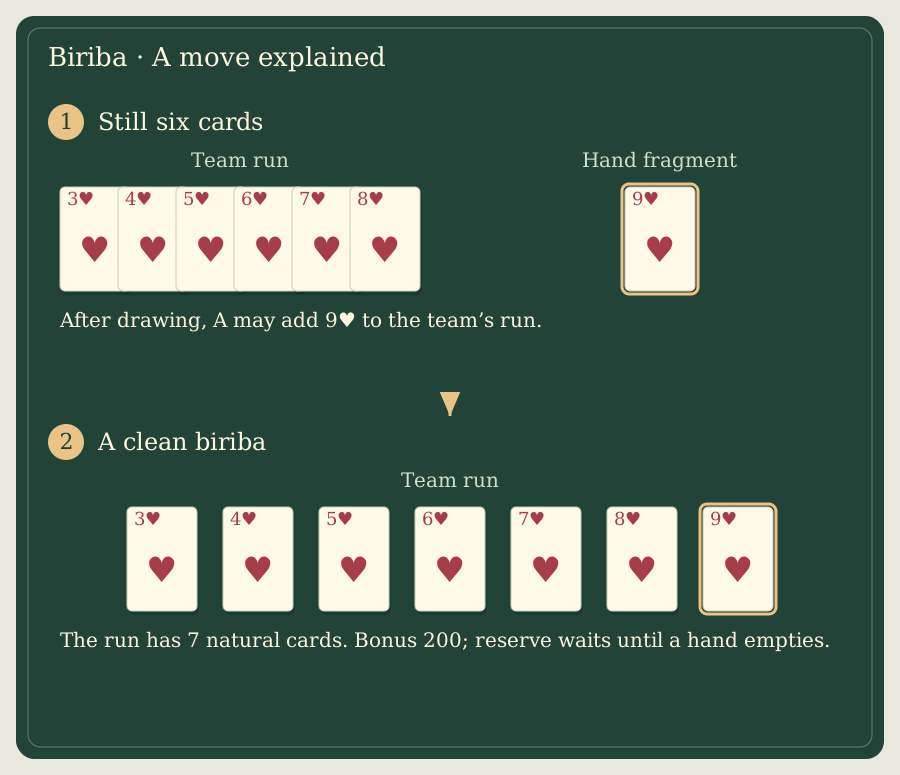
Team owns run 3♥–4♥–5♥–6♥–7♥–8♥. After the normal draw A adds 9♥: now 7 natural cards make a clean biriba, bonus 200 and card value 45. This alone does not give reserve: a hand must legally empty. Later, if A melds the final card while reserve is untaken, A immediately takes 11 and continues that turn before the compulsory discard.
← On a small screen, scroll the diagram horizontally. →
Common questions
Does completing a biriba immediately give reserve?+
No; a player must then empty a hand legally.
May I close by melding my last card?+
No; final closure requires a last discard.
Are two twos always illegal in a run?+
A natural same-suit two may coexist with one other wild two.