← On a small screen, scroll the diagram horizontally. →
01 /
Players and cards
3–8 play without partners using 52 cards, no jokers, ranked A–K–Q–J–10–9–8–7–6–5–4–3–2. There are no trumps. Escape from play; the final card-holder loses. This is Punjabi Getaway: the highest led-suit card’s owner picks up, not the player who ran out of that suit.
02 /
Deal and opening
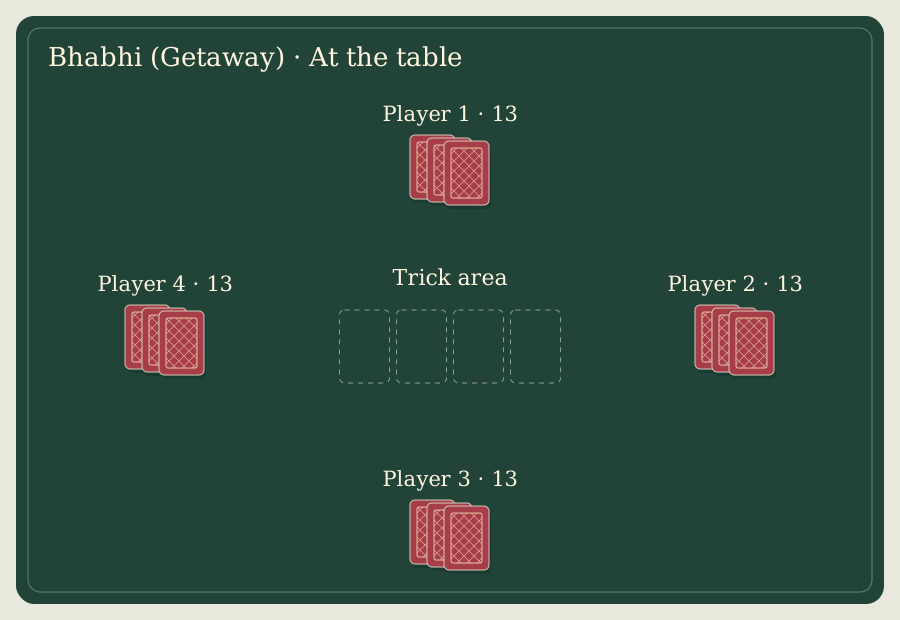
Choose first dealer randomly, then rotate left, our agreement to distribute unequal hands fairly. Shuffle and deal everything singly clockwise; a difference of 1 card is normal. Conceal hands. The A♠ holder must open with that ace. There is no stock.
03 /
Playing a turn
The opening trick is special: everyone plays exactly one card. Follow spades if held, otherwise anything. Discard the entire opening trick face down even after an off-suit card. The A♠ holder leads again with anything.
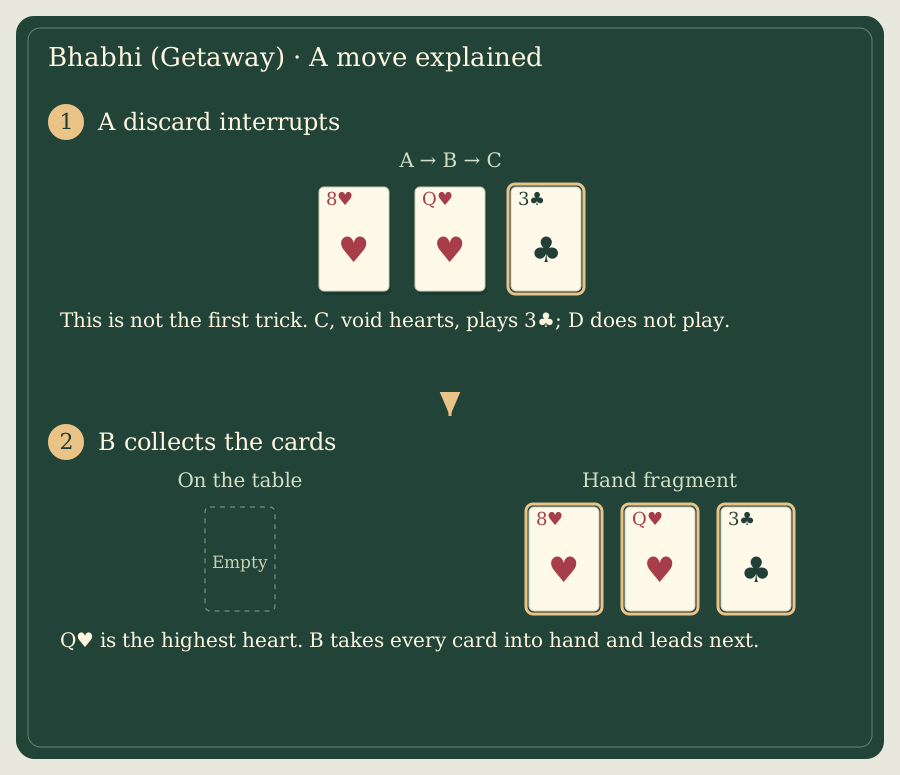
Thereafter follow suit in turn if able, without compulsory overtaking. If void, play anything: this tochoo immediately interrupts the trick. Later players do not play. The highest card of the original suit takes every played card, including the tochoo, into its owner’s hand; that owner leads next. If all follow suit, discard the trick permanently and its highest card determines the next leader.
04 /
Ending the game
An empty hand escapes except when entitled to the next lead. If that player’s final card is highest in an all-following trick, shuffle the old waste before adding this trick, draw 1 card blindly from it and lead that card. Escape becomes possible only after relinquishing the lead. Picking up a trick also replenishes the hand.
Before any trick you may voluntarily take the entire hand of your nearest active left neighbour; that neighbour escapes. Skip empty hands. The final card-holder loses: equal ranks cannot occur within one suit and the selected profile has no draw.
05 /
Scoring
Tricks and ranks have no point value. For a series agree the deal count and record 1 loss for the last player; fewer losses is better and equal totals share places. Playing after a tochoo, playing out of turn or falsely discarding while holding the suit is penalised by taking the current trick and leading next.
06 /
History and selected variant
Getaway is documented in Punjab and Bangladesh; its precise inventor and date are unknown. Bhabhi is a common name referring to a relative by marriage and used as a taunt for the loser. The neutral name Getaway changes no rules. Sources also describe other pickup procedures; do not mix them within a game.
07 /
Worked example
After the opening trick, A leads 8♥, B plays Q♥ and C, void hearts, discards 3♣. D does not play. B must pick up 8♥, Q♥ and 3♣ because the queen is highest in hearts; B then leads. C does not collect: the discard only interrupted play.
← On a small screen, scroll the diagram horizontally. →
Common questions
Who picks up after a discard?+
The highest led-suit card’s owner, not necessarily the discarder.
Can my last winning card let me escape?+
No; entitlement to lead requires drawing from the old waste.
Does an opening-trick discard cause pickup?+
No; everyone completes the opening trick and it is discarded.