← On a small screen, scroll the diagram horizontally. →
01 /
Pack and deal
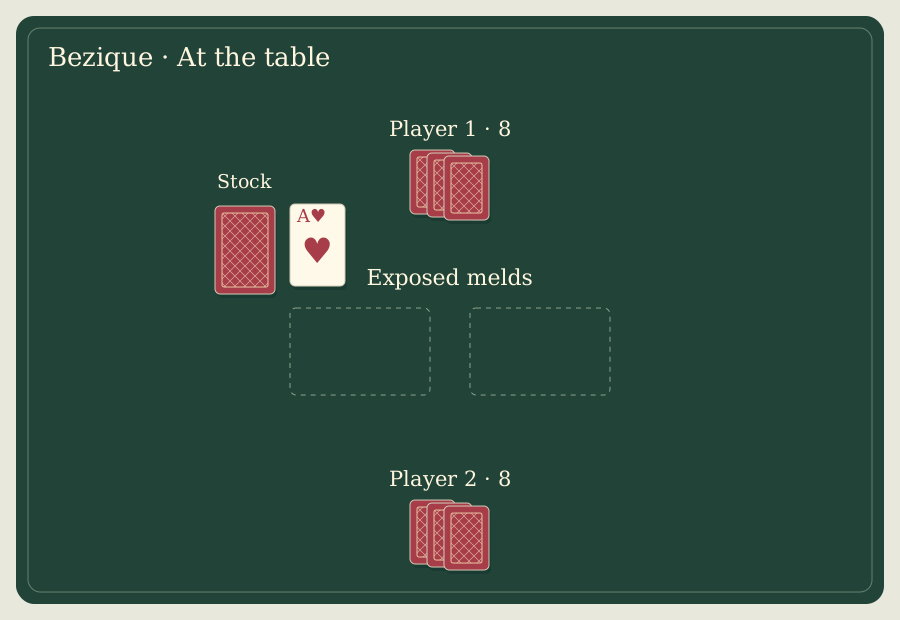
For 2 players combine 2 matching-backed packs of 32 cards, 7 through ace: 64 total, with 2 copies of every card. Rank A, 10, K, Q, J, 9, 8, 7. Choose the initial dealer by a high-card draw, repeating ties; alternate dealers. Shuffle, let the opponent cut and deal 8 each in packets of 3, 2, 3. Expose the next card as trump, with the remaining 47 face down across it as stock. Non-dealer leads.
02 /
Two phases of trick play
While stock remains, play any card, without following suit or trying to win. Highest trump wins, otherwise highest of the led suit; identical duplicates favour the card led. The winner stores the trick, may declare and score before drawing, draws first, and the loser draws next. The winner then leads. Your hidden and exposed meld cards together constitute your hand; exposed cards remain playable.
After trick 24, the winner draws the last hidden card and the loser the indicator. Gather remaining meld cards into hand. After the stock ends, no new declarations are allowed and unscored pending awards are lost; all points already recorded remain yours. For the final 8 tricks, follow suit and overtake if possible; void in the suit, trump if able, otherwise discard. Duplicate equality still favours the lead. Highest trump, otherwise highest led-suit card, wins and leads next.
03 /
Every scoring combination
A same-suit marriage K–Q scores 20, or 40 in trump. A trump sequence A–10–K–Q–J scores 250. Any 4 aces score 100; 4 kings 80; 4 queens 60; 4 jacks 40. Suits need not differ. Four tens do not score. Bezique is Q♠ with J♦, worth 40; both copies of both cards together form double bezique, worth 500.
After winning an open-stock trick, lay declarations face up, separate from captured cards. Only 1 ordinary declaration can be scored per trick won. In Cady’s procedure, additional visible declarations may wait for later trick wins; announce the pending score. Playing a required card before scoring, or letting the stock end, loses that pending award. You may score a new declaration while leaving an earlier one pending.
A physical card cannot be reused in the same or a lower combination of its class. Classes are marriages/sequences, bezique, and equal-rank sets. A marriage can grow into a sequence on a later win for an additional 250, but sequence first forbids a later marriage with those cards. A single bezique can grow into double for an additional 500; if both separate singles were previously scored, retain both 40 awards. All four declared directly score only 500. Cards can score in different classes, such as a king in a set and then a marriage. Replacing a partner card does not refresh an already used card.
04 /
Trump sevens and the complete count
Our stated dix convention awards 10 once per physical trump seven: on its initial turn-up to the dealer, or when its holder shows it after a trick win, exchanges it for the indicator after a win, or first plays it. Showing or exchanging is allowed only before the last stock draw and before drawing; it may accompany the ordinary meld. Mark which seven already scored, so the exchanged or drawn indicator cannot score again. The exchange itself adds no second bonus.
After all 32 tricks, each captured ace or ten scores 10, for 160 across the pack. Last trick scores 10; there is no sweep or stock-ending bonus. Add these to meld and dix points already recorded. Across deals the goal is 1000. Finish the current deal; if either reaches the goal, the higher total wins. If both reach it with equal totals, the game is drawn in the selected end-count profile. If neither reaches it, deal again.
05 /
Use a card in another class
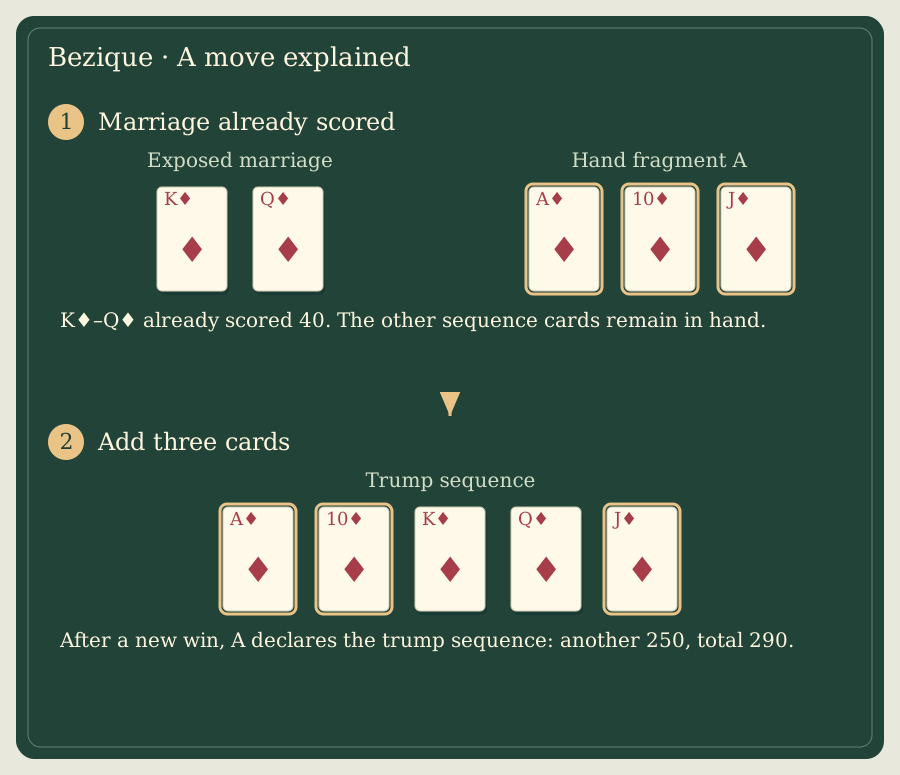
Diamonds are trumps. You score 4 kings for 80, including K♦. On a later trick win, add Q♦ for a trump marriage, another 40. After another win, add A♦, 10♦ and J♦ for a sequence, another 250. If every required card is still yours, the subtotal is 370. Do not score another marriage by replacing only Q♦: the old king has already served in that class.
← On a small screen, scroll the diagram horizontally. →
06 /
Historical context and other Bezique games
Cady’s nineteenth-century treatise documents ordinary Bezique and distinguishes it from the larger Rubicon game. The marriage-game family developed through related French games; the consulted evidence does not securely identify a single inventor. Polish Bezique creates melds from captured cards, while Rubicon and Chinese forms change pack size and scoring. None of those mechanisms is silently included here. Dix handling and whether to end immediately or complete the deal are real table differences, fixed above.
Common questions
Are exposed meld cards removed from my hand?+
No. They remain yours and may be played to tricks.
Can I meld captured cards?+
Not in ordinary Bezique. That belongs to Polish Bezique.
Does the last stock draw earn a bonus?+
No. Only the absolute last trick of the deal earns the last-trick bonus.