← On a small screen, scroll the diagram horizontally. →
01 /
Aim and equipment
Use 1 player and 52 cards without jokers. Ace is low, followed by 2–10, J, Q, K. Complete 4 foundations, each in one suit from ace to king.
02 /
Setup and deal
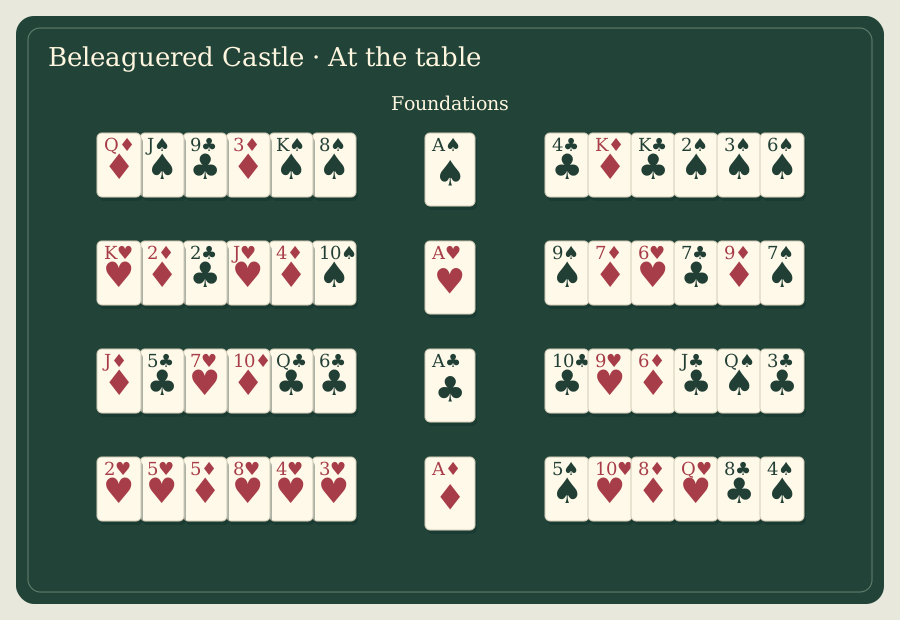
Place the 4 aces vertically in the centre. Shuffle the remaining 48 cards into 8 face-up rows of 6, with 4 rows on either side. Overlap outward; only each outermost card is available. There is no stock and no free cell.
03 /
Legal actions
Move one available card onto another row end exactly 1 rank higher, regardless of suit or colour: 7♥ fits on 8♣. An empty row accepts any available card, not only a king. Never move a sequence as a unit. A foundation accepts the next card of its own suit; there is no K–A wrap. Foundation cards cannot return.
04 /
Scoring
There are no suit, speed or sequence bonuses. You may record the number of foundation cards to compare attempts, but victory requires all 52. This optional progress record is not another winning condition.
05 /
Ending the game
Win when all 4 foundations end in kings and no cards remain elsewhere. With no legal continuation, the puzzle is unsolved; no stock or redeal rescues it. Repeating moves is not victory. For another attempt gather and shuffle the whole pack. A one-player game has no shared-player tie.
06 /
Context and variants
This belongs to the open castle-patience family. Its name evokes rows surrounding central foundations; the checked rules do not establish a sole inventor. Streets and Alleys leaves aces in the deal, producing a different opening. Do not import FreeCell cells.
07 /
Worked example
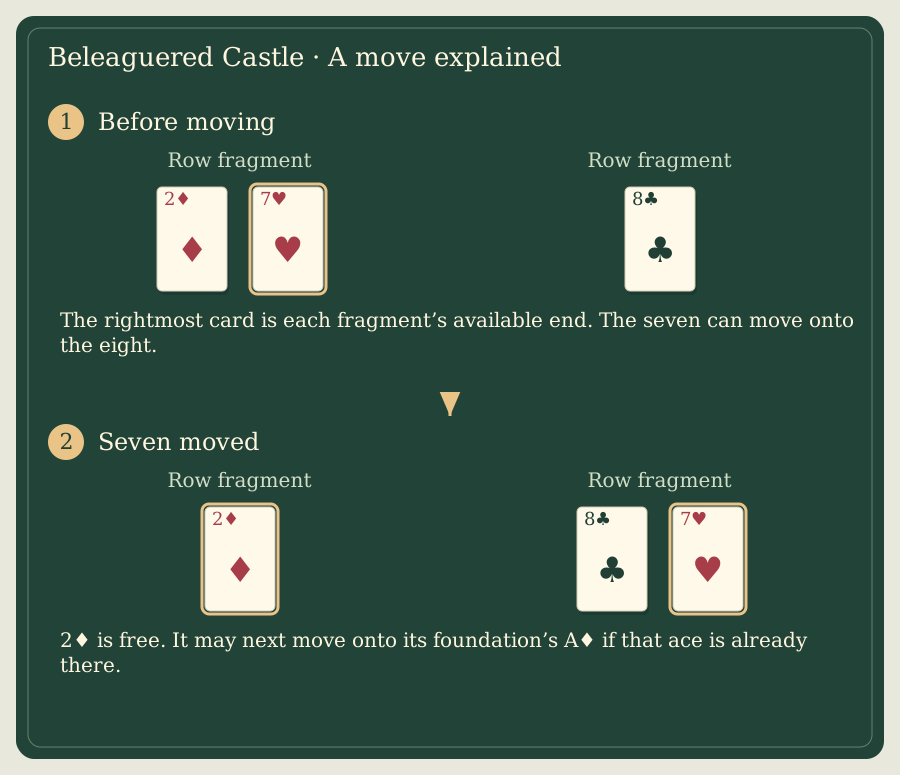
One row ends in 7♥ and another in 8♣. Move 7♥ onto 8♣: different suits are legal. This uncovers 2♦; if its foundation holds A♦, send 2♦ there. The first move frees a card; the second advances a foundation. You cannot move both cards together as a packet.
← On a small screen, scroll the diagram horizontally. →
Common questions
May I move a whole run?+
Only through a sequence of legal individual moves.
Are empty spaces kings-only?+
No, an empty row accepts any available card.
Is there a draw or redeal?+
No, all 52 cards are already in the layout.