← On a small screen, scroll the diagram horizontally. →
01 /
Selected patience
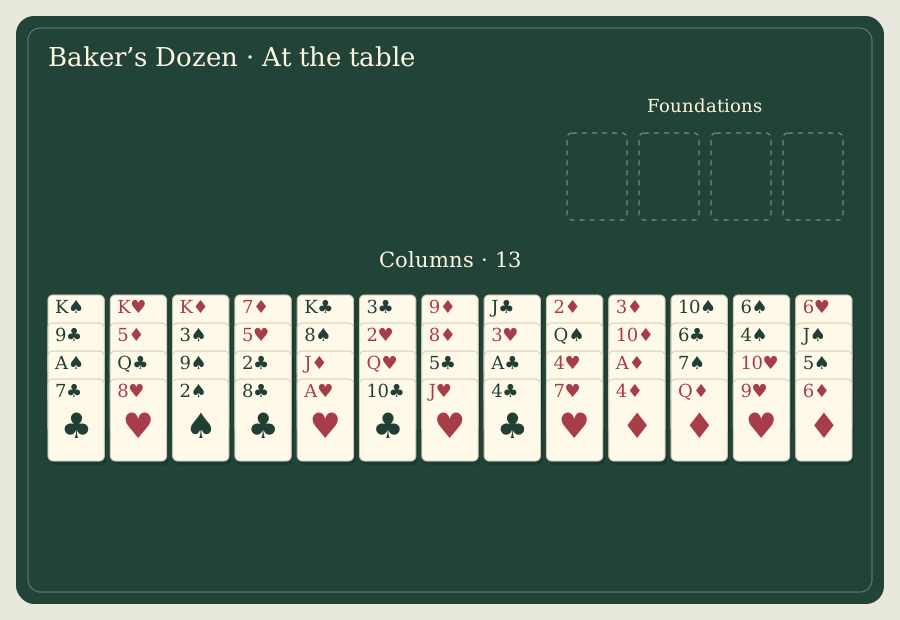
Baker’s Dozen is an open patience with thirteen columns. It is distinct from Baker’s Game, which has free cells. We use the modern all-face-up layout; older descriptions sometimes hide cards. The name refers to the number of columns, while a precise inventor is not established.
02 /
Deal and kings
Shuffle 52 cards without jokers and deal 13 columns of 4, all face up and overlapped so ranks remain visible. Move every king to the buried end of its own column, preserving the other cards’ order and the kings’ relative order. Buried means away from the playable top, not laid over it. There is no stock or waste.
03 /
Tableau moves
Only a fully exposed column top can move. Place it on another column’s top exactly one rank higher: a 7 fits any 8, regardless of suit or colour. Ace is low; king cannot wrap onto ace. Move only one card at a time, never a whole built sequence. A newly uncovered top becomes available next.
04 /
Four foundations
Leave four foundation spaces. An available ace starts its suit; add 2, 3 and so on through K in that same suit. Foundation cards cannot return in this profile. A foundation move is optional while other legal moves exist; check whether that card is still needed as a tableau support.
05 /
Empty columns
A completely empty column stays empty: it accepts neither a king nor any other card. There are no free storage cells. Unlike many patiences, clearing a column does not create a new support. You cannot redeal, shuffle the remaining cards or bypass the single-card restriction by moving a group.
06 /
Win and score
Win by moving all 52 cards to four complete A–K foundations. If cards remain and no route toward finishing is available, the deal is lost. Moving a card back and forth is not progress. There is no separate points match or draw. Filling spaces and moving groups are easier variants, disabled here.
07 /
Free an ace
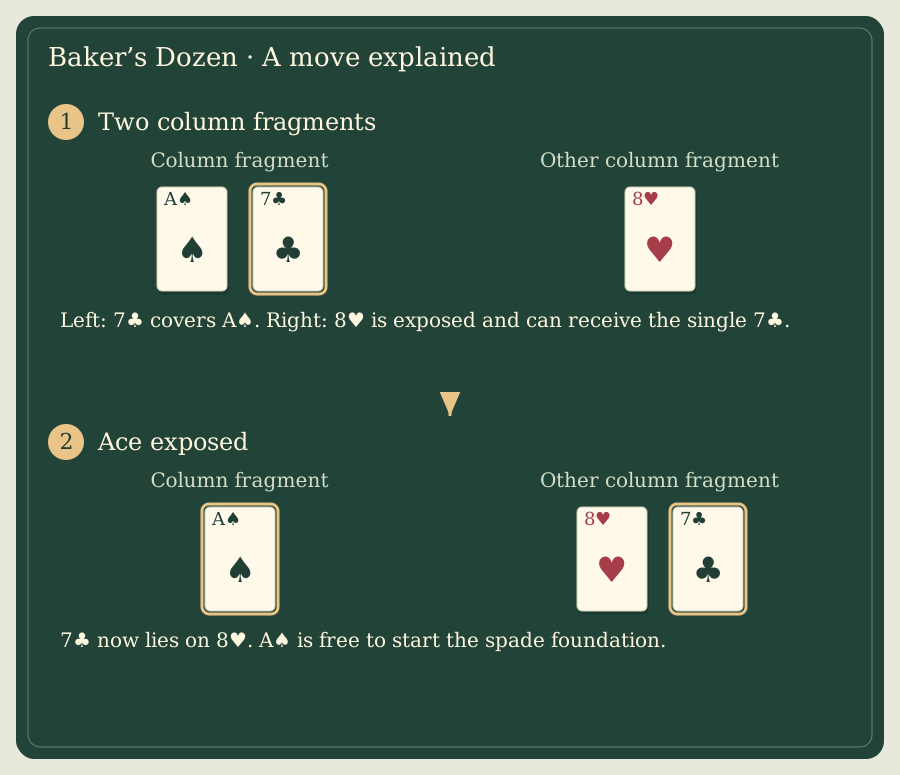
The first column ends in 7♣, with A♠ directly beneath; the second ends in 8♥. Move 7♣ onto 8♥: colour does not matter. A♠ is now available to start the spade foundation. Moving 7♣ and A♠ together would be illegal because only one exposed top moves.
← On a small screen, scroll the diagram horizontally. →
Common questions
Can a king fill a space?+
No, empty columns remain unavailable.
Must colours alternate?+
No: tableau building depends only on adjacent ranks.
Are all cards visible initially?+
Yes, in this selected open version.