← On a small screen, scroll the diagram horizontally. →
01 /
History
Player accounts associate Back Alley with the US military; a Texas Tech Vietnam oral-history interview also mentions playing Back Alley Bridge. Pagat cautiously treats the joker partnership game as a later tradition than individual play. No precise inventor or invention date is asserted.
02 /
Table and deals
Four players form fixed opposite partnerships. Use 52 cards plus distinguishable BIG and LITTLE jokers. Plain suits rank A–K–Q–J–10…2. Trumps place BIG then LITTLE above the ace.
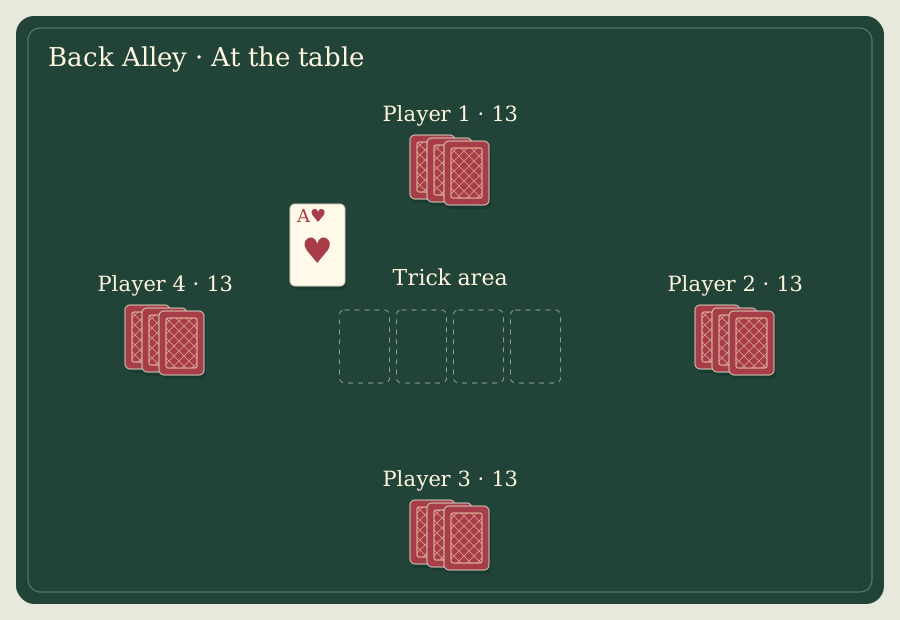
Deal and play clockwise; agree the first dealer. Hand sizes are 13,12,…,2,1, then 1,2,…,12,13. After dealing, turn the next card for trumps. A turned joker means no trumps; replace the other joker from any hand with the next undealt card.
03 /
Bids
One circuit starts left of dealer. Pass, bid an integer from one to hand size minus one, or say board: your pair will take every trick. Pass is zero; partners add numeric bids. Bids need not increase.
Successive board announcements around the table have multipliers×1,×2,×3,×4. A pair uses only its highest board; partner’s other bid is irrelevant. Four passes mean no score and the next dealer redeals the same hand size.
Highest numeric bidder leads; earliest wins numeric ties. If any boards were announced, the last board bidder leads.
04 /
Tricks and jokers
Follow suit if possible; otherwise play anything. Jokers belong to trumps. Highest trump wins, otherwise highest led-suit card. Each winner leads next.
Do not lead trumps until one was played in an earlier trick. A player who personally bid board may lead trump immediately. Teaching agreement: a player holding only trumps may make a forced trump lead.
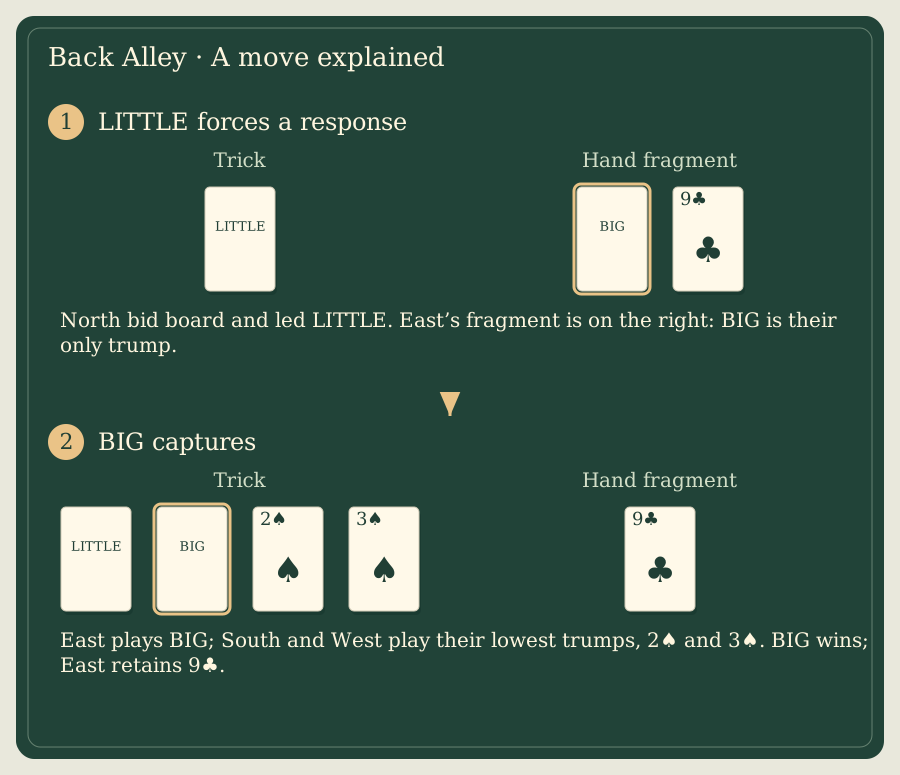
A BIG lead forces everyone to play their highest remaining trump; LITTLE forces their lowest. With no trump, discard freely. A joker played in response imposes no special obligation. No-trump hands contain no jokers.
05 /
Scoring and match ending
For numeric team bid b and tricks t: if t≥b score 5 b+(t−b); otherwise−5 b. Two passing partners earn one per trick when another player has bid.
Board replaces numeric scoring: ±10 hm, with hand size h and that pair’s highest board multiplier m. Taking every trick earns plus; anything less loses the full amount. Settle both pairs independently.
Highest cumulative score after 26 played deals wins. Teaching agreement: equal totals share a draw. All-pass redeals do not advance the schedule.
06 /
Bid and joker examples
With five cards each, North bids two and South one. Their target is three. Taking four earns 5×3+1=16; taking two loses 15.
Now West bids the first board, North the second, East passes and South the third. North–South use multiplier three: all five tricks earn 10×5×3=150; four or fewer lose 150. West retains a×1 board for their pair. A team does not automatically inherit its opponents’ multiplier.
With spades trump, North leads LITTLE. East has only BIG among trumps and must play it, beating LITTLE. Requiring the lowest remaining trump does not guarantee that the low joker wins.
← On a small screen, scroll the diagram horizontally. →
07 /
Keep variations separate
A 25 deal schedule uses only one one-card deal. Rainbow, Boston, blind bids and alternative board tariffs are not used here. Agree any such extension before dealing.
Common questions
Must a team make its exact bid?+
No. The bid is a minimum; overtricks earn a small extra.
Can I bid numeric one with one card?+
No. Pass or board are the choices.
Must I trump when void?+
No. You may discard another suit.
Why26rather than25deals?+
The selected schedule contains two separate one-card deals.