← On a small screen, scroll the diagram horizontally. →
01 /
History and context
Avinas is a Lithuanian relative of Schafkopf. Pagat cites Borisevicius’s demonstration in Munich in November 1991, his rule sheet and written clarifications in 1992. These document a version; they do not date the game’s invention.
02 /
Players, pack and trumps
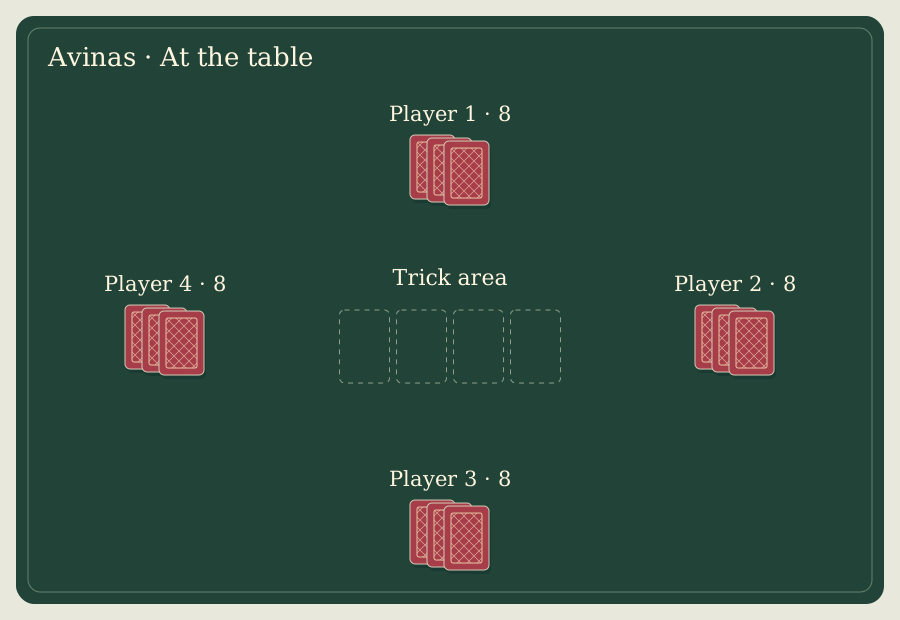
Four people form fixed partnerships, sitting opposite partners. Use 32 cards, seven through ace. Deal and play clockwise; pass the deal left after each hand.
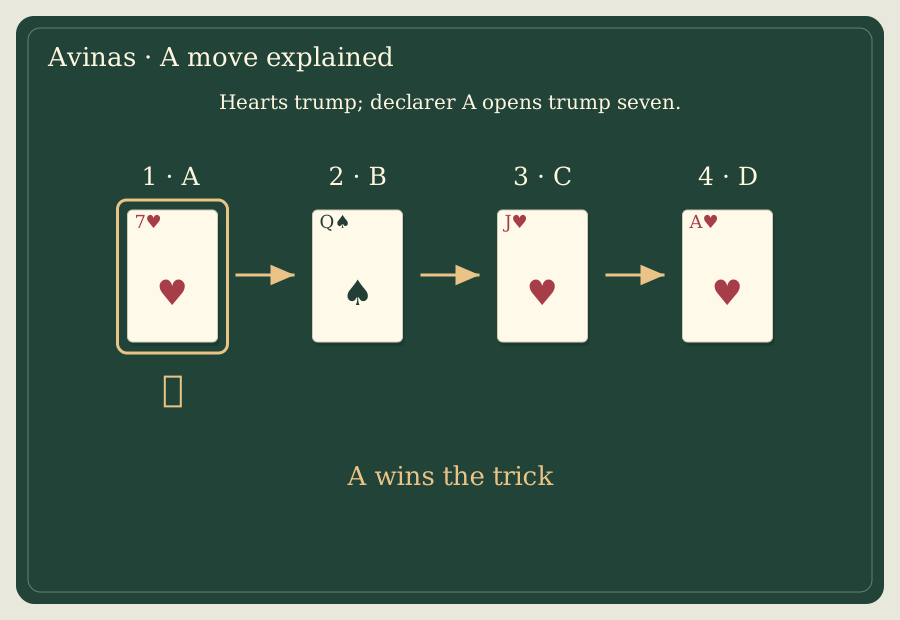
All queens and jacks are trumps. Trump order: Q♣, trump 7, Q♠, Q♥, Q♦, J♣, J♠, J♥, J♦, then trump A, 10, K, 9, 8. Other suits rank A, 10, K, 9, 8, 7.
Values: A=11, 10=10, K=4, Q=3, J=2, others zero. Total: 120.
03 /
Dealing and choosing declarer
Deal eight each in batches of four. Expose each opponent’s fourth and eighth cards. Inspect those cards for yourself and your partner too, but expose only sevens.
If any sevens were exposed, the last exposed seven fixes the trump suit. Its recipient is declarer. Record the number of exposed sevens as n.
With no exposed seven, begin left of dealer: pass or state the length of a possible trump suit without naming it. Higher lengths overcall; count all queens, jacks and the chosen suit together, counting each card once. Longest bid wins. The opening trump reveals the suit; if it is a queen or jack, declarer’s left neighbour asks the suit. Bidding more trumps than actually held loses the match.
Teaching agreement: use one clockwise bidding circuit; an all-pass hand scores nothing and the next dealer deals. The source does not explicitly discuss additional bidding circuits.
04 /
The compulsory opening leads
Declarer leads a trump. The first trick’s winner must also lead a trump if able. With none, lead any card face up or down; everybody else follows as though a trump had been led. The source allows a facial signal to partner indicating whether a face-down card is valuable. Reveal it after all responses; the highest trump wins.
Afterwards, each winner leads next. Follow suit if possible, treating queens and jacks as trumps. Otherwise trump or discard freely. Highest trump, otherwise highest led-suit card, wins. There is no duty to overtake.
05 /
Exposed sevens: the Rams ledger
Normally play eight tricks: declarer’s pair needs 61 points; 60 loses. Before the first lead, either member of that pair may knock, undertaking all eight tricks. A defender may counter-knock, doubling again. The first defensive trick defeats an all-tricks undertaking immediately.
| Contract | Success: defenders | Failure: declarers |
|---|---|---|
| No knock | n | 2n |
| Declarers knock | 2n | 4n |
| Counter-knock | 4n | 8n |
These are penalty Rams. First cancel the other pair’s outstanding Rams; record any remainder against the penalised pair. Only one pair can therefore have uncancelled Rams at once.
06 /
No exposed sevens: the pips ledger
Declarer or partner may stop play at any time. Having already captured 61 means success; otherwise they fail. Count only cards captured when stopped. If nobody stops earlier, settle after eight tricks.
| Outcome and penalised side | That side’s captured points | Pips |
|---|---|---|
| Success: defenders | 31+ | 1 |
| Success: defenders | 2–30 | 2 |
| Success: defenders | 0 | 3 |
| Failure: declarers | 31–60 | 2 |
| Failure: declarers | 2–30 | 4 |
| Failure: declarers | 0 | 6 |
A total of one cannot occur: the smallest valuable card scores two. Pips accumulate without cancellation. This branch does not change Rams.
07 /
Ending the match
Stop when either pair reaches at least 12 penalty pips. If the other pair has zero pips, the pair with 12+ loses. If both have pips, outstanding Rams take priority: the pair with Rams loses. With no Rams at all, fewer pips wins.
Teaching agreement: a complete tie on the deciding measures is a drawn match. No stakes are needed. Keep two columns for each pair: Rams and pips.
08 /
A two-ledger worked example
North–South have two Rams; East–West have none. Two sevens appear next deal. East–West declare, do not knock and capture 65 points. North–South receive two more penalty Rams, leaving them four.
North–South then win a deal with three exposed sevens and no knock. The three penalty Rams due against East–West first cancel three of North–South’s four Rams. North–South now have one; East–West still have none.
Later the pip totals are four and eleven respectively. East–West declare a no-exposed-seven deal and stop on 40 points. Failure adds two pips, giving them thirteen. The match ends, but East–West win: both sides have pips, so North–South’s remaining Ram decides the loss.
Keep both ledgers visible while replaying this sequence. If you merge Rams and pips into a single total, the final result becomes impossible to explain correctly.
← On a small screen, scroll the diagram horizontally. →
09 /
Keep the chosen version separate
Other descriptions may handle the trump seven or bidding procedure differently. Do not substitute ordinary Schafkopf trump order. All queens and jacks belong to trumps, regardless of printed suit; the selected version places the trump seven above Q♠.
Common questions
Does reaching twelve pips automatically lose?+
No. If both sides have pips, the outstanding Rams ledger takes priority.
Must I trump when void?+
Not in an ordinary trick. The special second lead after the opening trump is an exception.
What does n mean?+
The number of sevens exposed during the deal, from one to four.
Can losing a deal win the match?+
Yes. The source expressly confirms this consequence of the match-ending priorities.