← On a small screen, scroll the diagram horizontally. →
01 /
Set up seven columns
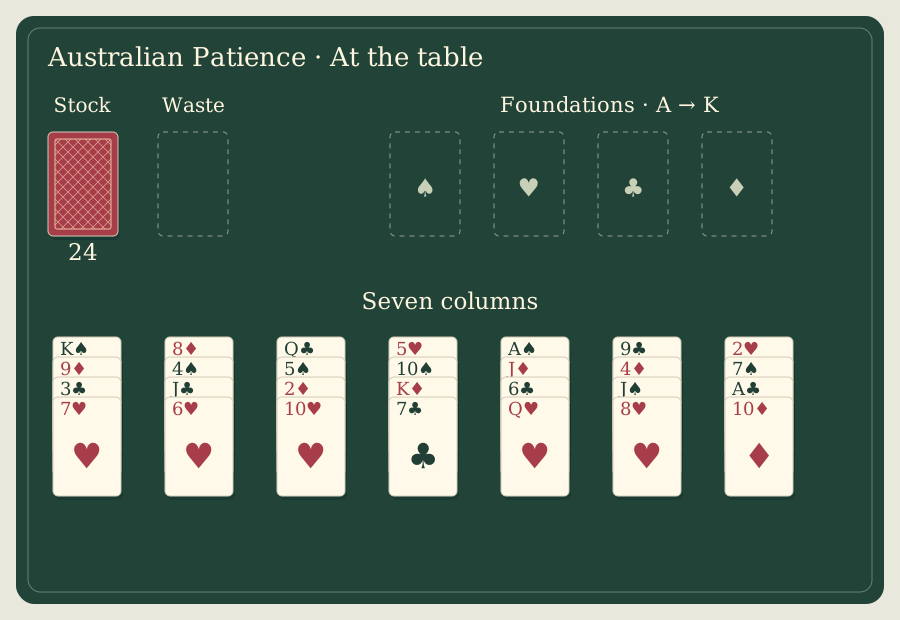
Without jokers, deal seven columns of four cards, all face up and overlapping. Only the last card of a column is fully exposed. The remaining 24 cards form the face-down stock. Leave room for a waste pile and four foundations.
Ranks run K–Q–J–10…2–A. Move all 52 cards to the foundations, each suit building separately from ace through king.
02 /
Legal moves
A fully exposed tableau card or the top waste card may go to its ascending same-suit foundation. Tableau building runs down in suit: 8♥ goes on 9♥, not 9♣.
You may select a buried tableau card and move it with every card covering it. Only the first card of that group must fit the destination; the rest need not form a sequence. Only a king, alone or with its group, may fill an empty column. Do not move cards back from the foundations.
03 /
Drawing and finishing
At any time, turn one stock card onto the waste. Only the top waste card is playable; removing it uncovers the previous card. You may draw again even when another move exists, but the new card blocks the old one.
Never turn the waste back into a stock. Completing all four foundations through kings wins. If the stock is exhausted and no legal continuation remains, the game is lost. An empty stock alone is not a loss: finish the moves still available.
04 /
Why a group may be unordered
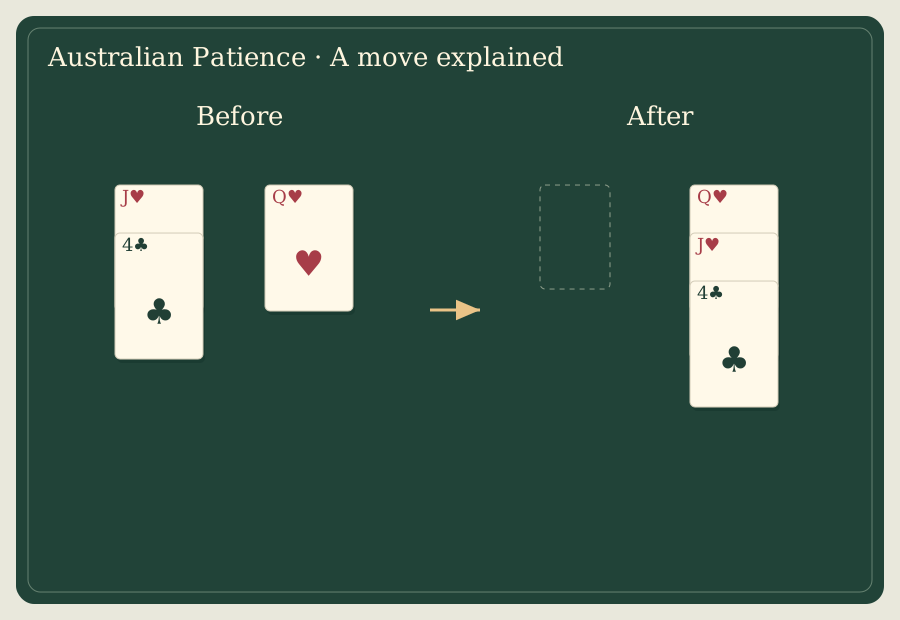
Suppose a column contains J♥ covered by 4♣, and another column exposes Q♥. Move the whole J♥–4♣ group onto the queen: the required join is Q♥–J♥, not the unrelated four. That four cannot yet go to its foundation unless A♣, 2♣ and 3♣ are already there.
Now imagine 5♣ appears on the waste. It can receive the four only after entering the tableau: you cannot move tableau cards onto the waste. Access constraints like these matter more than simply seeing several aces.
← On a small screen, scroll the diagram horizontally. →
05 /
Context and variants
Pagat describes the game as Australian and credits Michael Doer with introducing it to the site. That documents a playing tradition, not an established invention date. Its movement of unordered groups resembles Scorpion; same-suit building distinguishes it from familiar Klondike.
Two-player versions use two packs and shared foundations, with either alternating turns or simultaneous play. Their competitive scoring does not apply to the solo game, where the objective is completing the entire layout.
Common questions
Can an unordered group move?+
Yes, provided its first card fits the destination and every covering card moves with it.
How many stock passes?+
One. There is no recycling of the waste.