← On a small screen, scroll the diagram horizontally. →
01 /
Set up auction poker
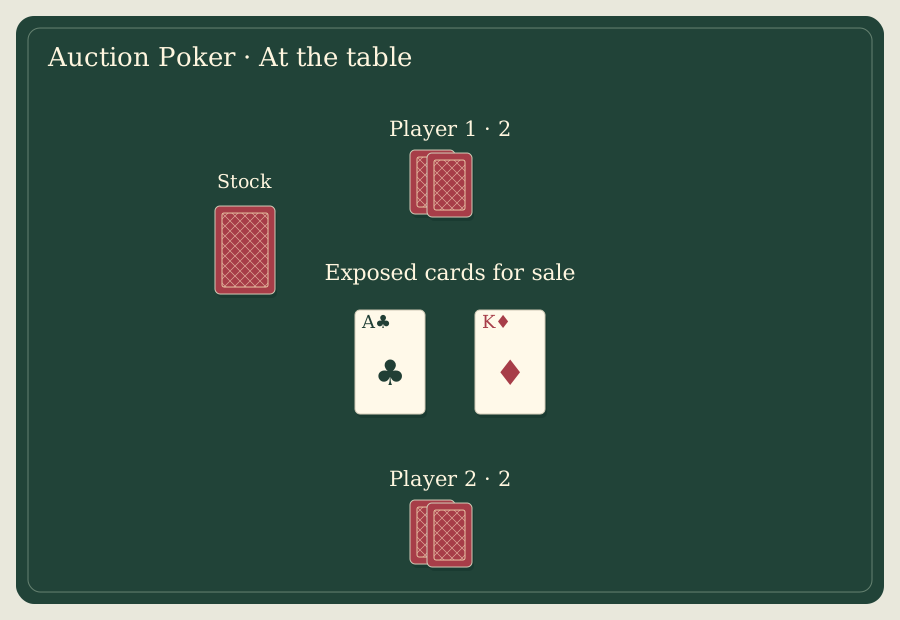
This guide selects Pagat’s seven-card high-low Auction. It is distinct from Auction Bridge and the separate non-poker game called Auction. Use 52 cards without jokers and play chips for 2–7 players. Each player antes 1 and receives two cards face down.
Our teaching limits are mandatory bids of 1–3 on each of five auctions, followed by one betting round with a bet of 1 and at most three raises of 1. Require a fresh-deal reserve of 20: ante 1, five purchases of up to 3 and final betting up to 4. Nobody folds midway through the auctions in this selected profile; folding is available in the final betting round.
02 /
Five simultaneous auctions
Expose one table card per player. Everyone secretly commits 1, 2 or 3 chips in a closed fist. Reveal bids together. Every bid enters the pot, including losing bids.
The highest bidder chooses a card first, the next highest chooses from those left, and so on. Break equal bids by the strongest already exposed poker hand, then clockwise position after the dealer. Assess exposed hands before anyone selects from the current row. With no exposed cards at the first auction, positional order settles ties.
Keep purchased cards exposed. Repeat four more times with fresh rows. Each player ends with two concealed and five exposed cards. There is no normal betting round between auctions. The purchase price buys selection priority, not a guaranteed particular card.
03 /
The one betting round
After the fifth auction, hold a normal betting round. Our convention starts with the strongest exposed hand, breaking a tie by clockwise position after the dealer. With no outstanding bet, check or bet 1. Facing a bet, call, raise by 1 or fold. Check-raising is allowed. Continue clockwise until all remaining players answer the last raise, or everyone checks.
Folded players cannot win. If only one remains, award the pot immediately without declarations. Auction payments are not refunded and are not outstanding wagers that opponents must call.
04 /
Declare high, low or both
Remaining players use spare markers from outside their playing stacks and simultaneously reveal a declaration fist: zero chips means low, one high and two both. These chips are markers, not further pot payments. Select any five of seven for high and any five for ace-to-five low: ace is low, straights and flushes are ignored, and duplicate ranks count against you. There is no eight-low qualifier here; the high and low selections may differ.
A both declarer must win each direction outright against every relevant high/both and low/both contender. Losing or tying either direction eliminates that player from the allocation. If nobody wins both, split between the best surviving high and low declarations. If all remaining declarations are in one direction, its winner takes the whole pot. If everyone declared both and none succeeds, carry the pot into the next deal.
05 /
Comparisons and odd chips
High categories are straight flush, quads, full house, flush, straight, trips, two pair, pair and high card. Compare main groups first, then kickers; compare the higher pair first for two pair and the triplet first for full houses. For unpaired low hands compare ranks from highest down, favouring the lower first difference. Any unpaired low beats a paired one; if all are duplicated, prefer the lower duplicate category, then lower main groups and kickers.
Equal five-card hands share their portion; suits do not decide. Give an odd overall pot chip to high and an indivisible chip within a tied portion to its first winner clockwise after the dealer.
06 /
Worked auction and award
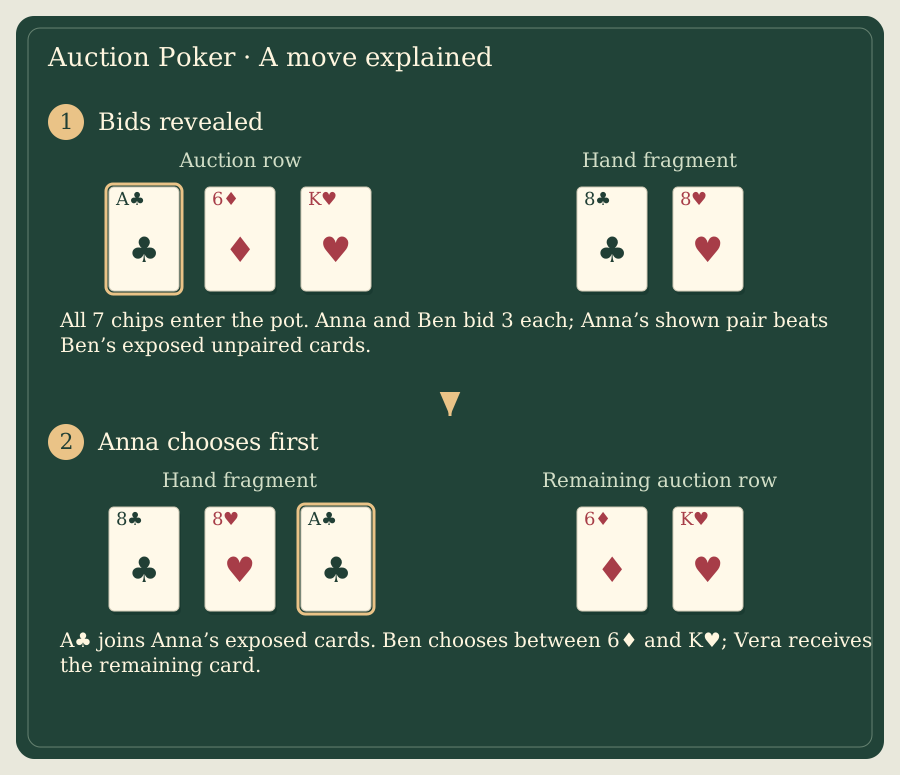
Three players see A♣, 6♦ and K♥. Anna and Ben bid 3 each; Vera bids 1. All 7 chips enter the pot. Anna already shows paired eights while Ben has only different ranks, so Anna selects first, Ben second and Vera receives the remaining card. Even bidding 3 buys priority rather than guaranteeing the ace.
At showdown Anna declares high with trip queens, Ben low with 7–5–4–2–A and Vera high with two pair. With a pot of 40 and no both declaration, Anna receives 20 and Ben 20. Each subtracts their ante, auction payments and bets to find their net result.
← On a small screen, scroll the diagram horizontally. →
07 /
Context and scope
Pagat places Auction among home poker games in which additional pot contributions buy cards. The consulted account does not establish an inventor or origin date. The name describes the mechanism, not a connection to bridge.
Different bid ceilings, a different low scale or another failed-both policy change the game. The procedure above is one explicitly selected set of conventions rather than a universal rulebook for every game called Auction Poker.
Common questions
Does a losing bidder pay?+
Yes. Every auction bid enters the pot.
When may I fold?+
In this teaching profile, during the single normal betting round after all five auctions.
What happens to an unsuccessful both declaration?+
That player is excluded unless they win both directions outright.