← On a small screen, scroll the diagram horizontally. →
01 /
Historical 1920 profile
Auction Bridge preceded Contract Bridge: after a made bid, all tricks beyond six count toward game, even when not bid. We select the American New York Whist Club 1920 code printed in Helen Derby Elwell’s New Auction Bridge. Earlier British value bidding and later flat honour bonuses are not mixed into this profile. Its table therefore differs from some modern summaries.
02 /
Players and deal
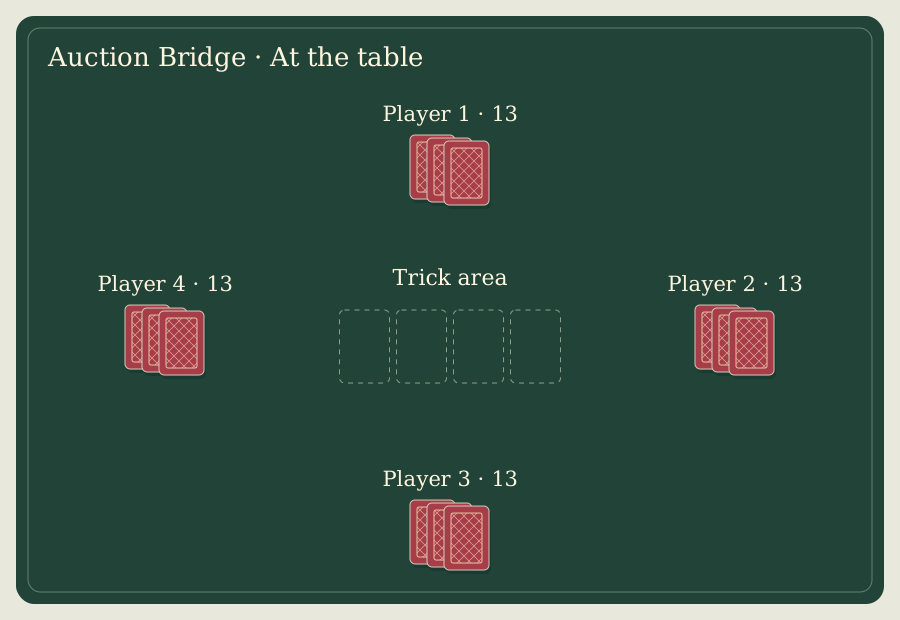
Four form fixed opposite partnerships. Use 52 cards without jokers, A–K–Q–J–10–9–8–7–6–5–4–3–2 in every suit. Auction chooses trumps; NT means no trumps. Choose first dealer by lot. Left neighbour shuffles, right cuts; dealer deals singly clockwise from the left until everyone has 13. No stock or drawing. Deal passes left after each hand.
03 /
Auction, double and redouble
Dealer calls first, then clockwise. A bid of 1–7 promises 6 plus that number of tricks. At one level denominations rise ♣, ♦, ♥, ♠, NT; any higher level outranks all lower levels. Thus 1NT beats 1♠ and 2♣ beats 1NT regardless of point value. Passing does not prevent later bidding.
On turn, double the latest opposing bid if only passes intervened; its side may redouble the latest double. A fresh bid cancels double/redouble. Three consecutive passes after a bid, double or redouble close the auction. Four initial passes score nothing; next player deals. Declarer is the winning pair’s first bidder of the final suit or NT, not necessarily the last raiser.
04 /
Dummy and tricks
Declarer’s left leads face up. Declarer’s partner exposes all 13 cards by suit as dummy; declarer chooses plays from both hands. Play clockwise. Follow led suit if possible; when void, trump or discard any card. No duty to overtake. Highest trump, otherwise highest led suit, wins; next lead comes from the winning hand, including dummy. Play all 13 tricks even after game is secured.
05 /
Below line: every odd trick
Divide the ledger into trick score below the line and bonuses/penalties above. Value v per trick beyond the first 6 is ♣=6, ♦=7, ♥=8, ♠=9, NT=10. On success score (tricks−6)×v below, including all unbid extras. Double multiplies this by two, redouble by four. On failure score zero below, even with more than 6 tricks.
Accumulating 30 or more below wins one game. After the completed deal draw a line: both sides’ current part scores reset for the next game, but remain in rubber totals. Surplus does not carry into another game; a deal cannot win two games.
06 /
Doubles, undertricks and slams
Each undertrick gives defenders 50 above the line, 100 doubled, 200 redoubled. This code has no vulnerability. A made doubled contract additionally earns 50 for success plus 50 per trick beyond the promised total; redoubled, both bonuses are 100. These are added to the multiplied below-line score.
Either side actually taking 12 tricks earns small slam 50; all 13 earns grand slam 100 instead. No advance slam bid is required; even a failed level-7 bid taking 12 retains small-slam bonus. Doubling does not multiply slams or honours.
07 /
Honours: 1920 table
Count honours from original hands, not captured cards, regardless of contract success. Trump honours are A,K,Q,J,10. At value v: 3 held by a pair score 2v; 4 divided score 4v; 4 in one hand score 8v; all 5 split 3+2 score 5v; all 5 split 4+1 score 9v; all 5 in one hand score 10v. Apply one matching row, not cumulative rows. Fewer than 3 score zero.
At NT, honours are aces: 3 held by a pair score 30, all 4 divided 40, all 4 in one hand 100. All are above line, do not help game and are never doubled. For example, 4 spade honours in one hand score 8×9=72, not the later flat bonus 80.
08 /
Rubber and final result
Once a pair has won two games, finish that deal and award it 250 above line for the rubber. Add every earlier above- and below-line entry for each pair; the higher total wins by the difference. The two-game pair can lose overall because of opposing bonuses and penalties. Exact equal totals are a draw in this home profile. Do not import modern rubber bonuses or 20/30/40 trick values.
09 /
Unbid extras count
A 1♠ contract promises 7 tricks. Taking 10 scores (10−6)×9=36 below line, a game despite bidding only one odd trick. This component excludes honours, recorded separately. Compare 1♥ doubled taking 9: (9−6)×8×2=48 below and 50+2×50=150 above for making and two overtricks, again before honours.
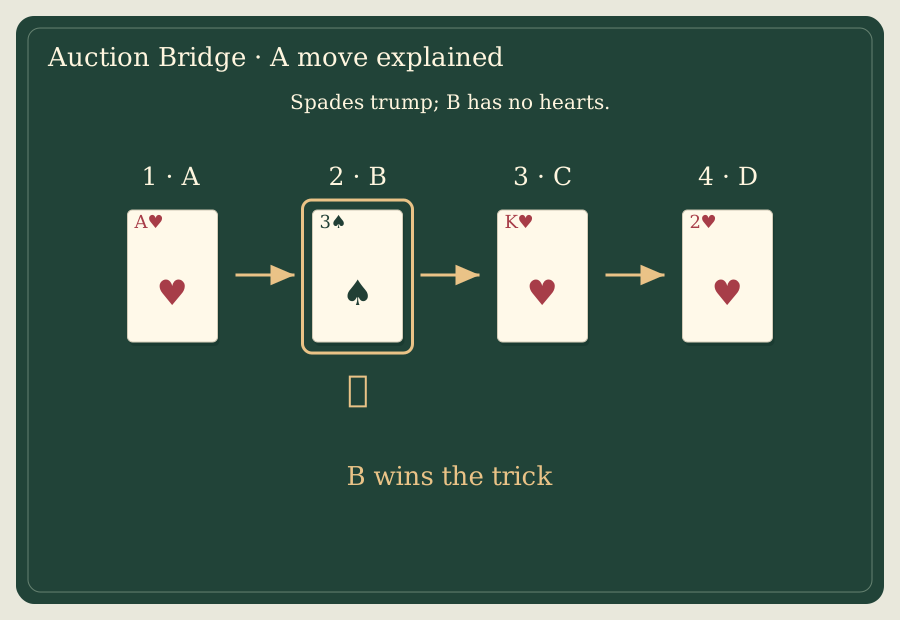
A separate spade-trump trick runs A♥, 3♠, K♥, 2♥. Second player has no hearts; others follow. 3♠ captures and that hand leads next; this is not honour scoring.
← On a small screen, scroll the diagram horizontally. →
Common questions
Must game be bid to score it?+
No: make the contract and every trick beyond six counts below line.
Does doubling increase honours?+
No: honours and slams are not multiplied.
Does winning two games ensure the higher total?+
No, final totals include both sides’ bonuses and penalties.