← On a small screen, scroll the diagram horizontally. →
01 /
A heads-up teaching table
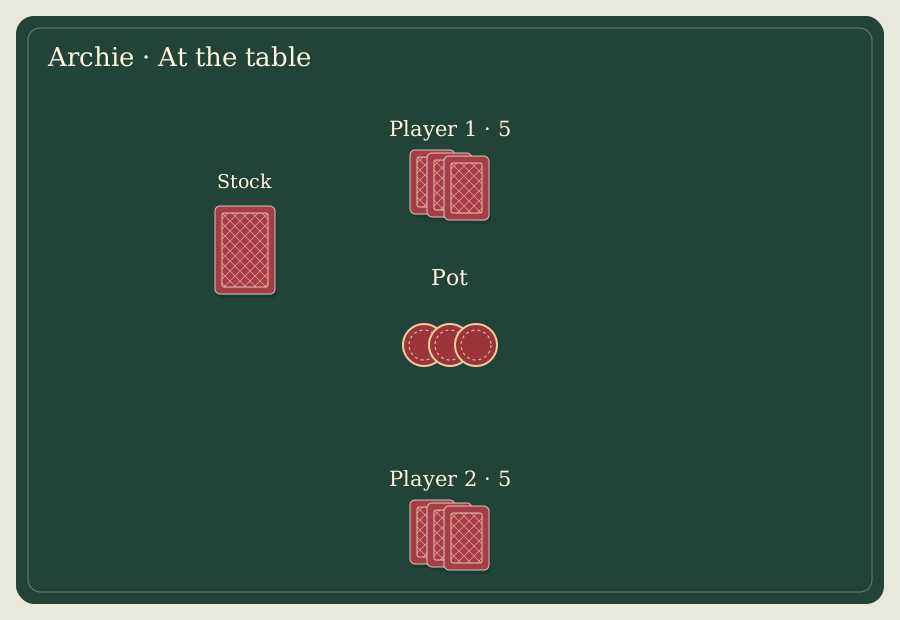
Archie combines three draws with qualifiers in both directions. This guide selects BARGE’s pair-of-sixes high qualifier and its specific rule when nobody qualifies. The teaching table has exactly two players, 52 cards, no joker and no burns. Even if both replace all five cards on all three draws, only 40 cards are used, so no discard reshuffle is needed.
There is no ante. The dealer posts a small blind of 1 and the other player a big blind of 2. Bets and raises are 2 for the first two rounds and 4 for the last two, with one bet plus at most three raises per round. Require a 48-chip fresh-deal reserve: maximum contributions of 8 + 8 + 16 + 16, including blinds. This is our teaching profile, not a claim that Archie itself permits only two players.
02 /
Deal and draw three times
Deal five cards face down to each player. Before the first draw, the dealer/small blind acts first: add 1 to call 2, raise the total wager to 4, or fold. The big blind responds and retains the option to raise if the wager was merely called. Blinds count towards the amount already paid.
After betting, both players commit zero to five discards. Deal the same number of replacements face down, starting with the big blind. Keeping all five is allowed. Hold the second betting round at the 2-chip increment.
Draw again and bet at 4, then draw a third and final time and bet at 4. The big blind acts first on every post-draw round. Exchange the dealer and blind positions for the next deal.
03 /
Betting actions and closing a round
With no outstanding wager, check or bet the current increment. Facing a wager, call, raise by the increment or fold. Check-raising is allowed. A round closes once both players have had their opportunity to act and matched the final wager, or both check. The big blind retains the initial option to raise after a mere call. Complete betting before beginning the next draw.
If an opponent folds, the remaining player wins immediately: the qualifiers govern showdown. Otherwise expose all five cards after round four. There is no high/low declaration; a hand automatically competes in every direction for which it qualifies.
04 /
The two qualifying thresholds
High requires at least paired sixes. Any two pair, even deuces and threes, qualifies because it is a higher category. Standard high order is straight flush, quads, full house, flush, straight, trips, two pair, pair, high card. Within a category compare the main groups and then kickers; compare the higher pair first for two pair and the triplet first for a full house.
Low requires five different ranks no higher than eight. Ace is low; straights and flushes are ignored. A–2–3–4–5 is best. Compare qualifying lows from their highest card down, favouring the lower first difference. The same five cards may qualify for both directions.
05 /
Awarding the pot
If both directions have qualifying hands, split the pot between the best high and best low. If only one direction qualifies, its winner takes everything. If no hand qualifies in either direction, BARGE awards the entire pot to the best ordinary high hand, even if it is weaker than paired sixes.
Equal hands share the relevant portion. Suits do not outrank one another. Give an odd overall chip to high; an indivisible chip within a tied portion goes to its first winner clockwise after the dealer. Subtract each player’s own contributions from their award to calculate the hand result.
06 /
Two different outcomes
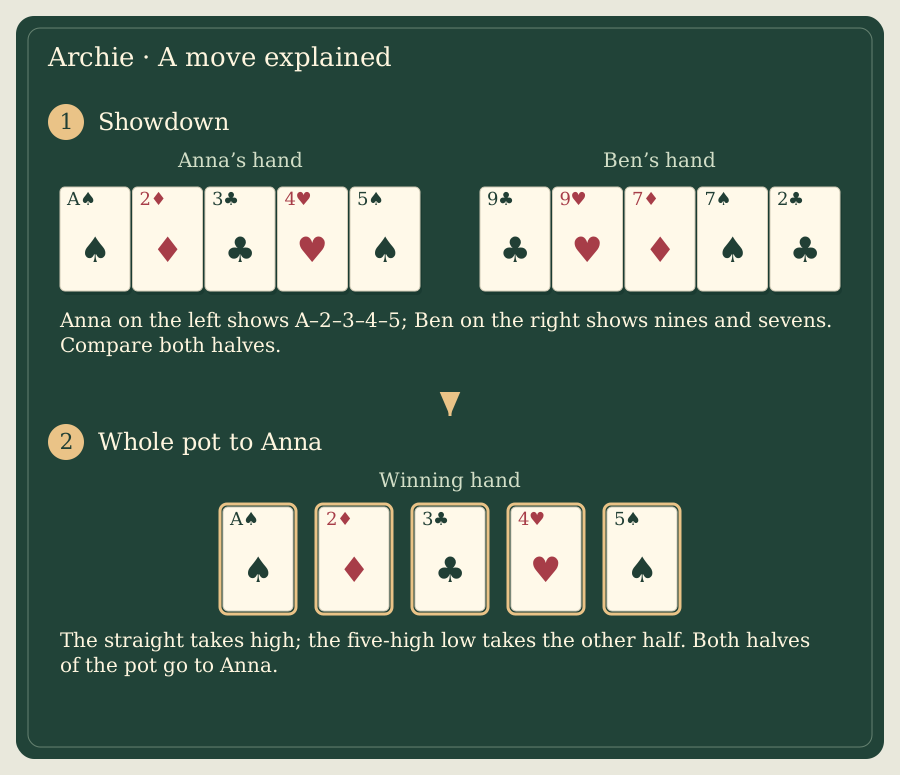
Anna holds A♠ 2♦ 3♣ 4♥ 5♠; Ben has 9♣ 9♥ 7♦ 7♠ 2♣. Anna has a straight for high and the best possible low. Her straight also beats Ben’s two pair, so she scoops without declaring both.
Now Anna has K♥ 9♦ 7♣ 4♠ 2♥ and Ben has 4♣ 4♦ Q♠ 8♥ 3♣. Neither reaches paired sixes for high. Neither qualifies low: Anna has high cards and Ben a pair. Under BARGE’s fallback Ben wins the whole pot with his ordinary pair of fours; the pot is not divided equally.
← On a small screen, scroll the diagram horizontally. →
07 /
Why the selected ruleset matters
Archie appears in mixed-poker settings, and BARGE publishes a ruleset for it. References differ: Pagat describes paired nines for high and an equal division among all surviving players when nobody qualifies. Those rules are not combined with BARGE’s here.
A larger table needs a discard-reshuffle procedure because three draws can exhaust the pack. It is unnecessary in this explicitly heads-up teaching version. The primary rules consulted do not establish a definite inventor or exact invention date.
Common questions
Does any two pair qualify high?+
Yes. Two pair outranks every one-pair hand, even when made of deuces and threes.
Must I declare a direction?+
No. Qualifying hands compete automatically.
What if nobody qualifies?+
In this BARGE version, the best ordinary high hand takes the pot.
Can Archie have more than two players?+
Yes. This explicitly heads-up teaching table avoids running out of cards.