← On a small screen, scroll the diagram horizontally. →
01 /
Players and materials
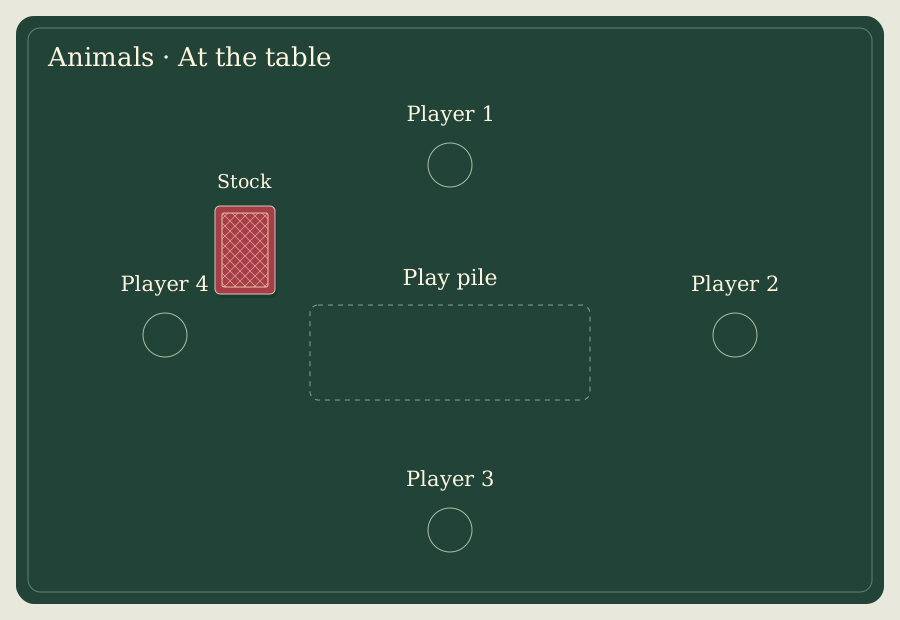
Gather four to eight players and a 52-card deck without jokers. Equal ranks match, such as two jacks of any suits. Aces do not beat kings because there is no card-strength comparison. Only equality matters. Use enough table space for everyone to see the top card of every personal pile at the same time.
02 /
Assign the animals
Everyone chooses a different animal. Repeat the names around the table until people know the associations: Anna is Fox, Ben is Owl, Vera is Cat and Greg is Wolf, for example. Do not share an animal or change it midway through a round. Choose a dealer and rotate that role between rounds; this is a convenient table arrangement rather than a required traditional selection ceremony.
03 /
Deal from one shared deck
Dealer shuffles and retains the face-down pack. Deal one face-up card to each player in turn, building a face-up personal pile in front of each. Each new card covers that pile’s previous top card. The normal dealing order continues after a claim, regardless of who won it.
For a teaching game, start left of dealer and move clockwise. Pause briefly and consistently after exposing each card so everyone can spot a match. Do not distribute the whole deck into private face-down hands at the beginning: that is a different Snap procedure.
04 /
Name the other animal
When two personal top cards match, only those piles’ owners compete. Each calls the other owner’s animal. The first correct caller takes the opponent’s entire pile and puts it underneath their own. Their own top card therefore remains visible. Bystanders cannot take the cards, however quickly they notice the match.
Explicit teaching agreements: if more than two tops match, an eligible owner may name one other matching owner and take that pile. If correct calls are inseparably simultaneous, leave the piles unchanged. A wrong name earns no cards and carries no extra penalty in this version. Resume the existing dealing order after settling the claim.
05 /
Finish and count
When the shared deck runs out, settle any claim triggered by its final card and count every card in each personal pile. Most cards wins. Under our stated convention, players tied for the greatest total share victory. A player with an empty pile is not eliminated: the shared deck will deal them another card on their next turn.
06 /
Fox against Owl
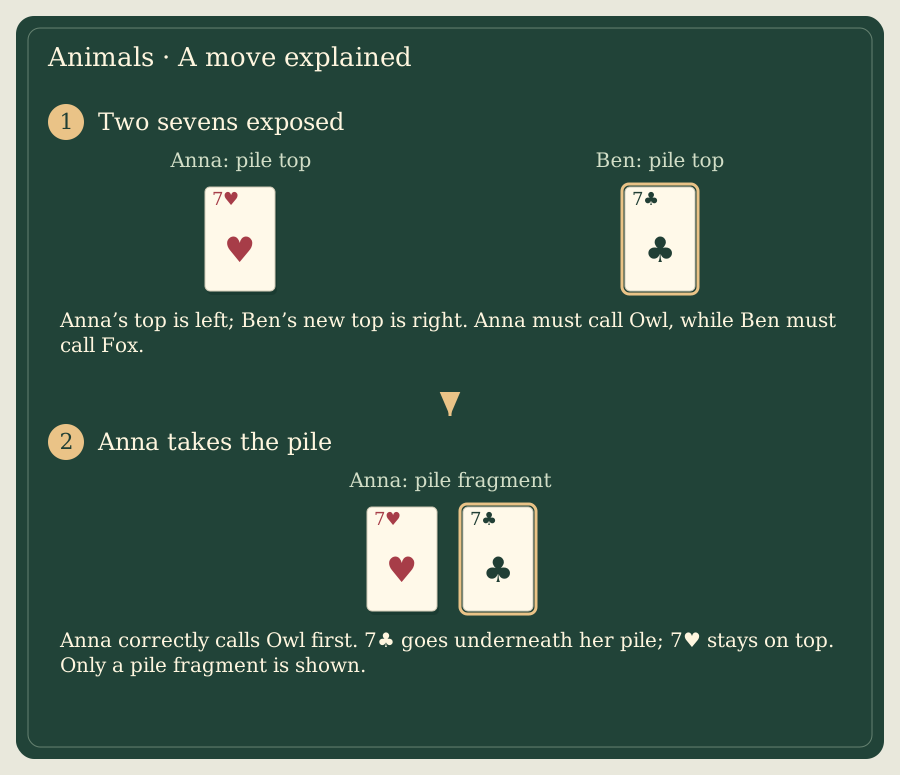
Anna, Fox, has 7♥ on top. Ben, Owl, receives 7♣. Anna needs to call Owl while Ben needs to call Fox. Anna answers correctly first and puts Ben’s entire pile beneath hers. Calling your own animal, the rank seven or merely Snap is not the required response.
← On a small screen, scroll the diagram horizontally. →
07 /
Variants and context
Barnyard Snap may replace animal names with their noises. Another version asks players to say a noise word, such as meow, rather than imitate the sound. Choose one response system before starting. Animals here identifies this particular Snap relative, not every illustrated animal-card product. The rule source supplies neither a confirmed inventor nor a precise invention year for the variant.
Common questions
Can anyone claim a match?+
No. Only owners of matching personal top cards compete here.
Must the suits match?+
No. The ranks alone must match.
Am I out when my pile is empty?+
No. The common deck continues dealing you cards.