← On a small screen, scroll the diagram horizontally. →
01 /
Set up
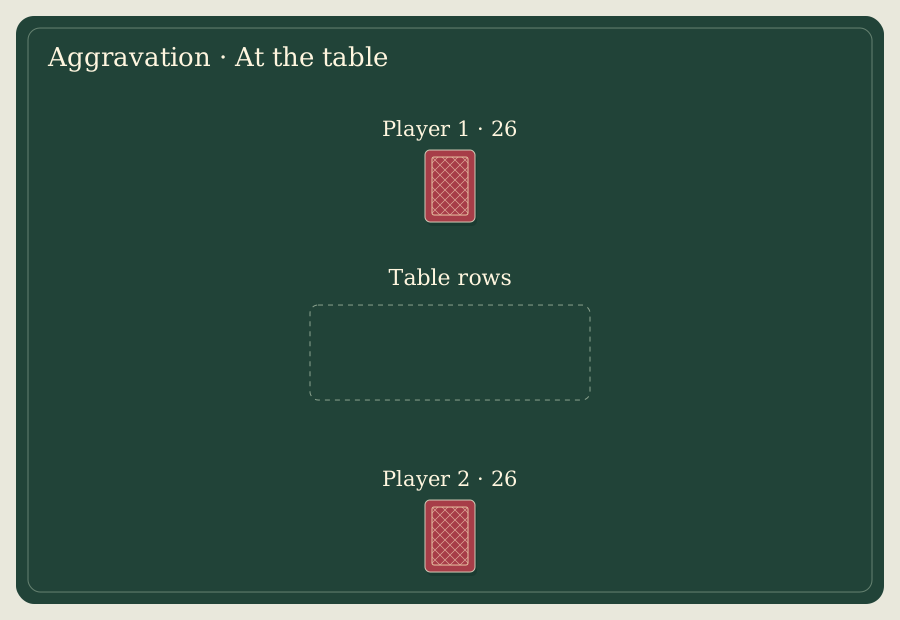
Shuffle a standard 52-card pack and split it equally: 26 cards each. Hold your packet face down without inspecting its order. Suits and card strength are irrelevant.
02 /
Reveal and cover
Reveal one card each simultaneously, forming two rows. When no ranks match, add another card to each row. Whenever two or more exposed cards have the same rank, cover them quickly from your packet. Cover newly created matches too.
Both players may cover the same match: one can cover each member of a pair. When no matches remain, extend the rows together again. Do not collect the table piles.
03 /
Claiming the win
An empty packet is only the first requirement. Find a matching exposed pair, touch both cards with your index fingers and call “Aggravation!” to win. Save your last card for covering a match; the opponent alone adds new positions. Your last card may cover one member of a match; afterwards find a match to make the claim. With no matches, the opponent continues revealing alone.
No points are counted. The sources do not resolve precisely simultaneous claims. For a practice session, agree to call that a draw and redeal; use the same convention if both packets are empty without any match; this is an editorial convention.
04 /
Worked position
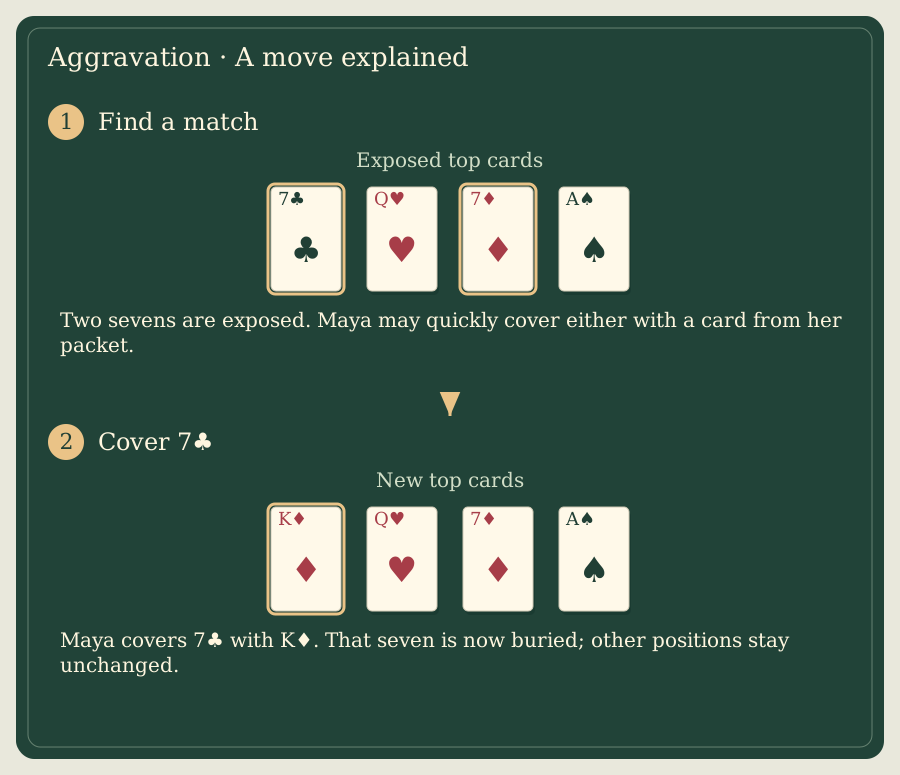
The exposed cards include 7♣, Q♥, 7♦ and A♠. Maya covers 7♣ with K♦ and reaches for 7♦ with 2♣. If Oliver has already covered the second seven, his play stays. Seeing the pair first does not reserve both positions.
Now Maya has one card remaining. She uses it to cover a valid matching card. Her packet is empty, but the new layout contains no matching ranks. She cannot claim yet. Oliver reveals another card, making two aces visible. Maya must touch those aces and call the game before she has won.
For a slow demonstration, change one top card at a time and ask the learner to point to every current match. Then let both players act together.
← On a small screen, scroll the diagram horizontally. →
05 /
Related games and practice
Pagat presents Aggravation beside California Speed; Denexa documents the expanding-row game too. Its precise origin is not established here. California Speed has a fixed layout, so do not import its row-collection procedure.
Try the first game slowly, announcing a matching rank before covering anything. Once the pattern is comfortable, play at normal speed. Leave enough space between rows for both players to reach cards without disturbing neighbouring piles.
Common questions
May I use a match in the opponent’s row?+
Yes: look across the whole exposed layout.
Must suits match?+
No, only ranks.
Are covered cards recycled?+
No. Leave them beneath their covering cards.