← On a small screen, scroll the diagram horizontally. →
01 /
Sri Lankan profile
304 is a partnership game strongly associated with Sri Lanka. Its promoted J and 9 connect it to the Jass family; an exact invention story or date is not established. This guide selects Pagat’s detailed Sri Lankan profile with two auctions, closed trump and Caps. It is not 29 or a permanently open-trump simplification.
02 /
Pack and deal
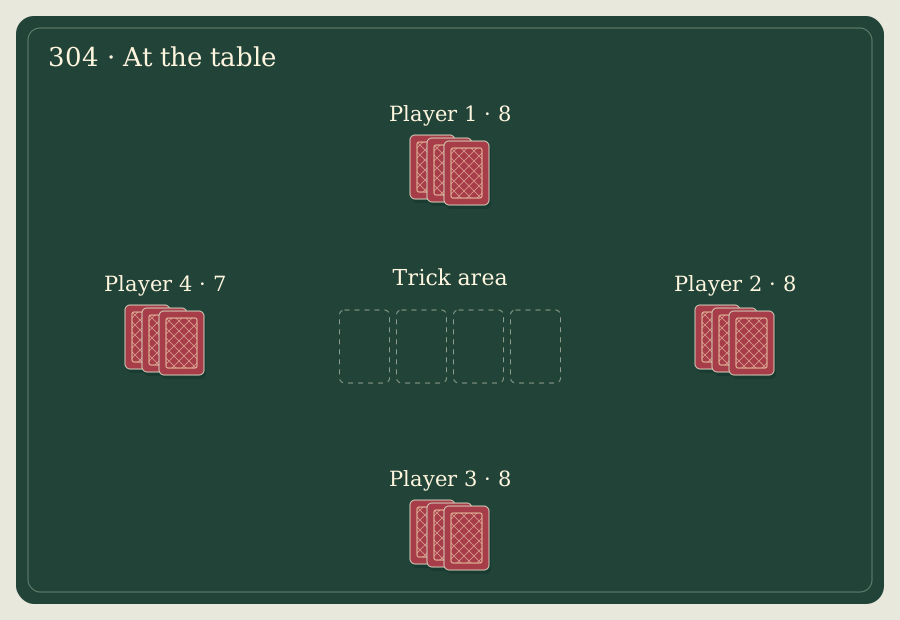
Four play in opposite partnerships. Deal, auction and play run anticlockwise. Use 32 cards, 7–A in each suit. Every suit ranks J–9–A–10–K–Q–8–7; values are 30–20–11–10–3–2–0–0, totalling 304. Give each pair 11 tokens. Shuffle and offer the left neighbour a cut. Deal batches of 4 starting on the right, then another 4 after the first auction. Next dealer is on the right.
Only the right neighbour, with initial card values below 15, may demand a same-dealer redeal before their first call. After bidding or passing it is too late.
03 /
Two auction stages
The right neighbour starts. Bid a multiple of 10 from 160, higher than before, or pass; passing does not permanently withdraw you. A player’s later call, or overcalling partner, requires at least 200. At your turn you may ask partner to speak for you; that counts as a turn for both. A bid followed by three passes ends the auction. Four initial passes score nothing; the next dealer deals.
Winner sets one of the initial cards aside as hidden trump before seeing the second packet. After completing the deal, one circuit starts with that winner: pass or bid at least 250 above the old bid. Pass over partner’s bid in this circuit; no delegated calls. A new winner replaces the indicator. Highest is Partner Close Caps, personally winning all 8 tricks, above numerical bids through 300.
04 /
Closed trump
Dealer’s right leads first; each winner leads next. Follow suit if able, otherwise play anything. Highest trump wins, otherwise highest led suit. While the indicator is closed, every void player responds face down. Trump maker holds 7 cards plus the indicator: that indicator may cut another player’s non-trump lead, or play in the final trick. Before opening, the maker cannot cut with a different hand card; a face-down hand discard is non-trump. The set-aside indicator does not compel following trumps when none remain in hand. The maker cannot lead trump to the first trick.
At trick end maker inspects hidden responses. With no trump, they stay hidden and led suit wins. If a trump appears, reveal the others’ responses and indicator, then award highest trump; maker’s own non-trump discard stays hidden. Return an unplayed indicator to maker’s hand. All subsequent cards play face up.
05 /
Opening and special cases
Maker may expose and retrieve the indicator before the opening lead, choosing ordinary open play. At bids of 250 or more a closed indicator must be exposed after the first trick. If maker leads trump when nobody else has any, maker must lead every remaining hand trump before another suit; a closed indicator still cannot be led before the last trick. If both defenders held no trumps at all, anyone noticing may declare spoilt trumps: no score and same dealer redeals, provided the final card of the final trick has not been played. During a trick players may inspect the preceding trick, not earlier tricks or unrevealed cards.
06 /
Caps and the solo maximum
Caps means all 8 tricks, not merely 304 points. Once known information proves your side can take everything remaining, announce Caps, expose your hand and state the order. This profile grants until the current trick ends, rather than requiring a mid-trick interruption. A correct call before the seventh trick begins earns an extra token; later calls do not. Calling too early, too late, failing to call or deliberately dropping a trick to conceal the opportunity is Wrong Caps. A Caps claim is possible only if your side has taken every earlier trick.
In Partner Close Caps, partner’s cards stay face down and unused. Bidder leads; three play, skipping partner. Bidder must personally take 8 tricks. Reveal trump after the first; no separate Caps call or exhausted-trump rule applies.
07 /
Tokens and finish
For a made bid, maker’s side receives tokens; for failure it pays: below 200, +1/−2; 200–240, +2/−3; 250–300, +3/−4; Partner Close Caps, +4/−5. Exactly the bid suffices. Correct early Caps adds 1 to the normal reward. Wrong Caps replaces the bid result with a loss of 2 tokens; losing a trick after announcing Caps costs 5 instead of 2.
Both sides’ card totals add to 304. Explicit finishing agreement: if a penalty exceeds the remaining tokens, surrender the remainder without debt. First pair holding all 22 tokens wins; a completed match cannot tie.
08 /
A hidden nine
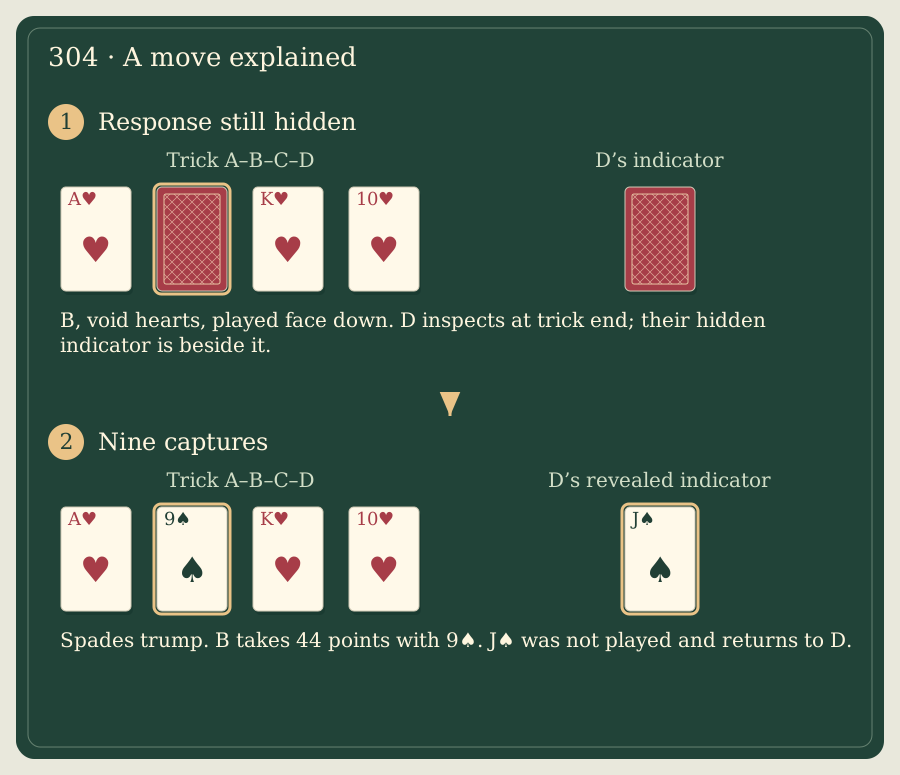
Trump maker D has hidden J♠. A leads A♥, void B plays 9♠ face down, C follows K♥ and D 10♥. Inspection finds trump: expose 9♠, show J♠ and return it to D. B takes 11+20+3+10=44 points: the indicator was not played and cannot beat the nine. With a 200 contract and 214 captured, the bid succeeds: without Caps tokens change from 11:11 to 13:9.
← On a small screen, scroll the diagram horizontally. →
Common questions
Does passing end first-stage bidding?+
No; on returning the player cannot bid below 200.
Are all points enough for Caps?+
No: all 8 tricks, including zero-value tricks, are required.
Does the indicator automatically win?+
No, only a card actually played to that trick can win it.