← On a small screen, scroll the diagram horizontally. →
01 /
The game at a glance
Highest first: straight flush, three of a kind, straight, flush, pair, high card. A-K-Q is highest straight, A-2-3 lowest; K-A-2 is invalid. Compare same categories by rank, pair then kicker, or descending cards. Suits do not break ties. There is no five-card hand or community board.
02 /
Prepare and deal
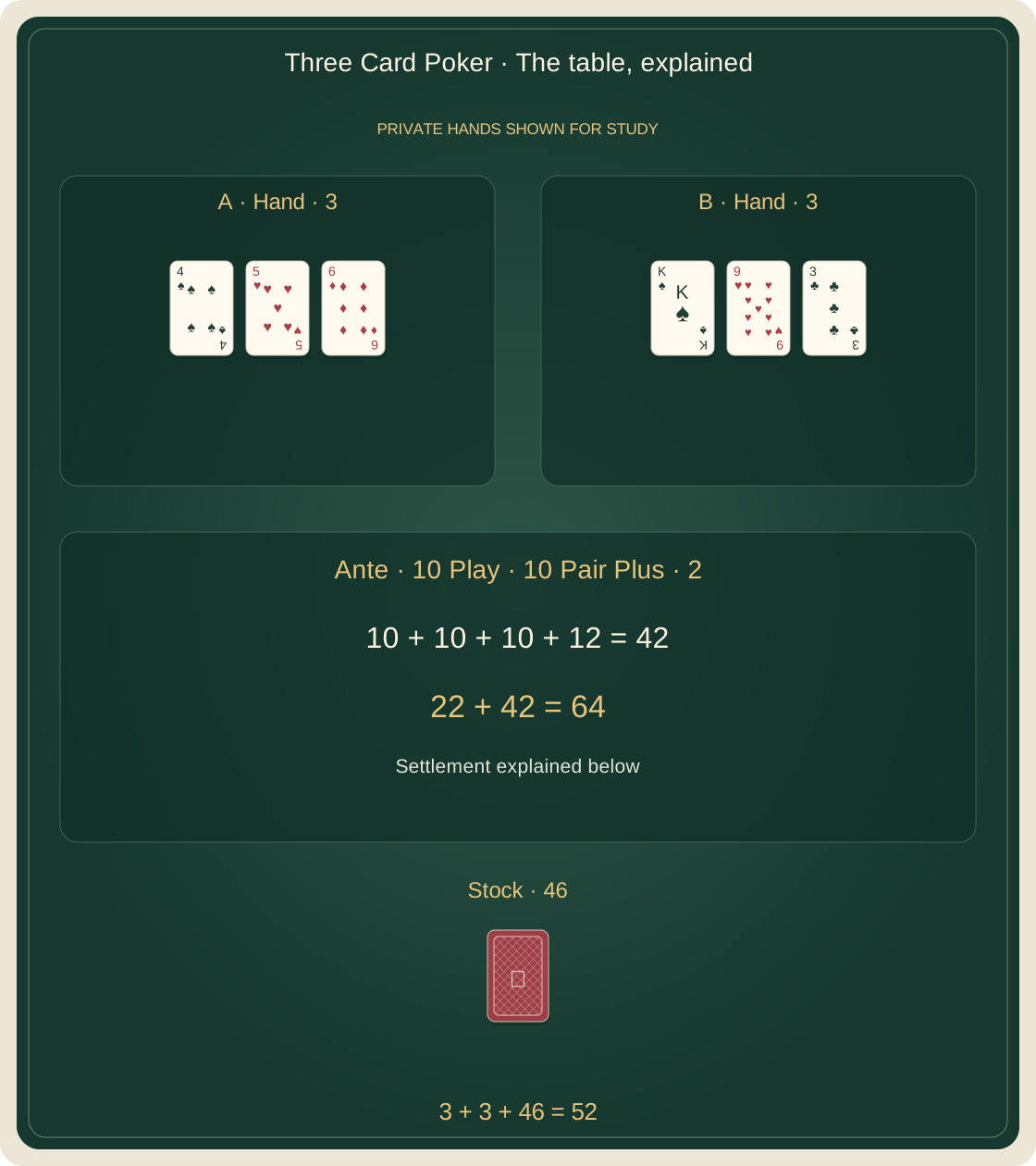
Place Ante before dealing; Pair Plus is optional and also placed before cards. Dealer shuffles and cuts, then deals 3 private cards to each occupied betting position and 3 to themselves. No exchanging or drawing. Each player faces the dealer independently, not other players; our diagram counts player and banker as 2 seats.
03 /
How play proceeds
Inspect your hand and either fold Ante or place Play exactly equal to Ante. No raising or bluffing the dealer into folding. Only after decisions does dealer expose their hand. Pair Plus may be played alone; in this selected ruleset a player may also fold Ante but retain Pair Plus by keeping the cards for its settlement.
04 /
Rules that change your decision
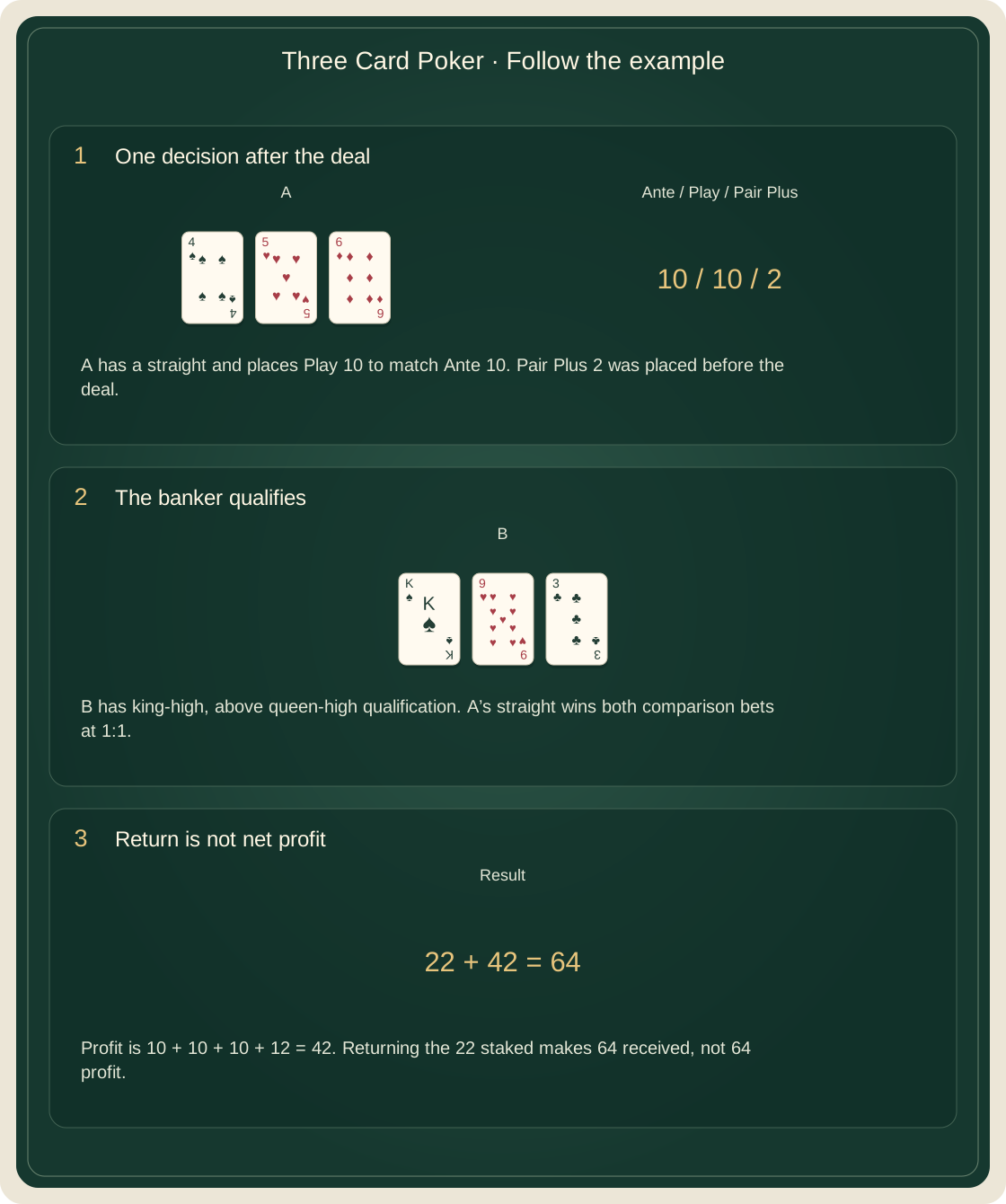
Dealer qualifies with queen-high or any higher category. Without qualification Ante wins 1:1 and Play pushes. With qualification, a better player hand wins both 1:1; equal hands push both; worse loses both. Folded Ante loses and has no Ante Bonus. Pair Plus has its own result regardless of dealer qualification.
05 /
Finish and scoring
On a continued Ante hand, Ante Bonus pays even if dealer beats you: straight 1:1, trio 4:1, straight flush 5:1, based on Ante. Pair Plus Table A pays pair 1:1, flush 4:1, straight 6:1, trio 30:1, straight flush 40:1; high card loses. These odds describe profit; a winning wager also returns its stake.
| Hand | Ante Bonus · profit | Pair Plus · Table A profit |
|---|---|---|
| Pair | — | 1:1 |
| Flush | — | 4:1 |
| Straight | 1:1 | 6:1 |
| Trio | 4:1 | 30:1 |
| Straight flush | 5:1 | 40:1 |
06 /
A worked example
Player has 4♠ 5♥ 6♦, dealer K♠ 9♥ 3♣. Dealer qualifies but straight wins. Ante 10, Play 10 and Pair Plus 2 cost 22. Profit: Ante 10, Play 10, Ante Bonus 10, Pair Plus 12, total 42. Gross return 64 includes the original 22. No card is shared between hands.
| Account | Stake | Net profit |
|---|---|---|
| Ante | 10 | 10 |
| Play | 10 | 10 |
| Ante Bonus | — | 10 |
| Pair Plus | 2 | 12 |
| Total | 22 | 42 |
← On a small screen, scroll the diagram horizontally. →
07 /
What to watch at the table
Read the pay table before placing chips. Side bets do not improve the comparison hand or protect Ante and Play. A nonqualifying dealer returns Play even when your hand is weak. A bonus can coexist with losing comparison bets. Track each box separately instead of calling the whole round a simple win or loss.
08 /
Choose the rules before starting
Pair Plus tables vary: the same operator also lists schedules with reduced flush or trio payments. Do not import one table’s best payouts into another. This lesson covers only Ante/Play and Pair Plus, with no progressive or extra-card bets. Each round ends at settlement; reshuffle for the next round, with no cumulative match target.
09 /
History and related games
This is the modern proprietary casino game associated with Derek Webb’s development in the 1990s. Three-card comparison has older relatives such as Brag and Teen Patti, but their betting and ranking rules are not interchangeable. A casino’s published local rules remain the reference for its actual table.
10 /
Check your understanding
Does a flush beat a straight?
Show the answer
No. Three-card straights rank higher.
Is a paid bonus the whole returned amount?
Show the answer
No. Count returned stakes and net profit separately.
Common questions
Can I draw another card?+
No. Each hand stays at three cards.
How much is Play?+
Exactly equal to Ante.
Does Pair Plus require beating dealer?+
No. It depends only on your hand and its pay table.