← On a small screen, scroll the diagram horizontally. →
01 /
The game at a glance
High to low: trio, suited run, mixed-suit run, colour, pair, high card. Trio means three equal ranks. Compare trio or pair rank first, then the pair’s kicker. Colour and high card compare descending ranks. Suits never break a tie. In this profile A-2-3 beats A-K-Q; 4-3-2 is lowest and K-A-2 is invalid.
02 /
Prepare and deal
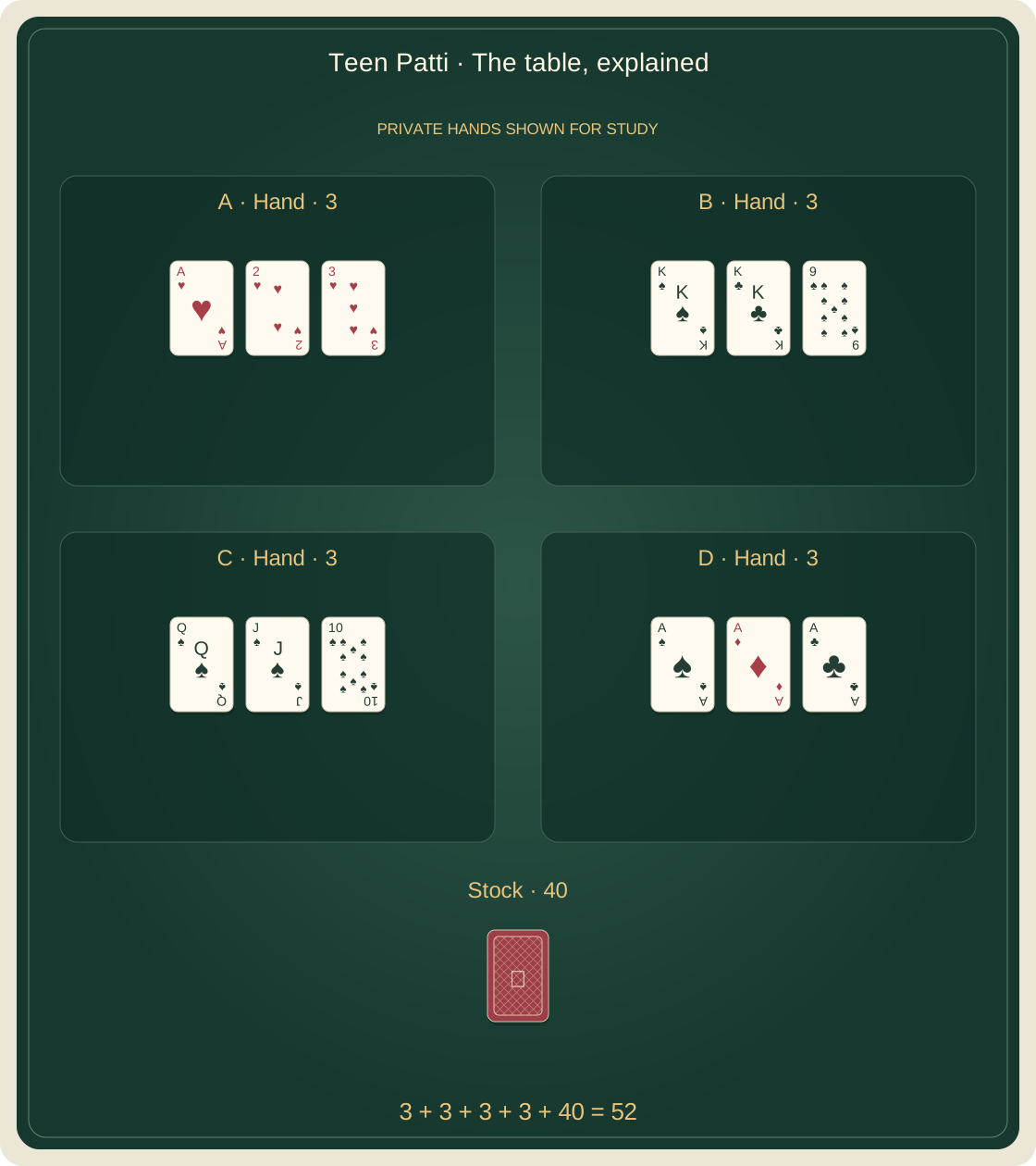
Agree the minimum unit and available counters. Everyone antes 1 unit. Shuffle and cut, deal 3 face-down cards each, one at a time clockwise. Dealer’s left starts. You may inspect your hand and play seen, or leave it unseen and play blind; once seen you cannot return to blind status. Rotate dealer left after settlement.
03 /
How play proceeds
Current stake starts at 1. On each turn add a new bet or fold, forfeiting earlier contributions. Blind pays between the current stake and twice it; the new stake equals that payment. Seen pays between twice and four times the current stake; the new stake is half that payment. Looking before betting changes the price immediately. There are no checks or contribution-matching rounds.
04 /
Rules that change your decision
A paid show is possible only with 2 players left. Blind pays the current stake before seeing their own hand. A seen player cannot demand show against blind; with both seen the cost is twice the current stake. Higher hand wins. Exact tie goes to the player who did not request the show, not a split pot.
05 /
Finish and scoring
If everyone except one folds, that survivor wins without showing. When all active players are seen, immediately after paying the minimum you may request a private sideshow with the previous bettor. They may refuse. If accepted, the lower hand folds; an equal hand forces the requester to fold. Keep other hands private and do not confuse sideshow with a final two-player show.
06 /
A worked example
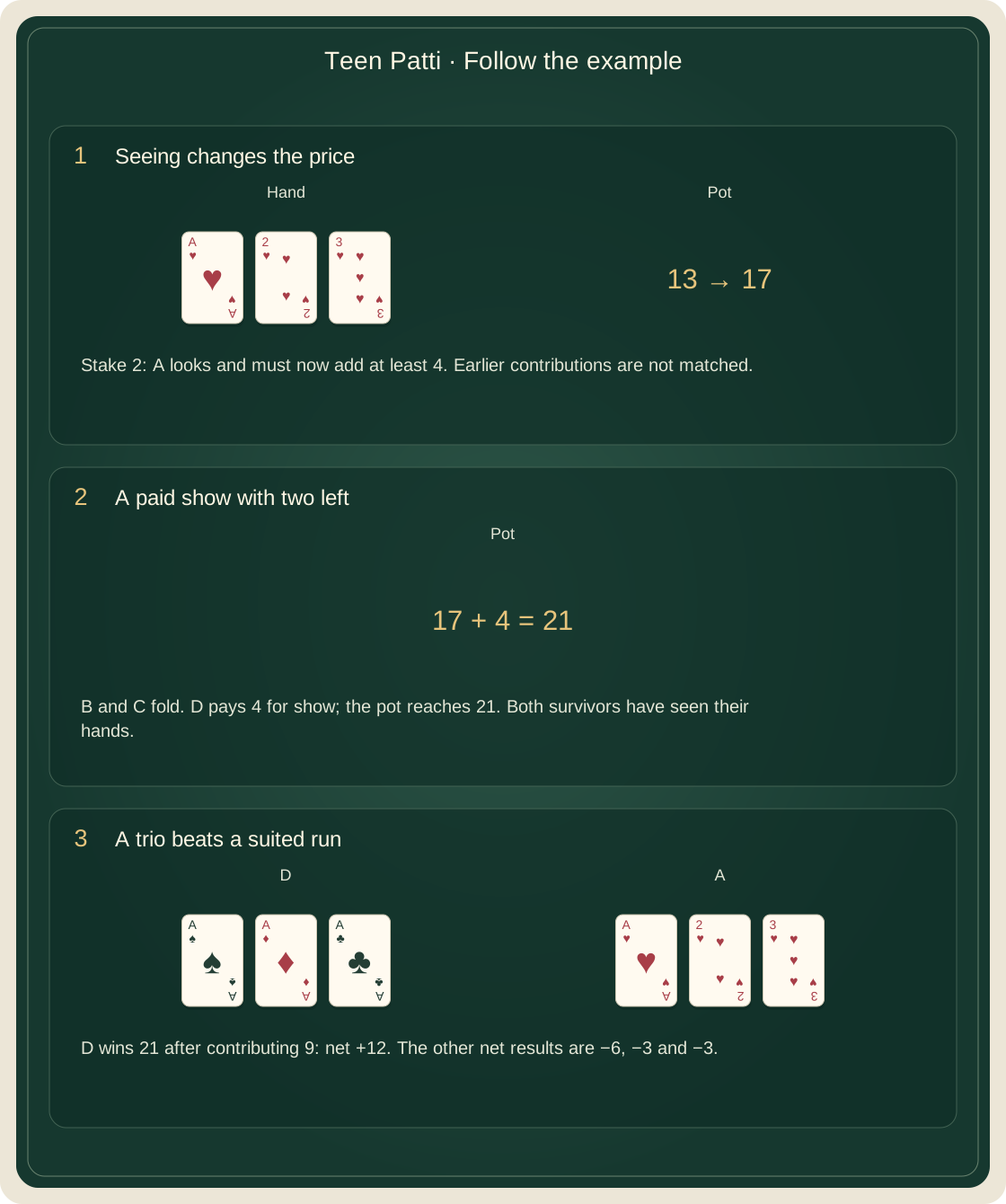
Four antes make 4. A blind adds 1; B seen 2; C blind 2 raises the stake to 2; D seen adds 4; A looks and adds 4. B and C fold. D pays 4 for a show: pot 21. D’s three aces beat A’s suited A-2-3. Contributions A/B/C/D are 6/3/3/9; net results −6/−3/−3/+12 total zero.
| Action | Payment | New stake | Pot |
|---|---|---|---|
| A · blind | 1 | 1 | 5 |
| B · seen | 2 | 1 | 7 |
| C · blind | 2 | 2 | 9 |
| D · seen | 4 | 2 | 13 |
| A · seen | 4 | 2 | 17 |
| B · fold | — | 2 | 17 |
| C · fold | — | 2 | 17 |
| D · show | 4 | 2 | 21 |
← On a small screen, scroll the diagram horizontally. →
07 /
What to watch at the table
Track the current stake separately from the pot and your own total contribution. Seeing is irreversible and doubles the minimum cost. An excellent suited run still loses to any trio. A counter limit must be agreed before play; this guide supplies no poker side-pot or all-in mechanism. Allow suitable counter denominations or agree even seen payments to avoid fractional stakes.
08 /
Choose the rules before starting
Other profiles reverse the top two runs, permit jokers, limit blind turns or charge more for show. Keep them separate. This lesson ends a deal when the pot is awarded; for a session agree a number of deals or stopping time, then compare counters. No fixed tournament elimination or match target is assumed.
09 /
History and related games
The Hindi name means three cards. Teen Patti is associated with South Asian social play and is close to British three-card Brag. Those connections do not establish an exact inventor or date. Live casino games using the same name may instead pit every player against a banker; their qualification and payouts are different.
10 /
Check your understanding
Can a seen player demand show against a blind survivor?
Show the answer
No. Continue betting or fold.
Who wins an exactly tied paid show?
Show the answer
The player who did not request it.
Common questions
How many cards each?+
Three private cards, no draw.
Does a suited run beat a trio?+
No. Trio is highest in this game.
Is the pot shared on a tie?+
No: requester loses the show or sideshow tie.