← On a small screen, scroll the diagram horizontally. →
01 /
The game at a glance
Use ordinary poker ranks. Highest first: straight flush, four of a kind, full house, flush, straight, three of a kind, two pairs, pair, high card. A royal flush is the top straight flush. Compare group ranks then kickers; suits never break ties. A can be low only in A-2-3-4-5, never wrap through K-A-2.
02 /
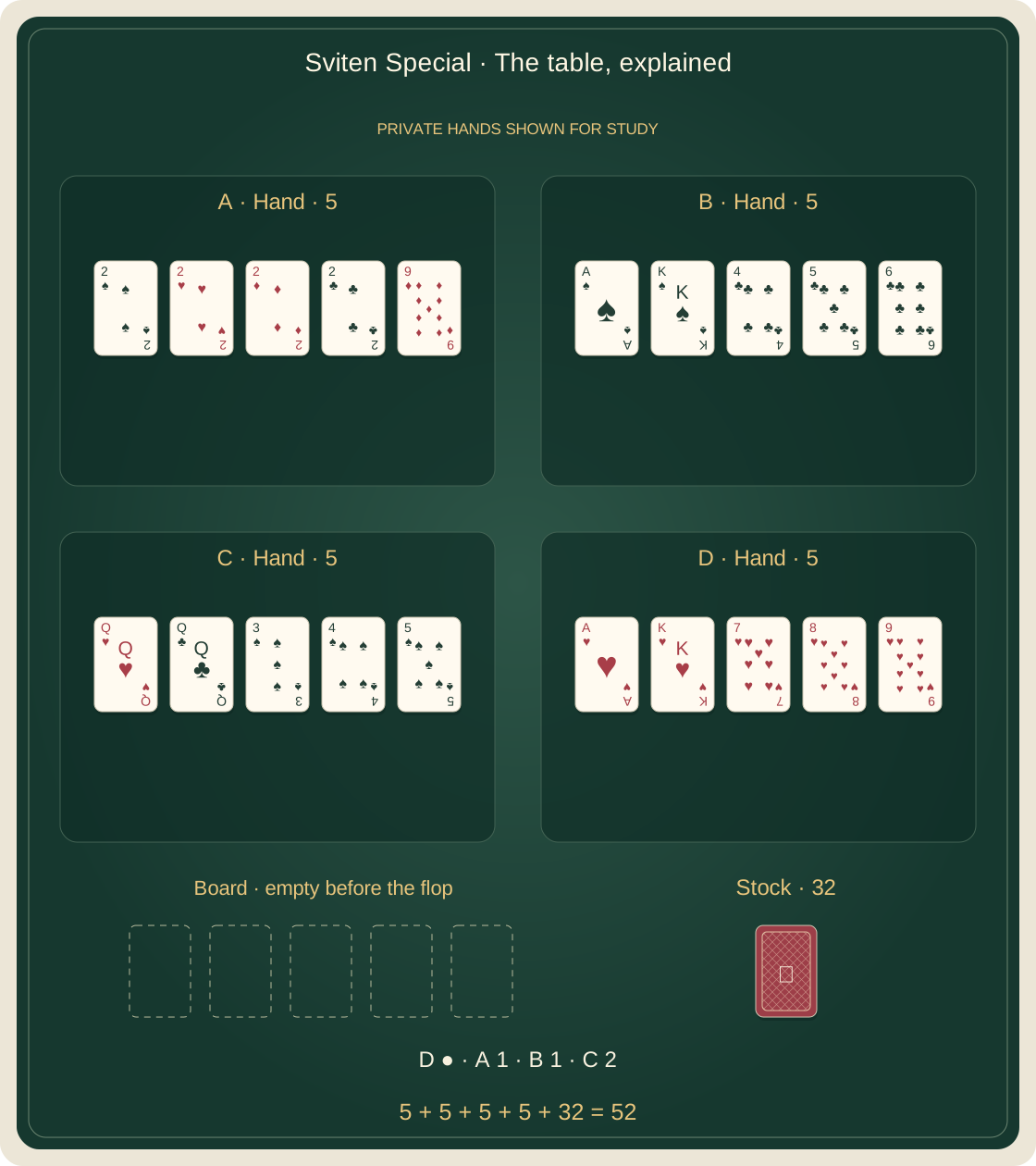
Prepare and deal
Shuffle and cut before dealing. Use 52 cards without jokers and a moving dealer button. In the selected four-player lesson D has the button; A and B post small blinds of 1 each, C posts the big blind of 2. Deal 5 private cards each clockwise. D acts first before the flop; after the flop A, the first active seat left of button, acts first. Move button left next deal.
03 /
How play proceeds
On your turn check if nothing is owed, call the amount due, bet or raise within limits, or fold. Folded cards cannot win. Deal a 3-card flop after the first betting round, then bet again. Exchange cards after that round. Deal turn and bet; deal river and bet. There are 4 betting rounds and no burn cards at any stage. A round closes when all active players have answered and matched the current bet or are all-in.
04 /
Rules that change your decision
All survivors declare discards before replacements, from first active seat left of button clockwise. Discard 0–5 and receive the same number. For exactly 1, offer it face up: accept, or reject it and take the next card face down compulsorily. Keep each player’s own discards aside until their replacement finishes. If stock runs out, shuffle only eligible earlier muck; never return that player’s own withheld discards or cards still in other hands. An accidentally exposed replacement returns to stock for reshuffling and a new draw. After the first stock reshuffle, finish the current replacement before returning that player’s withheld cards. Mix the now eligible muck with the remaining stock after each completed player, before the next replacement. Keep a rejected open offer out of that recipient’s replacement pool until their exchange is complete.
05 /
Finish and scoring
Half the pot goes to the best final 5-card private hand; half goes to the best hand using exactly 2 private and 3 board cards. Same player may scoop both. If everyone else folds, the survivor takes everything without showdown. For all-ins create separate contribution layers: only contributors to a layer can win it, and split each layer by the same two tests. Our odd-counter agreement gives the extra whole counter to the draw half when the pot cannot be halved evenly; tied shares receive odd counters clockwise left of button.
06 /
A worked example
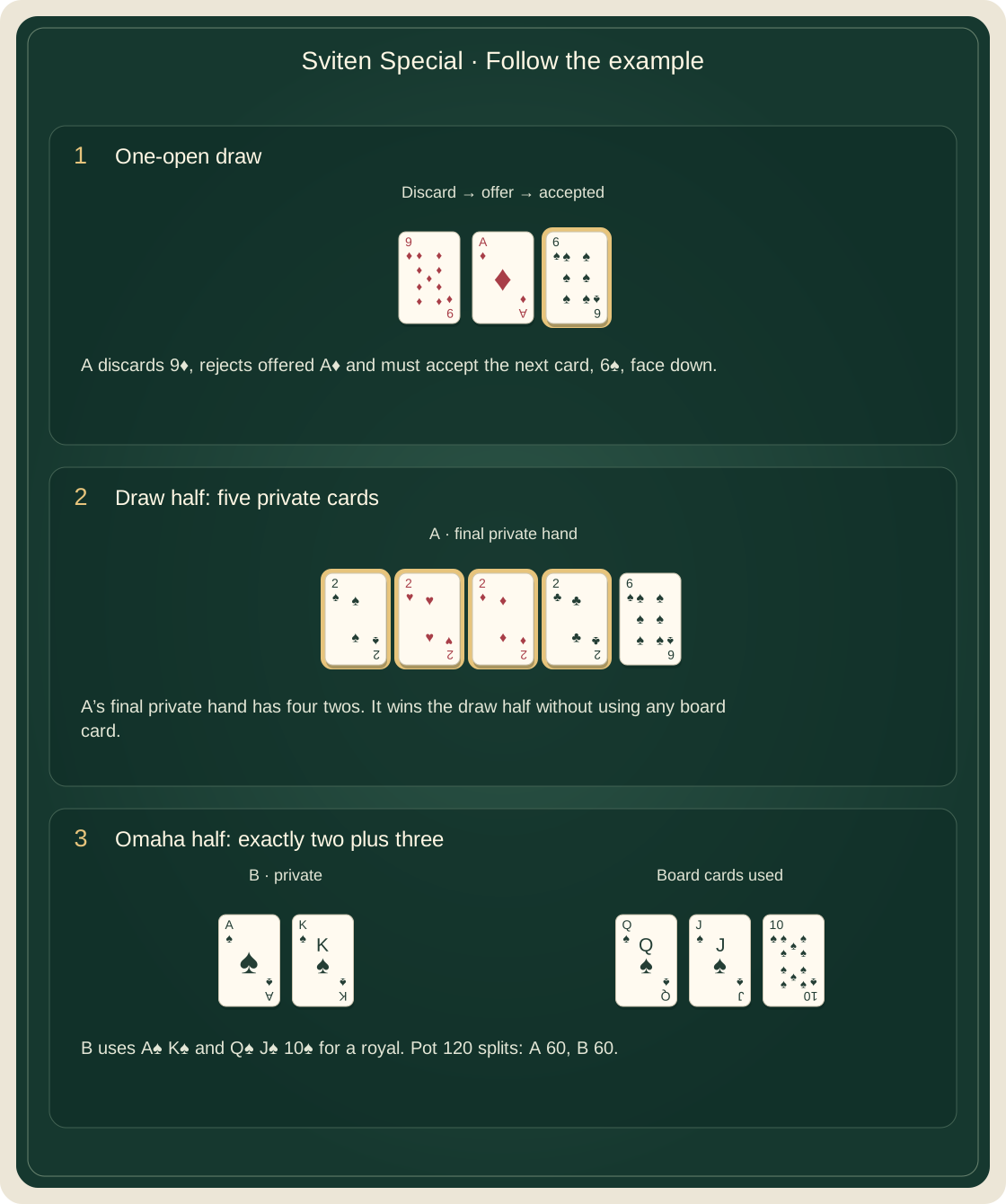
A starts with four twos and 9♦, discards 9♦, rejects exposed A♦ and accepts 6♠ unseen. B keeps A♠ K♠, exchanges 4♣ 5♣ 6♣ for 7♦ 8♦ 9♣. C and D stand pat. Final board Q♠ J♠ 10♠ 3♥ 4♥ gives B a royal flush using exactly A♠ K♠. A’s four twos win draw; B wins Omaha. Each contributed 30 to a pot of 120, so A and B receive 60 each, not 120 to either one.
| Betting round | A | B | C | D | Pot after round |
|---|---|---|---|---|---|
| 1 | 2 | 2 | 2 | 2 | 8 |
| 2 | 4 | 4 | 4 | 4 | 24 |
| 3 | 8 | 8 | 8 | 8 | 56 |
| 4 | 16 | 16 | 16 | 16 | 120 |
← On a small screen, scroll the diagram horizontally. →
07 /
What to watch at the table
Pot-limit maximum counts the call first. If pot is 20 and you owe 5, call 5 to make 25, then raise at most 25: put in at most 30 total. Minimum opening bet is the big blind; a full raise must be at least the previous full increment. A short all-in need not reopen raising for players who already acted. In our example each player contributes 2, 4, 8 and 16 over the rounds; all bets fit the pot limits.
08 /
Choose the rules before starting
Keep the 5 private cards separate from the board when evaluating. A board flush is not automatically yours: Omaha still needs 2 private cards of that suit. Decide blind sizes, side-pot and odd-counter procedure before playing. Selected draw and reshuffle procedures follow the organiser profile; two-blind, burn-card, closed single-draw and fixed-limit Drawmaha versions are separate. The chosen 4–7-player table avoids treating a heads-up blind arrangement as identical.
09 /
History and related games
The Festival credits Anders Bengtsson’s Stockholm Sviten club with the Swedish form in the early 2000s and reports his account of a 2004 introduction. Specialist testimony also describes a similar Canadian Celestial game in the 1980s. These are attributed accounts, not proof that nobody combined draw and Omaha earlier. The face-up single-card option developed within the Swedish tradition.
10 /
Check your understanding
Can you use one private card and four board cards for Omaha?
Show the answer
No. Exactly two private and three board cards are compulsory.
Can a player receive their own discards back during their replacement?
Show the answer
No. Keep those discards out until that player has received all replacements.
Common questions
When is the draw?+
After flop betting, before the turn.
Is there a low half?+
No. Both halves use high poker rankings.
Can the same player win both halves?+
Yes. Evaluate draw and Omaha independently for every eligible pot.