← On a small screen, scroll the diagram horizontally. →
01 /
Your first round
Flip 1 card in clockwise order. If it is a jack, everyone eligible may claim immediately, even when it is not their flipping turn. First correct slap captures the entire central packet. Continue until 1 player owns all cards. Winning 1 packet does not mean winning the game. Keep personal piles closed; there is no tactical hand to inspect.
02 /
Set up the table
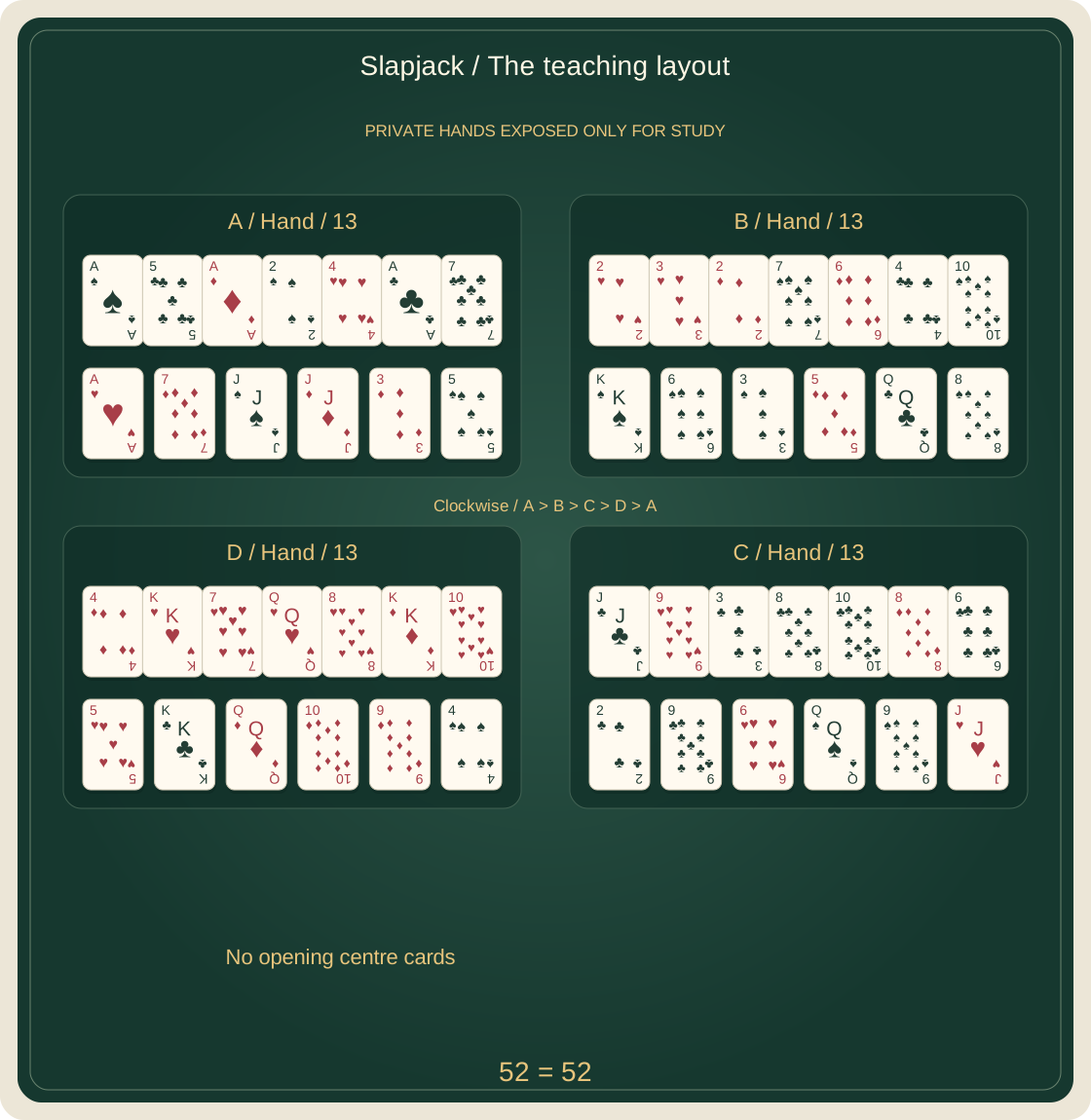
Shuffle 52 ordinary cards without jokers. Deal 1 at a time clockwise until all are distributed; uneven piles are fine. With 4 players each starts 13. Square each pile face down without looking. Dealer’s left flips first. Leave a reachable central space, without glasses or sharp objects beside it. Agree a light-touch claim rather than a hard strike.
03 /
Flip fairly
Take only the top card and turn it outward onto the central face-up packet. Reveal in 1 motion so the flipper does not preview it. Continue clockwise with players who still have cards. A non-jack by itself cannot win the packet, even if it matches the previous rank or completes a sequence. Suits have no effect.
04 /
A correct jack claim
Any jack qualifies. The first hand directly touching the jack wins it and all cards below it, not just the jack. If hands overlap, the lowest hand touching the jack wins. Turn captured cards down, combine under your personal pile and shuffle the combined pile before continuing. In this guide the captor flips next; keep that turn agreement throughout.
05 /
A mistaken slap
Slapping a non-jack costs 1 top card from your personal pile, face down, to the player who exposed that non-jack. Do not reveal or choose a preferred penalty card. It goes under the recipient’s pile. The central packet remains in place and normal turn order continues. Multiple false claimants each pay separately if they have a card.
06 /
Your last card is not instant elimination
After your pile empties, stop flipping but keep your 1 chance to claim the next jack. Win it and rejoin with the captured packet. Miss that jack and you are eliminated; later jacks do not give more chances. If no eligible rival remains and 1 player owns all 52 cards, that player wins.
07 /
3 flips and a wrong slap
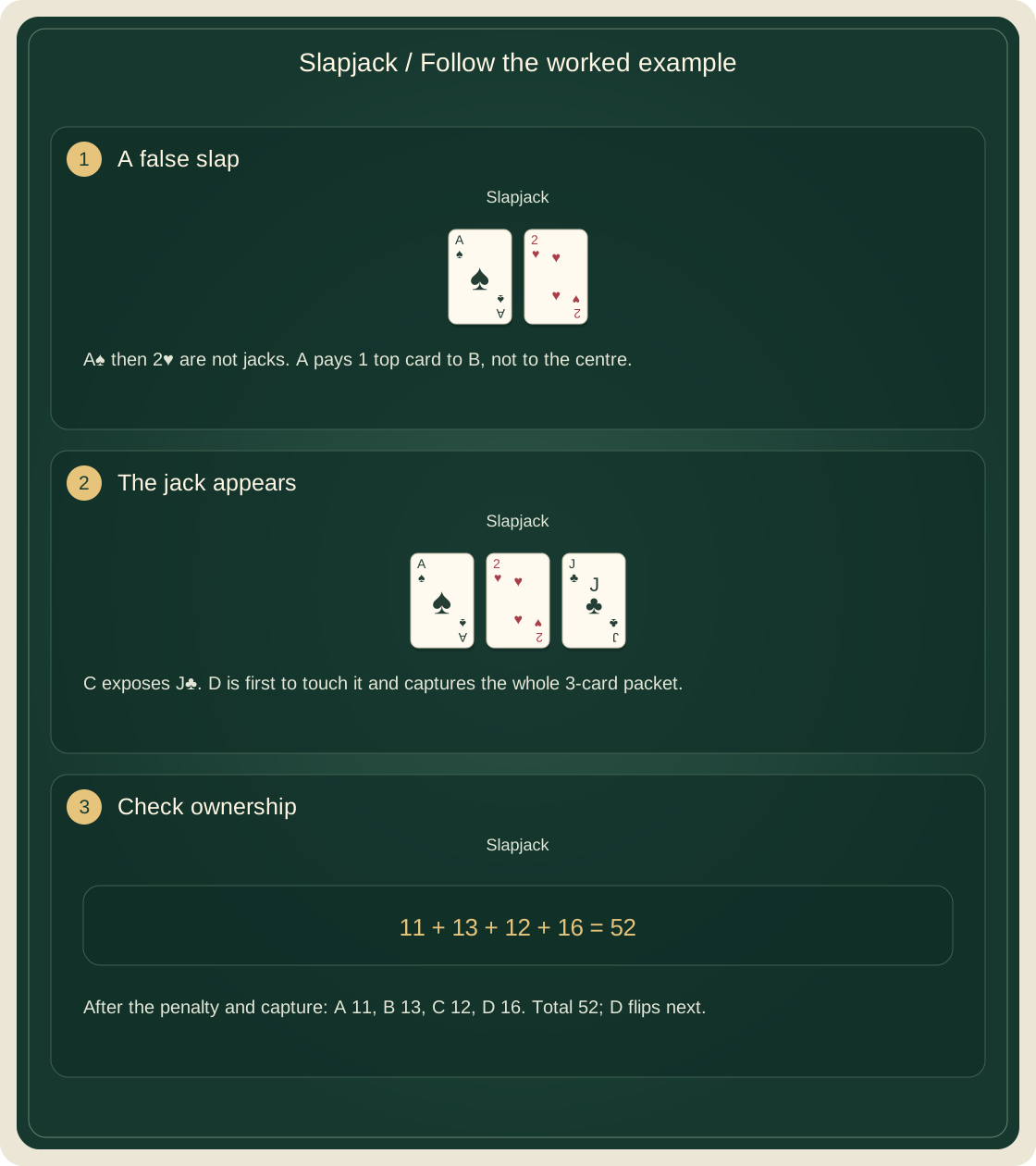
4 piles start 13 each. A exposes A♠, B exposes 2♥. A wrongly slaps and gives its next hidden card to B. The middle still contains A♠ and 2♥. C then exposes J♣; D reaches it first and captures all 3. Counts are now A 11, B 13, C 12, D 16: total 52. D shuffles its combined pile and flips next.
← On a small screen, scroll the diagram horizontally. →
08 /
Ending without arguments
Count ownership only if needed; the goal is all cards, not points per jack. Settle an overlapping-hand claim by which hand actually touched the jack, not by loudness. If a jack slides out of view, pause and restore the visible packet rather than awarding a guessed claim. Agree a time limit only as a separate house variant, since most cards at a deadline is not the normal victory condition.
09 /
Mistakes that change the game
Do not look at private piles, flip more than 1 at once, slap ordinary pairs or put a false-slap penalty into the centre. Do not let an eliminated player keep entering every future race. A jack is a claim signal, not a penalty demanding extra cards as in Beggar-My-Neighbour. Small children can use pointing or a soft marker instead of hands.
10 /
A simple game with regional names
Slapjack is part of the traditional reaction-game family and is described in modern Hoyle-style publisher rules. The sources used here do not establish a single inventor or precise first year. Snap and Egyptian Rat Screw share fast recognition, but trigger different claims. The name alone should never import their pairs, sandwiches or court-card payment sequences.
11 /
Check your understanding
Can a queen be slapped?
Reveal the answer
No. Only jacks trigger a correct claim in this profile.
A player has no cards. Can they claim every future jack?
Reveal the answer
No. They have 1 chance at the next jack; missing it eliminates them.
Common questions
Are uneven piles allowed?+
Yes. Deal all 52; piles need not be equal.
Who receives a false-slap card?+
The player who exposed the non-jack.
Are pairs a valid trigger?+
No, not in jack-only Slapjack.