← On a small screen, scroll the diagram horizontally. →
01 /
Your first round
Ante, post the button blind, deal two private cards and bet. Burn one and expose three together: the flop. Bet, burn and expose the turn; bet, burn and expose the river; bet again. Use any five from your two cards and the board, including no private cards if the board is best. Nobody may use a folded player’s private cards.
02 /
Cards, seats and the deal
Play with 2–6 players; move the dealer button clockwise after each hand. Shuffle the 36-card deck, collect equal antes, then the button posts an additional blind that counts toward its preflop wager. Ante does not count toward a call. Deal one card at a time clockwise from button’s left, twice. The first active player left of the button acts first on every betting round; the button acts last when still in.
03 /
What happens on your turn
In no-limit play you may wager up to your remaining stack. The minimum opening is one button blind. A full raise must increase the wager by at least the last full bet or raise increment: after an opening of 2 and a raise to 6, the next minimum is 10, not 8. The button can check preflop if everyone merely matches its blind, or raise when action returns. Burns remain unseen and outside the five-card board.
04 /
Hand strength, highest first
| Order | Combination |
|---|---|
| 1 | Straight flush |
| 2 | Four of a kind |
| 3 | Flush |
| 4 | Full house |
| 5 | Straight |
| 6 | Three of a kind |
| 7 | Two pair |
| 8 | One pair |
| 9 | High card |
05 /
Comparing hands and ties
A straight flush is five consecutive cards of one suit; the highest is the royal flush, 10–J–Q–K–A. Four equal ranks form quads; three plus a pair form a full house. A flush needs five of one suit, a straight five consecutive ranks. Compare the made rank first: trip rank before pair in a full house, higher pair before lower pair in two pair. Then compare remaining kickers highest first. Equal best five-card hands split the pot; suits never break a showdown tie.
06 /
Checks, calls, raises and folds
Check passes when nothing is owed. Bet opens a betting round. Call pays the difference to the current wager; raise increases that wager; fold gives up the hand and all chips already committed. Continue clockwise until every active player has responded to the last full raise and matched the wager or is all-in. A lone remaining player wins without showing. Use counters for practice and agree the stakes, minimum chips and split-pot odd-chip rule before dealing.
07 /
All-in and side pots
A player who runs out of chips stays eligible only for the portion matched by each opponent. Separate later contributions into side pots and compare only eligible hands in each. Return an unmatched excess. Example: contributions 5, 12, 12 create a main pot of 15 for all and a side pot of 14 for the last two. Winning the main pot does not win the side pot automatically. A short all-in below a full raise does not reopen raising for someone who has already acted.
08 /
The special low ace
An ace is high in 10–J–Q–K–A or low in A–6–7–8–9. The latter is nine-high, so 6–7–8–9–10 beats it. There is no A–2–3–4–5 because those small cards are absent, and Q–K–A–6–7 does not wrap around. In this profile a straight beats three of a kind. Print the ranking beside the table rather than importing a different app’s order halfway through a hand.
09 /
A complete worked example
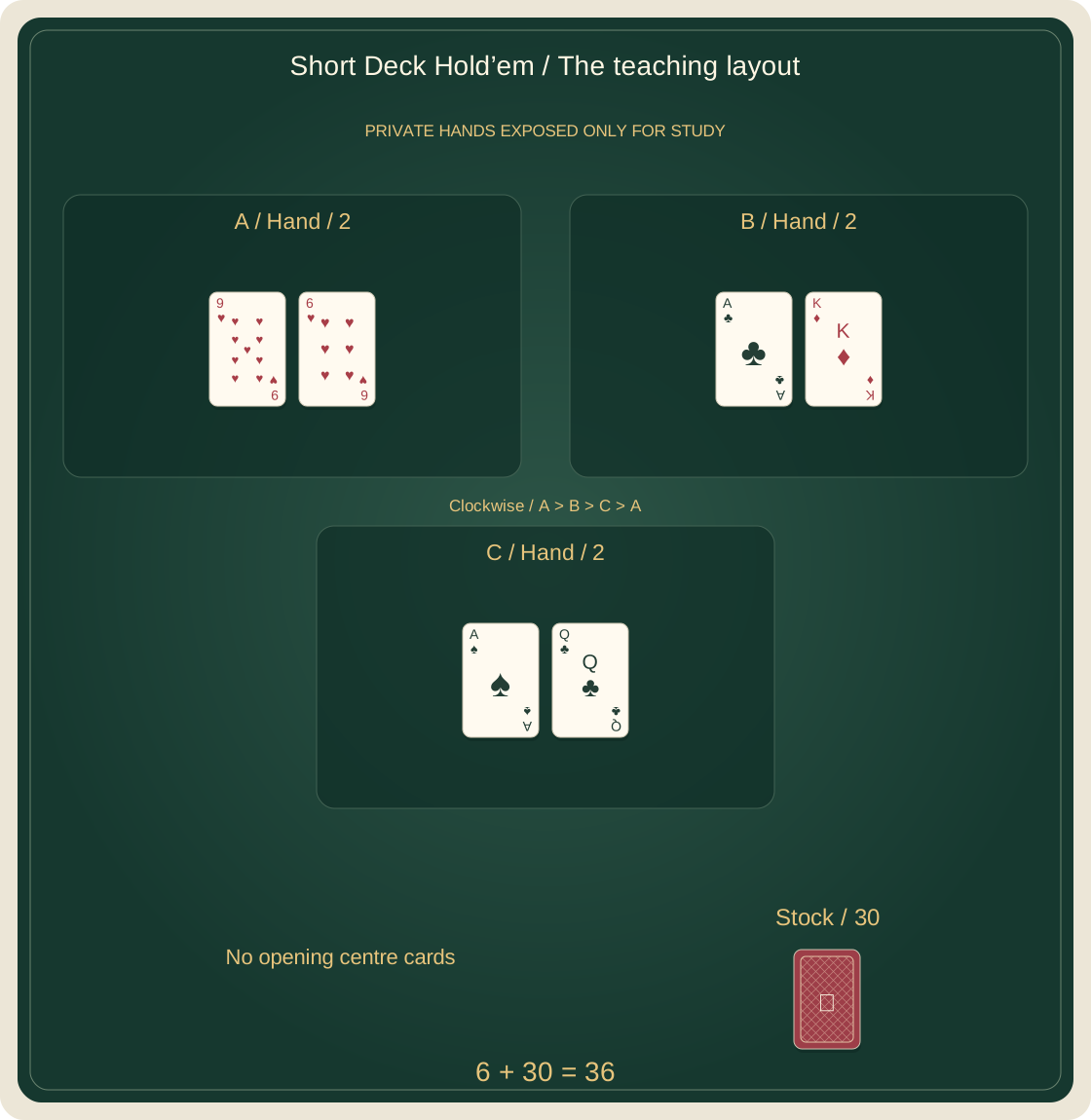
Player A
9♥ 6♥
Player B
A♣ K♦
Player C
A♠ Q♣
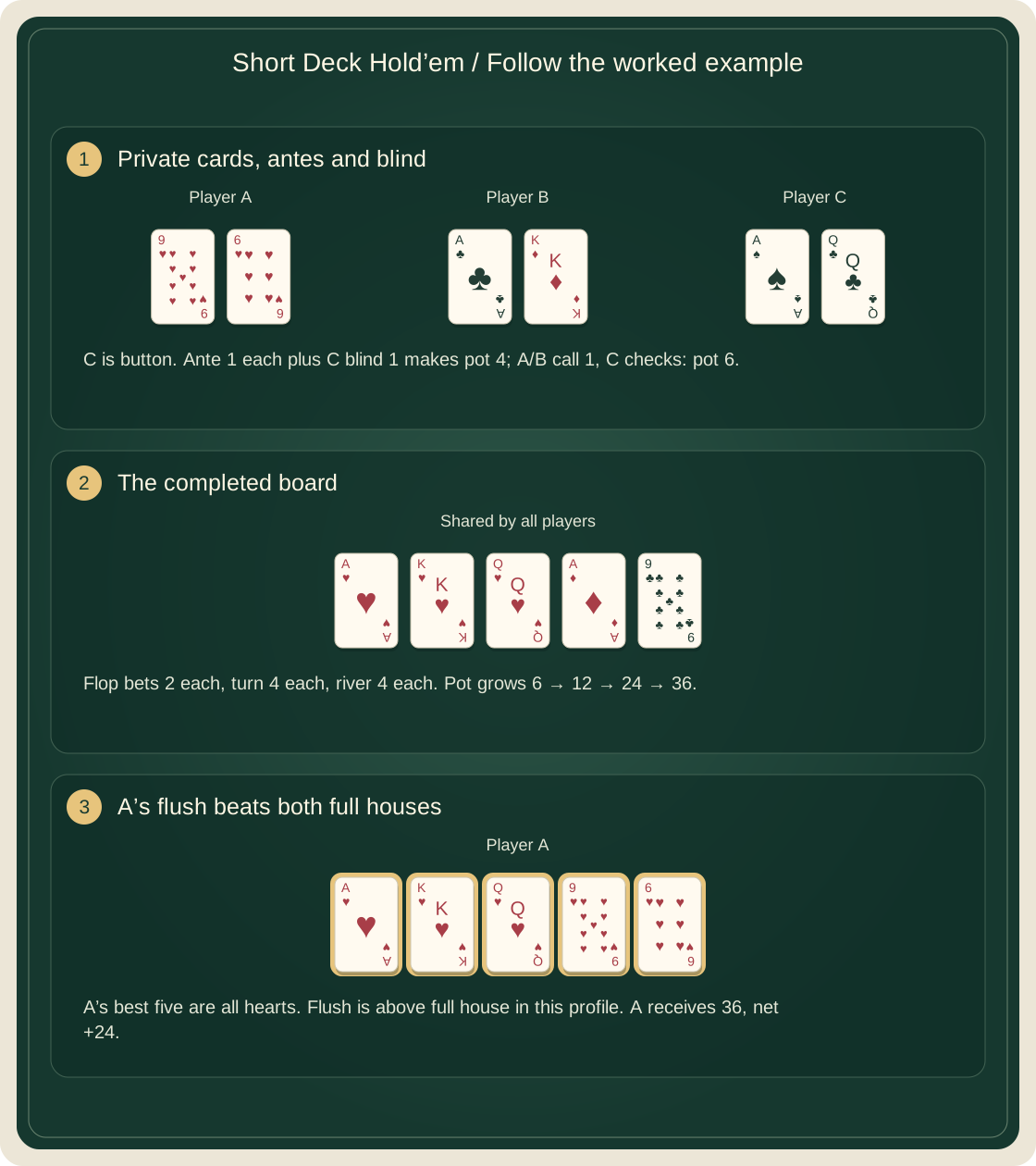
C is button. Each antes 1, C posts blind 1: pot 4. A and B call 1, C checks: pot 6. Flop A♥ K♥ Q♥: A bets 2 and both call, pot 12. Turn A♦: A bets 4 and both call, pot 24. River 9♣: A bets 4 and both call, pot 36. Three burns are 6♠, 7♠, 8♠.
← On a small screen, scroll the diagram horizontally. →
10 /
Why the flush wins
Player A
A♥ K♥ Q♥ 9♥ 6♥
Player B
A♥ A♦ A♣ K♥ K♦
Player C
A♥ A♦ A♠ Q♥ Q♣
A wins with an ace-high flush, ahead of B’s aces full of kings and C’s aces full of queens. Each invested 12; A receives 36 for net +24, B and C net −12. Six private cards, five board cards, three burns and 22 undealt cards account for all 36. The pair on the board does not change the flush-above-full-house rule.
11 /
When the round and match end
Award the pot to the last player not folded, or compare best five at showdown after river betting. Equal hands share; extra private cards are not kickers. Return uncalled excess and settle each side pot separately. Shuffle all cards and pass the button for the next hand. This example has no house deduction; if a table charges one, record it separately rather than silently reducing the winner’s teaching total.
12 /
Check your understanding
Does A–6–7–8–9 beat 6–7–8–9–10?
Reveal the answer
No. Nine-high loses to ten-high.
Does a straight beat trips here?
Reveal the answer
Yes. This chosen profile keeps that ordinary order. Another Short Deck profile may reverse it.
13 /
History and other versions
Short Deck became associated with Asian high-stakes poker and later reached a wider online audience. PokerStars introduced its six-handed 6+ game in 2019. That is a documented product launch, not a claim that the company invented every short-deck game. The main variation worth checking is trips versus straight; blind and ante structures also vary.
Common questions
Do I need branded cards?+
Use 36 ordinary cards: 6 through ace in all four suits. Remove 2–5 and jokers from a normal 52-card pack; no special deck is required.
Can I use the board alone?+
Yes. Use the best five of seven, with no required number of private cards.
Is every Short Deck ranking identical?+
No. Declare straight versus trips and the betting structure before play.