← On a small screen, scroll the diagram horizontally. →
01 /
Your first round
Post antes, deal two down and one up, then bet. Deal another up card and bet three times, reaching six cards. Deal the seventh down and bet once more. At showdown select any five of your seven. Remember the exposed folded cards: those cards can no longer complete your draw.
02 /
Cards, seats and the deal
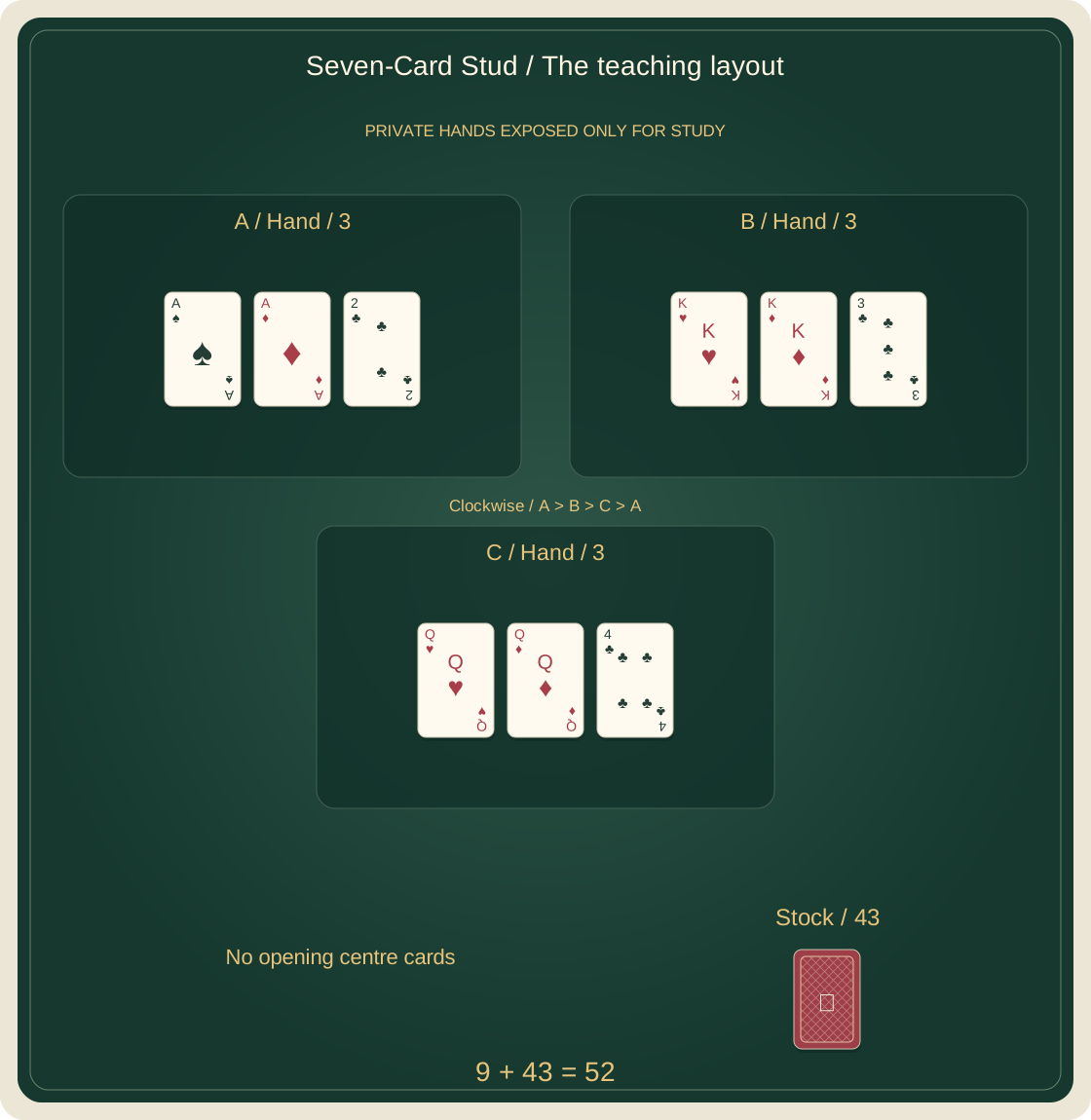
Shuffle 52 cards without jokers. After everyone antes, deal clockwise from dealer’s left, one card at a time: two face down, then one face up per player. A live dealer burns one card before each of fourth, fifth, sixth and seventh streets. A burn is not a community card. Each player receives only the cards of a street before its betting begins, never all seven at the start.
03 /
What happens on your turn
On third street the lowest door card must bring in, aces high; equal ranks use clubs, diamonds, hearts, spades from low to high. Here the bring-in is 1, or its holder may complete to 2 immediately. Another player may complete 1 to 2; that completion is not a full raise. Later streets begin with the highest visible poker board; ignore incomplete straights and flushes. Equal boards act first clockwise from dealer’s left.
04 /
Fixed limits and the open pair
Bet and raise in units of 2 on third and fourth streets, 4 on fifth through seventh. Fourth-street exception: if anyone shows a pair, a bet or raise may use 4; once the larger increment is used, keep it for that street. This guide caps a round at one full bet plus three raises, including heads-up as a declared table rule. The ante is dead money, not credit toward a call.
05 /
Hand strength, highest first
| Order | Combination |
|---|---|
| 1 | Straight flush |
| 2 | Four of a kind |
| 3 | Full house |
| 4 | Flush |
| 5 | Straight |
| 6 | Three of a kind |
| 7 | Two pair |
| 8 | One pair |
| 9 | High card |
06 /
Comparing hands and ties
A straight flush is five consecutive cards of one suit; the highest is the royal flush, 10–J–Q–K–A. Four equal ranks form quads; three plus a pair form a full house. A flush needs five of one suit, a straight five consecutive ranks. Compare the made rank first: trip rank before pair in a full house, higher pair before lower pair in two pair. Then compare remaining kickers highest first. Equal best five-card hands split the pot; suits never break a showdown tie.
07 /
Checks, calls, raises and folds
Check passes when nothing is owed. Bet opens a betting round. Call pays the difference to the current wager; raise increases that wager; fold gives up the hand and all chips already committed. Continue clockwise until every active player has responded to the last full raise and matched the wager or is all-in. A lone remaining player wins without showing. Use counters for practice and agree the stakes, minimum chips and split-pot odd-chip rule before dealing.
08 /
All-in and side pots
A player who runs out of chips stays eligible only for the portion matched by each opponent. Separate later contributions into side pots and compare only eligible hands in each. Return an unmatched excess. Example: contributions 5, 12, 12 create a main pot of 15 for all and a side pot of 14 for the last two. Winning the main pot does not win the side pot automatically. A short all-in below a full raise does not reopen raising for someone who has already acted.
09 /
A complete worked example
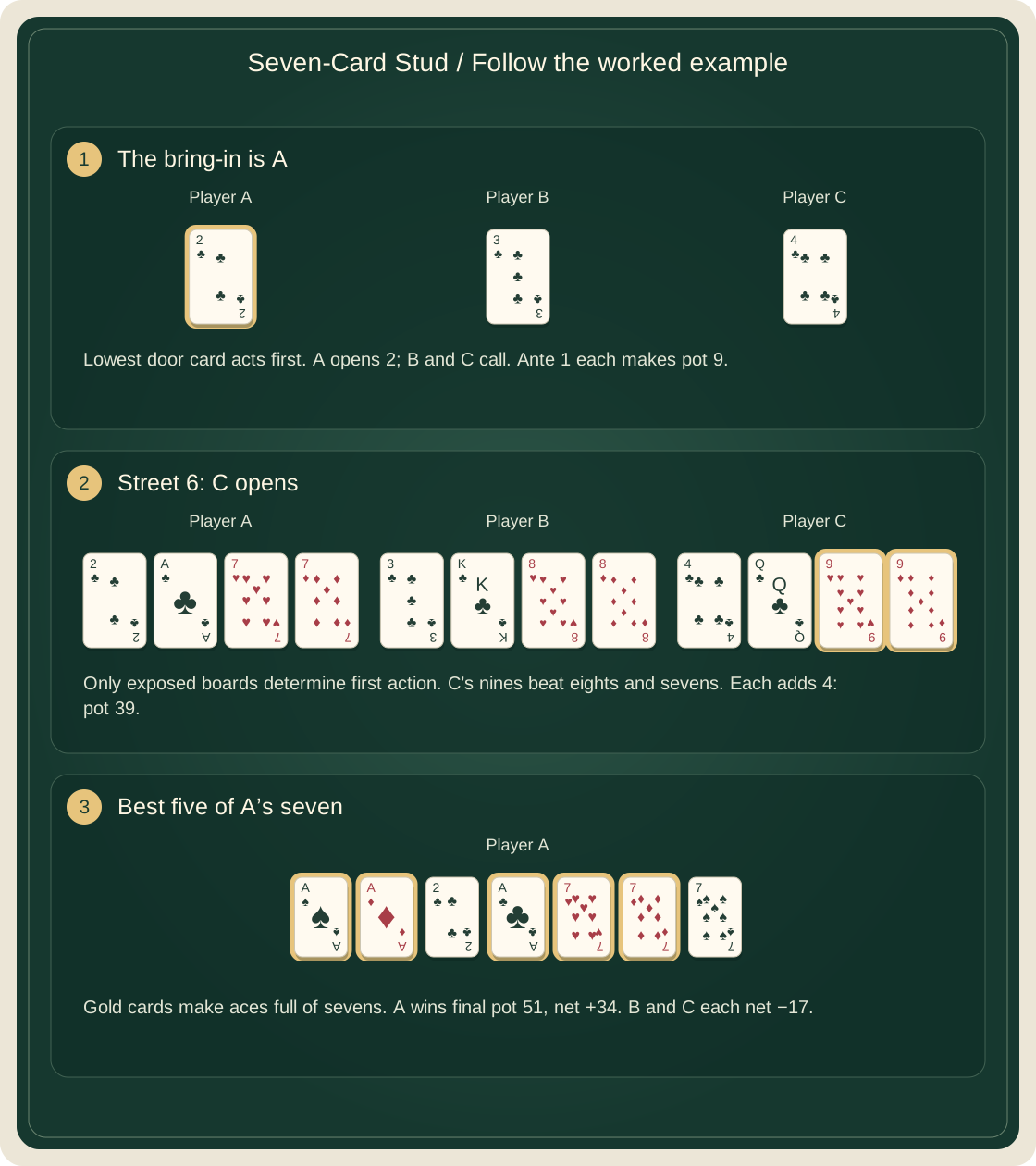
A, B and C each ante 1: pot 3. The diagram exposes private cards only for study. A has the lowest door card, 2♣, and opens a full 2. Everyone calls every street; no raises or folds occur. The table records the full hand, not an estimate of future results.
| Street | First | Each adds | Pot |
|---|---|---|---|
| 3 | A | 2 | 9 |
| 4 | A | 2 | 15 |
| 5 | A | 4 | 27 |
| 6 | C | 4 | 39 |
| 7 | C | 4 | 51 |
← On a small screen, scroll the diagram horizontally. →
10 /
Showdown and exact settlement
Player A
A♠ A♦ 2♣ A♣ 7♥ 7♦ 7♠
Player B
K♥ K♦ 3♣ K♣ 8♥ 8♦ 8♠
Player C
Q♥ Q♦ 4♣ Q♣ 9♥ 9♦ 9♠
A’s best five are three aces and two sevens; B has kings full of eights, C queens full of nines. A wins 51, net +34 after contributing 17; B and C each lose 17. C acts first on streets 6 and 7 because its exposed pair of nines beats the other exposed pairs. All 21 player cards plus 4 burns leave 27 undealt cards. A–2–3–4–5 is the lowest straight in this full-deck game.
11 /
When the round and match end
A hand ends when everyone but one folds, or after final betting and showdown. All-in players still receive their remaining cards. At a crowded table, if separate seventh cards cannot be supplied, use one face-up community seventh card for everyone still in. Burns may be reused only under the agreed live shortage procedure; folded hands must not become a new stock. Pass the dealer position for the next hand.
12 /
Check your understanding
An exposed pair appears on street 4. Must the big limit be used?
Reveal the answer
No. It becomes an option; once used, it remains for that street. From street 5 it is mandatory.
Do spades win a tied showdown?
Reveal the answer
No. Suit order assigns the bring-in only; equal best five-card hands split.
13 /
History and other versions
Seven-Card Stud was a major American cardroom game before the Hold’em boom. The WSOP records its tournament debut in 1973. Its later relatives include split-pot Stud Hi/Lo and low-only Razz. Remembering dead cards and interpreting exposed boards remain its distinguishing skills; those features matter more than knowing one precise inventor, which is not securely established here.
Common questions
Are all seven cards used?+
No. Only your best five count.
Is there a shared flop?+
No. Each player has individual cards; a common seventh is only a shortage exception.
Who opens fourth street?+
The strongest visible board, not necessarily the third-street bring-in.