← On a small screen, scroll the diagram horizontally. →
01 /
Your first round
Everyone antes. Receive two hidden cards and one visible door card. The highest door card pays the bring-in or completes to the small bet. After betting, deal three more visible cards one at a time, then a final hidden card, with betting after each street. Surviving players show their best five-card low; the lowest takes the whole pot. Folding opponents lets the last survivor win without showing.
02 /
The rules used here
Learning table: ante 1, bring-in 1, small bet 2, big bet 4, no rake. Allow one full bet plus three full raises per street; completing the bring-in is the first full bet, not a raise. No double-sized option for an exposed pair on fourth street. Play a set number of dealer circuits or stop between hands. These counters are a teaching scale, not a universal casino structure.
03 /
Cards, seats and the deal
Use one ordinary pack without jokers and rotate the dealer button. Shuffle and cut, collect antes, then deal clockwise in three passes: hidden, hidden, visible. Deal only to players still in the hand on later streets, burning one card before each new street. The final arrangement is two hidden, four visible, one hidden. With too few cards for individual seventh cards, burn if possible and place one face-up community card for all remaining players instead.
04 /
What happens on your turn
On third street, rank the door card high with ace low; equal highest cards use spades, hearts, diamonds, clubs from high to low. Action starts clockwise after the bring-in. On fourth and later streets, the lowest exposed poker hand acts first; a paired board loses to an unpaired board. Equal boards use the first seat clockwise from the dealer. Fourth street uses the small bet; fifth through seventh use the big bet. The visible board, not hidden cards, decides who starts.
05 /
Betting, folds and all-in
Check only when no wager is outstanding. Facing a bet, fold, call the amount owed or raise by the street’s fixed increment. Continue until all non-folded players have matched the wager or are all-in. A short all-in does not by itself reopen raising; use full-raise rules. Separate side pots by contributions, with folded money retained but folded players ineligible. Return an unmatched last wager. Never ask an all-in player to pay again.
06 /
Scoring and settlement
Choose any five of your seven. Unpaired hands beat paired hands; among unpaired hands compare the highest rank, then the next, all the way down. Thus 7–5–4–3–A beats 7–6–3–2–A. For paired hands, ordinary matching categories apply in reverse desirability: one pair beats two pairs, then trips, full house, quads. Within a category lower ranks win, then lower kickers. Straights and flushes never create a category. The wheel 5–4–3–2–A is best; no eight-low qualifier is needed. Equal rank values split; suits never break a showdown tie.
07 /
A complete worked example
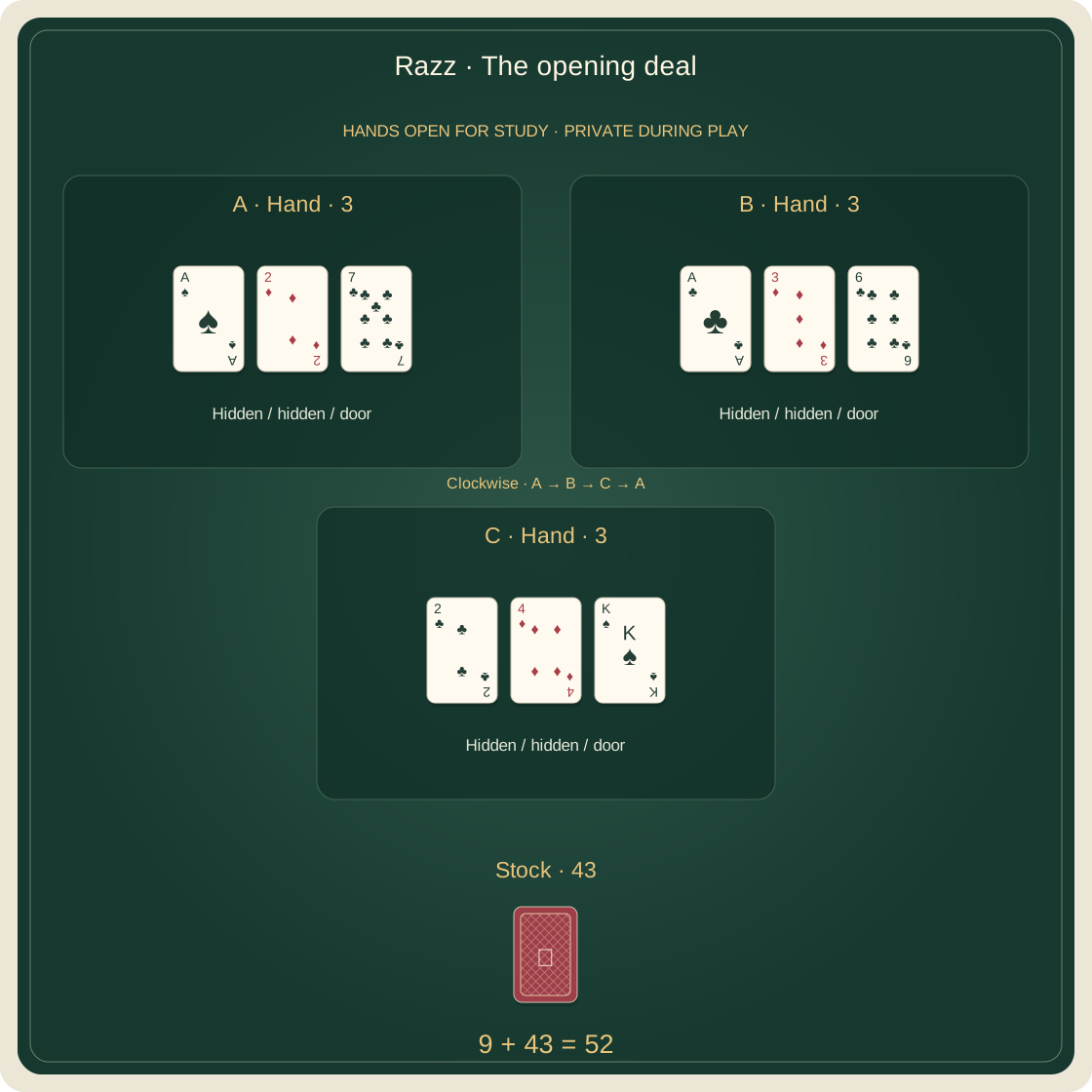
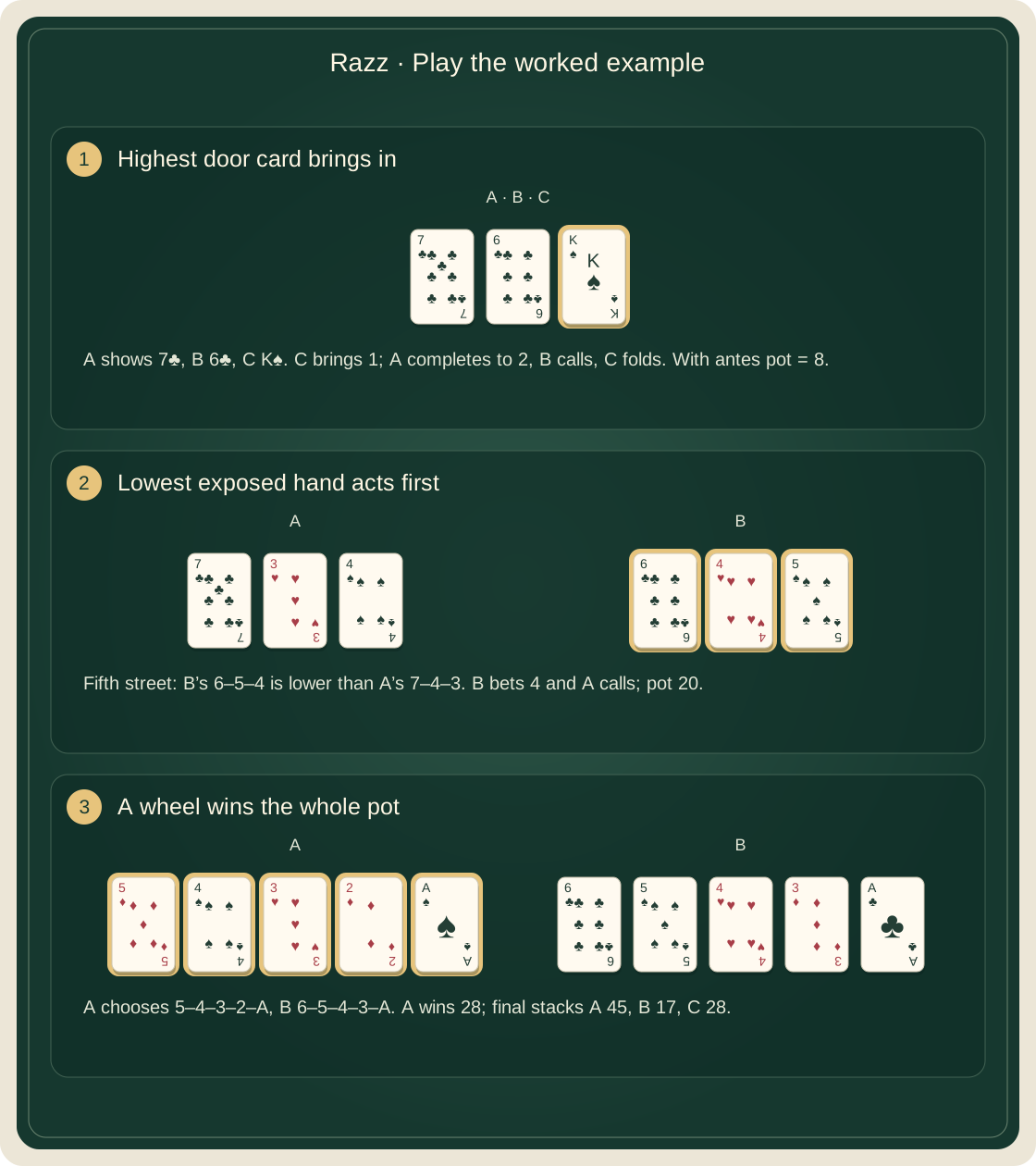
Three stacks start at 30. A has A♠ 2♦ / 7♣, B A♣ 3♦ / 6♣, C 2♣ 4♦ / K♠. Antes make 3. C brings 1; A completes to 2, B calls 2, C folds: pot 8. Fourth cards A 3♥, B 4♥: B bets 2, A calls, pot 12. Fifth A 4♠, B 5♠: B bets 4, A calls, pot 20. Sixth A K♥, B Q♥: both check. River A 5♦, B 8♦: B checks, A bets 4, B calls, pot 28. A’s wheel beats B’s 6–5–4–3–A. Contributions A 13, B 13, C 2; final stacks 45, 17, 28 conserve 90. Four burn cards and folded cards stay dead.
← On a small screen, scroll the diagram horizontally. →
08 /
Check your understanding
Does A–2–3–4–5 of one suit lose because it is a straight flush?
Reveal the answer
No. Straights and flushes are ignored; this is the best low.
A pair of low cards or an unpaired king-low: which wins?
Reveal the answer
The unpaired hand wins. Avoiding a pair matters before comparing high cards.
09 /
History and other versions
Razz developed within the American stud-lowball tradition. It appears as the low-only stud discipline in mixed-game rotations such as HORSE. Do not confuse it with stud high-low, where the pot can split, or deuce-to-seven lowball, where aces, straights and flushes behave differently. The familiar name describes a rule family, not evidence of a single documented inventor.
10 /
Mistakes to avoid
Read a low from the top down, not by adding card values. Watch folded low cards: an apparently useful draw may already be dead. Keep track of whose board is best on each street rather than letting the same person act first throughout. A bad river card need not enter your chosen five, but pairing an exposed low card can change both your prospects and the visible action order.
11 /
When the round and match end
At showdown the last bettor or raiser shows first, then clockwise. If the last street checked through, use the first surviving seat clockwise from the dealer. Award each eligible pot separately. Divide equal lows equally; for an indivisible odd teaching counter use the first tied seat clockwise from the dealer. Clear the cards only after the award has been checked.
Common questions
Is there an eight-low qualifier?+
No. The best available low wins even if it contains a king or a pair.
Do suits decide the winner?+
Only for equal door cards when assigning the bring-in. Equal showdown ranks split the pot.
Can the river be discarded and redrawn?+
No. Razz is stud, not draw poker. Select the best five from the cards actually dealt.