← On a small screen, scroll the diagram horizontally. →
01 /
Your first round
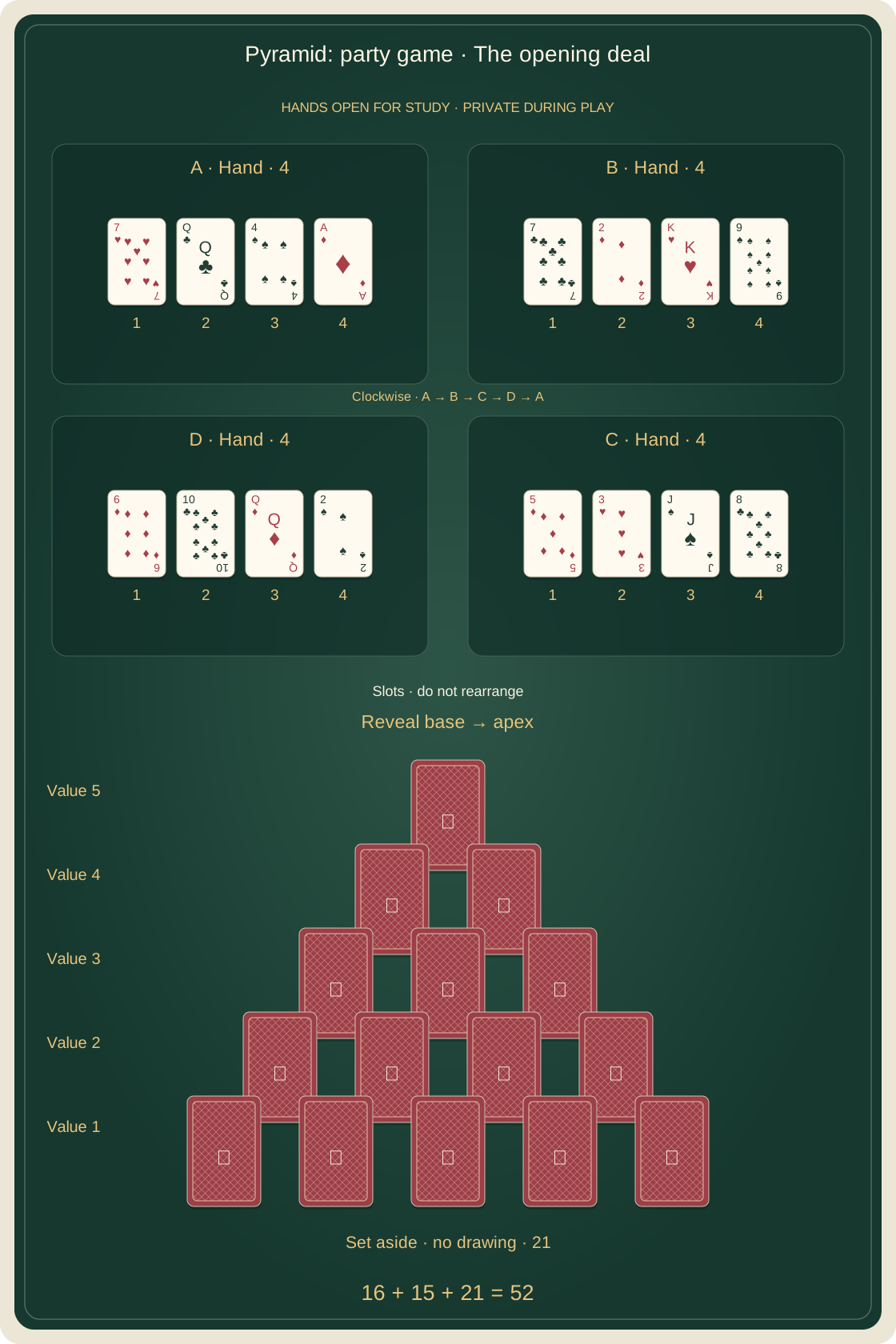
Lay 15 face-down cards as rows of 5, 4, 3, 2, 1 from base to apex. Deal 4 private cards each and memorize them once. Reveal base left to right, then work upward. Row values are 1, 2, 3, 4, 5. Match rank only; suits and rank strength do not matter.
02 /
Cards, seats and the deal
Use one 52-card pack, no jokers. At 4 players, 16 hand cards plus pyramid 15 leaves 21 unused, never drawn. Choose dealer randomly; dealer manages flips. Put memorized cards in four fixed slots; do not reorder or peek again. In the diagram only, hands are opened for study, while pyramid backs remain hidden.
03 /
What happens on your turn
For each revealed card, offer every player a claim or pass, starting left of dealer clockwise. A claim names one still-hidden slot and another player as recipient. You may tell the truth or bluff, but may claim only once on that flip. Resolve each claim before the next. More than one player may independently claim the same rank. No hidden slots left means no further claims, but you remain a possible recipient.
04 /
Accept or challenge before scoring
Without a challenge, recipient adds the row value and no card is shown or removed. If challenged, reveal ONLY the named slot. Matching rank: caller adds double row value and claimant removes that correct card permanently. Wrong rank: claimant adds double, recipient adds nothing, revealed card returns face down. No replacement. The doubled penalty replaces the ordinary one; do not charge both.
05 /
Scoring and settlement
Record penalties, not wins per card. At the top, an unchallenged claim costs 5; a resolved challenge costs 10 to exactly one player. Independent claims each score separately. No automatic penalty for a flip with no claims. Scores are not zero-sum: tokens are simply added to the penalized player’s tally. A public running sheet avoids repeated counting.
06 /
When the round and match end
Resolve every claim on the apex, then stop. Lowest penalty total wins our points version; equal lowest share victory. Do not add an unannounced memory recital or extra punishment to decide a tie. Shuffle all cards before another game and choose a new dealer. This is a finite party round, not a knockout game based on empty hands.
07 /
A complete worked example
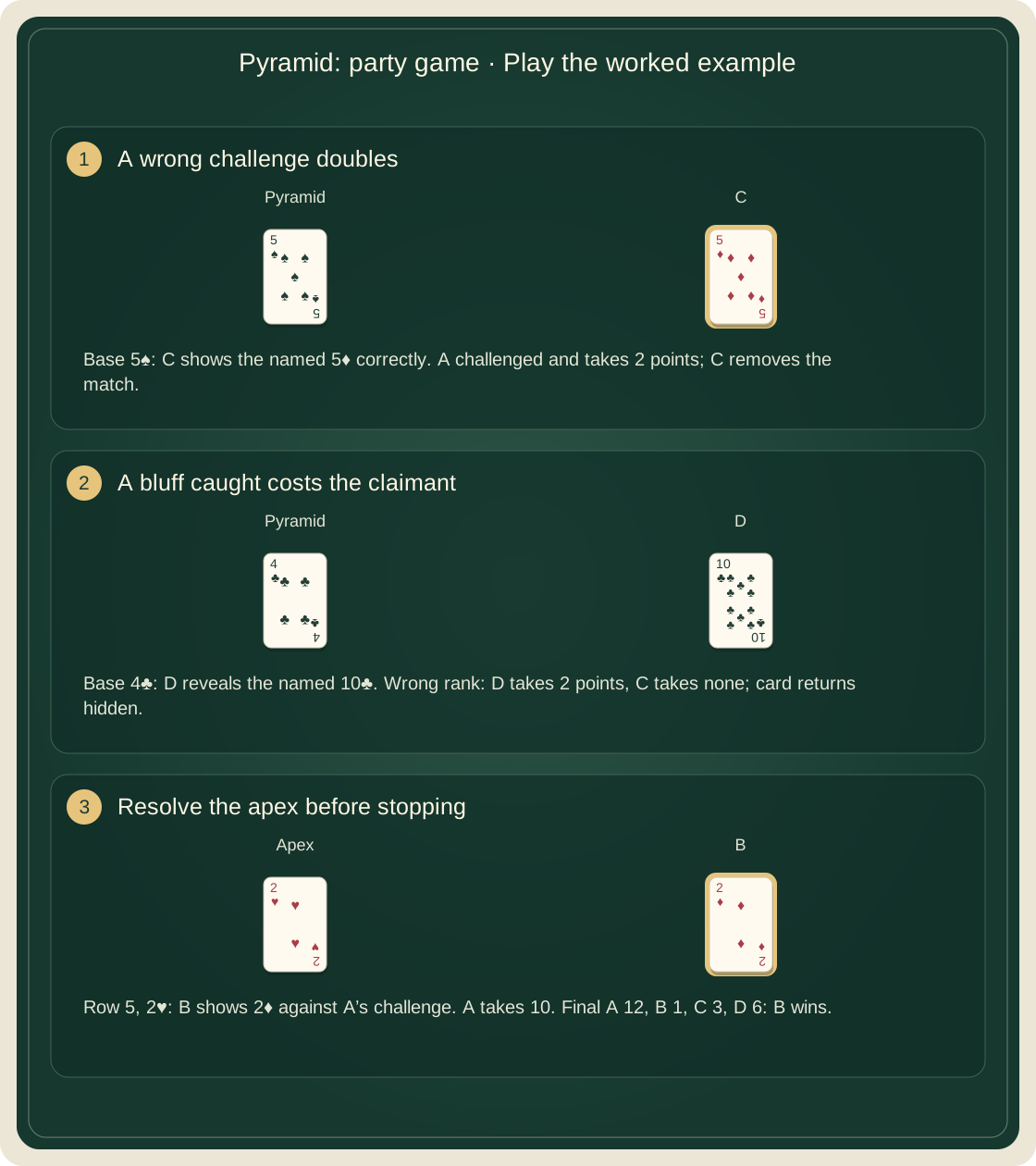
Four-player open-hand lesson, D deals. Initial hidden slots are listed left to right below. All unlisted flips have no claims. Base 7♠: A claims 7♥ against B, accepted, B +1. Base 5♠: C names 5♦ against A; A challenges, C reveals correctly and removes it, A +2. Base 4♣: D names 10♣ against C; C challenges, D is wrong, D +2 and keeps the card.
Player A
7♥ Q♣ 4♠ A♦
Player B
7♣ 2♦ K♥ 9♠
Player C
5♦ 3♥ J♠ 8♣
Player D
6♦ 10♣ Q♦ 2♠
← On a small screen, scroll the diagram horizontally. →
08 /
Later rows and final score
Row 2 Q♠: A names Q♣ against D, correctly challenged; A removes Q♣, D +4. Row 3 A♣: A names A♦ against C without challenge, C +3. Apex 2♥, row 5: B names 2♦ against A; A challenges incorrectly, B removes the match, A +10. Final A 12, B 1, C 3, D 6: B wins. Hands now have 3, 3, 3, 4 cards, with 3 correct revealed matches removed.
09 /
History and other versions
Pyramid is a modern social-game name with many local rules; the sources do not establish one inventor or precise date. Other versions use six rows, replace revealed hand cards, begin at the apex or add a final memory test. Those changes affect both deck arithmetic and scoring. They are separate profiles, not missing stages in this five-row game.
10 /
Check your understanding
Do I add ordinary and doubled penalties?
Reveal the answer
No. The challenge replaces the ordinary assignment.
Does a wrong revealed card leave my hand?
Reveal the answer
No, it returns face down in its original slot in this profile.
11 /
Mistakes to avoid
Do not refill hands from the unused pack, show a different slot after being challenged or claim again on the same flip. Keep revealed pyramid cards distinct from removed hand matches. A recipient with no hidden cards still receives penalties normally. The example exposes memory cards solely for explanation, not as permission to peek in real play.
Common questions
Are drinks required?+
No. This guide uses penalty points only.
Is this the solitaire?+
No. This is the multiplayer memory-and-bluff game.
Do shown matches return?+
No. Correct challenged matches are permanently removed without replacement.