← On a small screen, scroll the diagram horizontally. →
01 /
Your first round
Choose dealer and agree the stake before play. Deal 2 private cards each; exchange and vie in the first phase. After an actual bet is matched by all remaining players, deal 2 more each. More exchanges and bets follow. A rest closes betting; compare the remaining four-card hands, category first and points within category.
02 /
Card values
Suits have no precedence. The card values are neither poker ranks nor blackjack values. Add only the cards required by the hand category; a point hand counts its best two- or three-card suit, not all four cards.
| Card | Points |
|---|---|
| A | 16 |
| 2 | 12 |
| 3 | 13 |
| 4 | 14 |
| 5 | 15 |
| 6 | 18 |
| 7 | 21 |
| J / Q / K | 10 |
03 /
Card order and categories
Strongest first in the table. A chorus requires the same rank, not just four equal point values. Supremus is specifically A–6–7 of one suit plus an off-suit fourth card. If all four are that suit, it is instead fluxus. In a tie within category compare its total; exact equality goes to the eldest active hand.
| Category | Requirement |
|---|---|
| Chorus | Four equal ranks |
| Fluxus | All four in one suit |
| Supremus | Same-suit A–6–7: 55 |
| Primero | One card of each suit |
| Point / Numerus | Best suit of two or three |
04 /
Cards, seats and the deal
Use 40 cards without 8s, 9s, 10s or jokers. Play individually. Dealer gives 2 face down to each clockwise; left neighbour acts first in both phases. Replace discards immediately with the same number of stock cards, preserving hand size. Discards stay separate. Choose first dealer randomly and rotate left after each deal.
05 /
What happens on your turn
Vie opens a bet or raises the current total by stake 1. See pays the difference; after seeing you may revie by 1. Fold leaves all your committed counters behind. Pass allows an exchange without matching yet, but only once after the latest vie: next time answer by seeing or folding. Once you have matched, exchanging is optional; here even an unmatched pass may exchange 0 cards, as in the English reconstruction.
06 /
Forced seeing and the final rest
If a vie reaches the last opponent and nobody else has seen it, that last opponent must see rather than fold or pass. Phase 1 ends only after a vie is matched by every survivor. Deal 2 more to each survivor. In phase 2, ordinary matched vies do not end play; someone must rest. A rest adds 3 above the current matched total and cannot be raised. Others may see, pass once to exchange, or fold, subject to the last-opponent rule. When resolved, show all four cards.
07 /
When the round and match end
A full circuit with no vie in phase 2 is swigging: redeal, leaving counters for the next hand. We use the same agreement for an unbet first phase. If stock runs out, shuffle older discards; if a required replacement is still impossible, cancel that deal and carry the pot. No private hand is recycled. Table stakes limit winnings to matched contributions; excess forms side pots for eligible hands. Our practice ends after a dealer circuit: largest stack wins, equal leaders tie, leftover unclaimed pot split equally.
08 /
A complete worked example
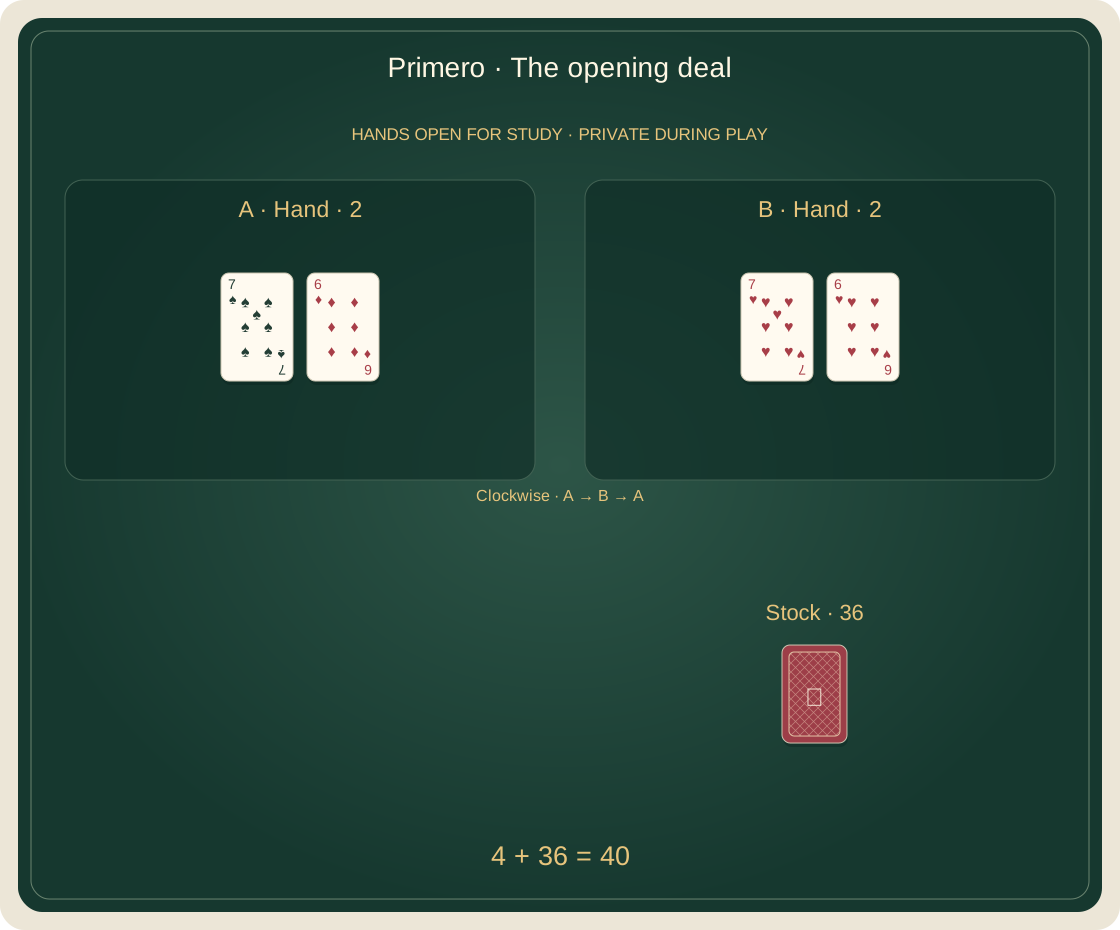
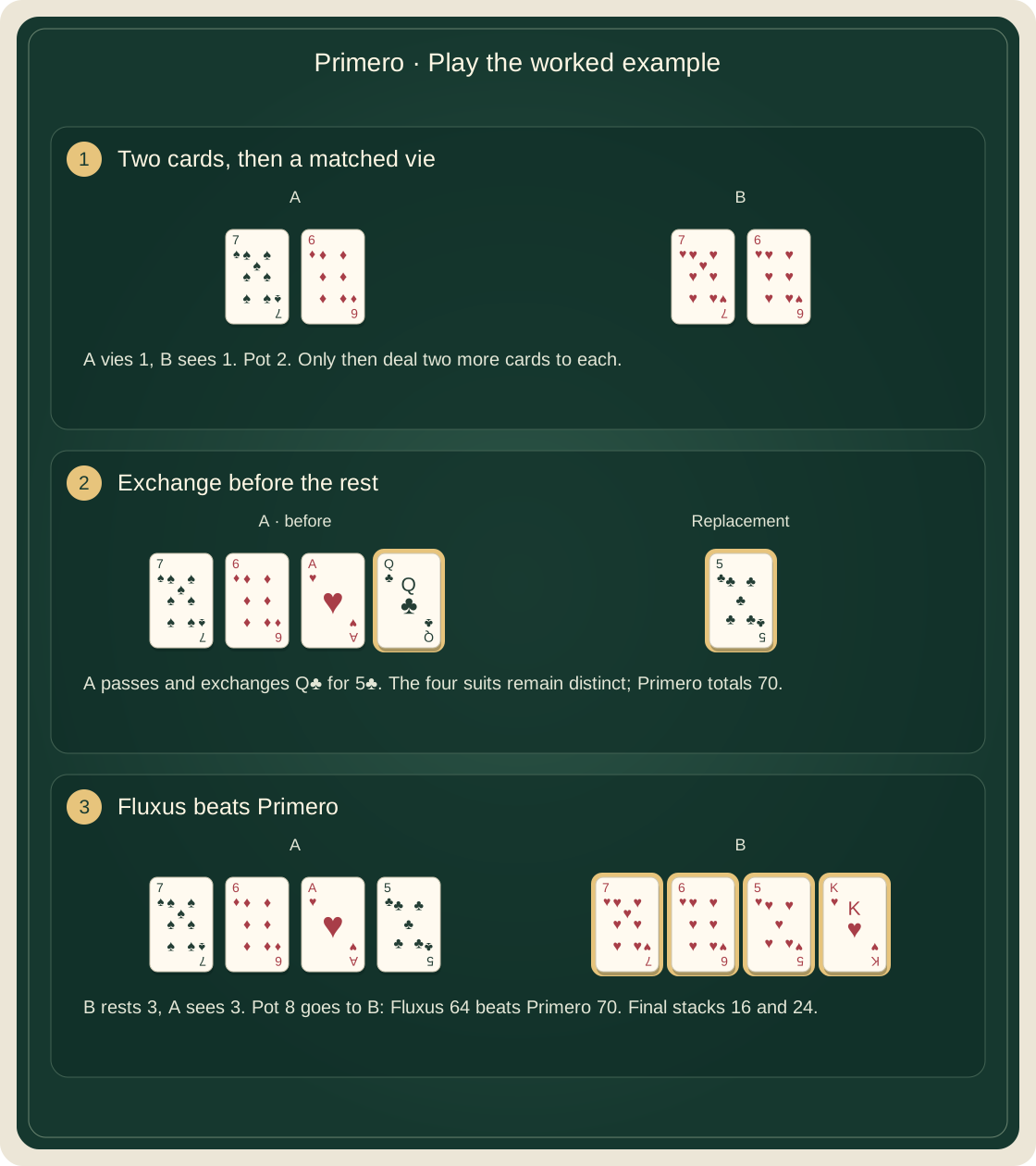
Two-player lesson, B deals, A starts; each has 20 counters. Open hands only for study. A vies 1, B sees 1 without exchange: pot 2. The second deal gives A A♥ Q♣ and B 5♥ K♥. A passes and exchanges Q♣ for 5♣, preserving four cards. B rests 3; A sees 3: pot 8.
Player A
7♠ 6♦
Player B
7♥ 6♥
← On a small screen, scroll the diagram horizontally. →
09 /
Category beats the larger total
A has 7♠ 6♦ A♥ 5♣: Primero, 21 + 18 + 16 + 15 = 70. B has 7♥ 6♥ 5♥ K♥: Fluxus, 21 + 18 + 15 + 10 = 64. B wins despite the lower sum. Both contributed 4; final stacks A 16, B 24, total 40. The discarded Q♣ and 31 unused stock cards are not part of either hand.
10 /
History and other versions
Primero was widely known across Renaissance Europe, with references in Italy, Spain, France and England. Du Coeur compares Cardano, Florio and Minsheu and labels his work a reconstruction. Italian declaration rules and partial refunds on folding are not imported into this English profile. Resemblance to poker does not prove a direct ancestral chain.
11 /
Check your understanding
Can I raise a rest?
Reveal the answer
No. It is the closing bet in this reconstruction.
Does the highest sum always win?
Reveal the answer
No. Compare categories first, then the relevant points.
12 /
Mistakes to avoid
Do not use five-card poker combinations, treat all coats as one rank for chorus, count off-suit cards in a point hand or let a folded hand return. Keep cards private during real play. English Primero does not require claiming a hand category aloud; those bidding declarations belong to a different reconstruction.
Common questions
How many cards form the final hand?+
Four, after the second deal and any exchanges.
Is a special deck needed?+
Remove 8, 9 and 10 from every suit of an ordinary pack: 40 cards, no jokers. Special historical cards are optional.
Is this the uniquely original rulebook?+
No. It is a named English reconstruction with explicit table agreements.