← On a small screen, scroll the diagram horizontally. →
01 /
Your first round
Choose the variant, limits and starting stacks before dealing. Play clockwise. Chips committed to the pot cannot be reclaimed by folding. Win either when all opponents fold, without showing, or at showdown with the best eligible hand. Our lesson uses play chips only, no monetary stakes.
02 /
Poker hand rankings
Strongest category first. Every example below is separate, not one physical deal. A royal flush is simply the ace-high straight flush. A may be low only in A–2–3–4–5, which loses to 2–3–4–5–6. K–A–2–3–4 is never a straight. All suits are equal.
| Hand | Example |
|---|---|
| Straight flush | 9♥ 10♥ J♥ Q♥ K♥ |
| Four of a kind | 9♠ 9♥ 9♣ 9♦ A♠ |
| Full house | K♠ K♥ K♣ 2♦ 2♠ |
| Flush | A♥ J♥ 8♥ 5♥ 2♥ |
| Straight | 9♠ 10♣ J♦ Q♥ K♠ |
| Three of a kind | 7♠ 7♥ 7♦ A♠ Q♣ |
| Two pair | J♠ J♥ 4♣ 4♦ A♠ |
| One pair | Q♠ Q♥ A♠ 9♦ 3♣ |
| High card | A♠ K♦ 9♣ 6♥ 2♠ |
03 /
Breaking ties without suit rankings
Same category: compare the repeated group first, then remaining kickers highest downward. Two pair compares higher pair, lower pair, kicker; full house compares triple, then pair. Straights compare top card; flushes and high cards compare all five in descending order. Identical five-card strength splits the pot. No sixth-card tiebreak. Agree odd-chip handling before play; our lesson gives it to the first tied winner left of dealer.
04 /
What happens on your turn
Check only if nothing is owed. Bet opens an unbet round. Call pays the difference owed; raise increases the total others must match; fold abandons the hand and its committed chips. Act only in turn. A round closes after all nonfolded, non-all-in players have matched and responded, or all check. An ante does not count towards the later bet; a blind normally does.
05 /
Limits, table stakes and side pots
Fixed-limit fixes bet increments; no-limit allows any legal raise up to stack; pot-limit restricts it by pot size. Standard table stakes forbid adding chips during a hand. A short call puts you all-in, eligible only for matched contributions. Separate excess into side pots; folded chips remain, but folded hands cannot win. Example: totals 20, 50, 50 create main 60 for all three and side 60 for only the latter two. Return unmatched excess; it is not a side pot.
06 /
Cards, seats and the deal
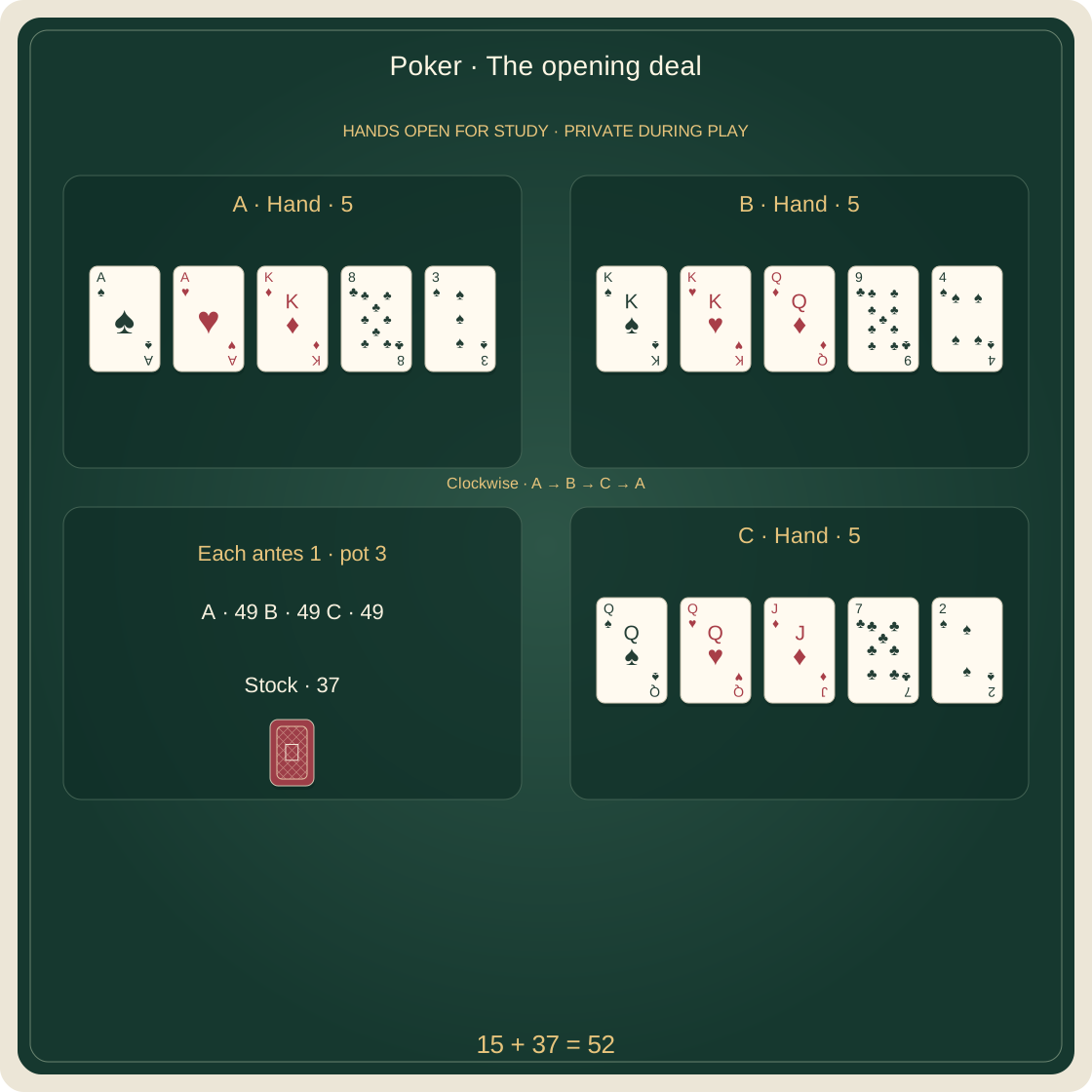
Teaching draw format: 3 players clockwise, C deals, A acts first in both betting rounds. Each starts 50 and antes 1. Deal 5 private cards each from 52, no jokers. Bet in units of 2. Even after everyone checks, continue to the draw in this lesson. Then A, B, C may discard 0–3 and receive the same number from stock; discards stay out, no burn in this lesson. Bet again in units of 4, then showdown. One opening bet plus one raise maximum per round.
07 /
A complete worked example
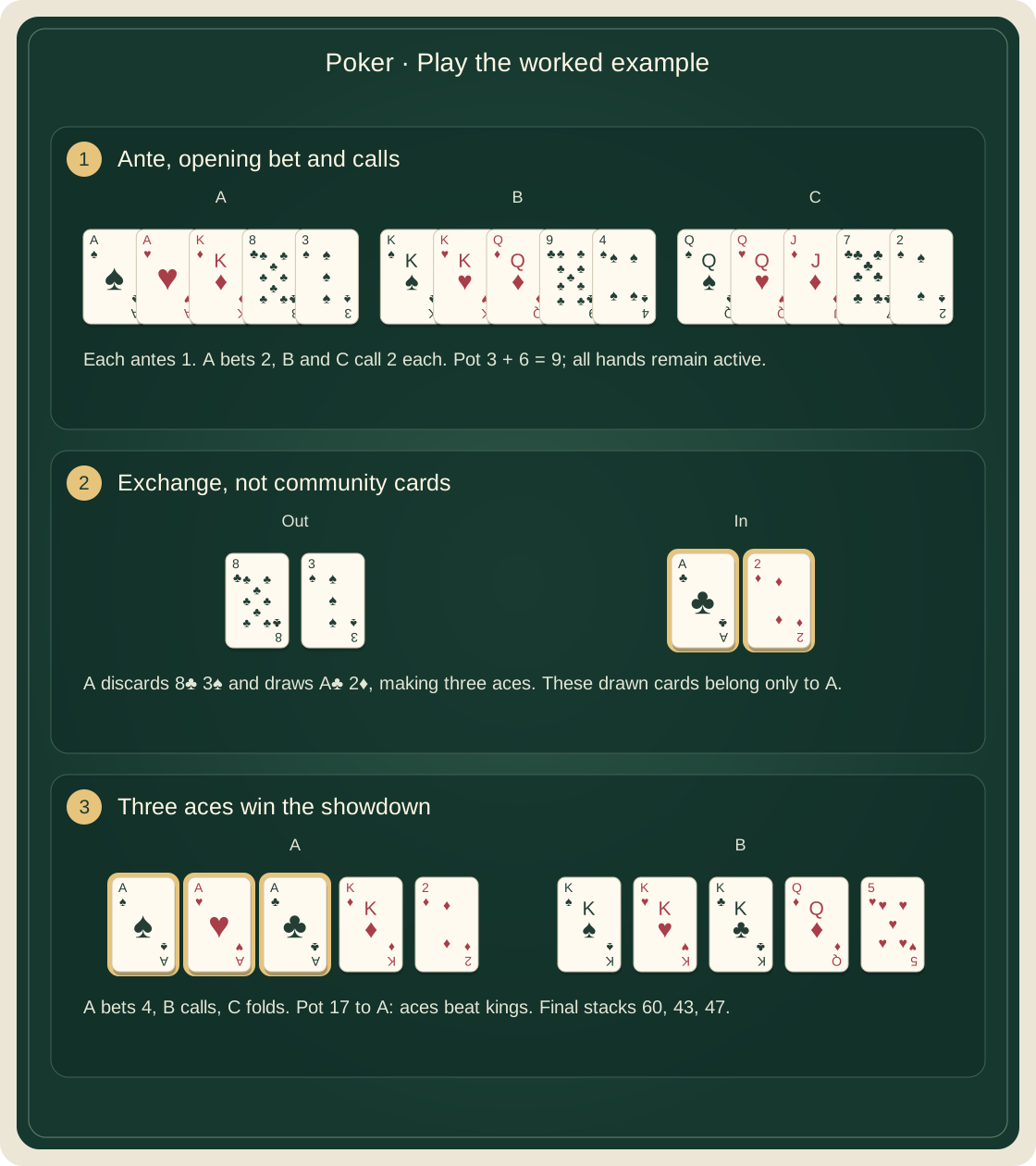
Open for study only. After antes, A bets 2, B and C call: pot 9. A discards 8♣ 3♠, draws A♣ 2♦. B discards 9♣ 4♠, draws K♣ 5♥. C discards J♦ 7♣ 2♠, draws Q♣ J♥ 10♥. Everyone still has 5; stock now has 30.
Player A
A♠ A♥ K♦ 8♣ 3♠
Player B
K♠ K♥ Q♦ 9♣ 4♠
Player C
Q♠ Q♥ J♦ 7♣ 2♠
← On a small screen, scroll the diagram horizontally. →
08 /
Three aces beat three kings
A bets 4, B calls 4, C folds: pot 17. A shows A♠ A♥ A♣ K♦ 2♦; B shows K♠ K♥ K♣ Q♦ 5♥. A’s higher triple wins; kickers do not reverse it. Total contributions A 7, B 7, C 3. Final stacks 60, 43, 47 sum to the original 150. C’s hidden triple of queens cannot claim any pot after folding.
09 /
When the round and match end
Show enough cards to prove the winning five; in this draw lesson show all five at showdown. Award each pot only among eligible hands, then move dealer left. Our practice session ends after everyone deals once, comparing final stacks; equal leaders tie. Other formats use cash-game departure or tournament elimination instead. Those are session rules, not hand rankings.
10 /
History and other versions
Poker took recognizable form in nineteenth-century America, particularly around the Mississippi, then diversified into draw, stud and community-card games. A single inventor is not securely established. Hold’em uses any five from seven; Omaha normally requires exactly two hole cards and three board cards. Stud has exposed cards and different action rules. Learn the chosen variant before reusing this lesson’s deal.
11 /
Check your understanding
Can a suit break a showdown tie?
Reveal the answer
No. Equal five-card strength splits the pot.
Can the shortest all-in win a side pot?
Reveal the answer
No. Only the pots matching that player’s contribution are eligible.
12 /
Mistakes to avoid
Do not treat a royal flush as an extra category above straight flush, use six cards to break ties, mix Omaha’s card-use requirement with Hold’em or let a folded hand win. Announce a raise in one clear action. Track each betting round separately from total pot contributions; calling pays only the outstanding difference.
Common questions
Is poker one set of dealing rules?+
No. Draw, stud and community-card formats differ; this page labels its teaching format.
Does a flush beat a straight?+
Yes, in standard high-hand poker.
Can I win without showing?+
Yes, if every opponent folds.