← On a small screen, scroll the diagram horizontally. →
01 /
Cards, seats and the deal
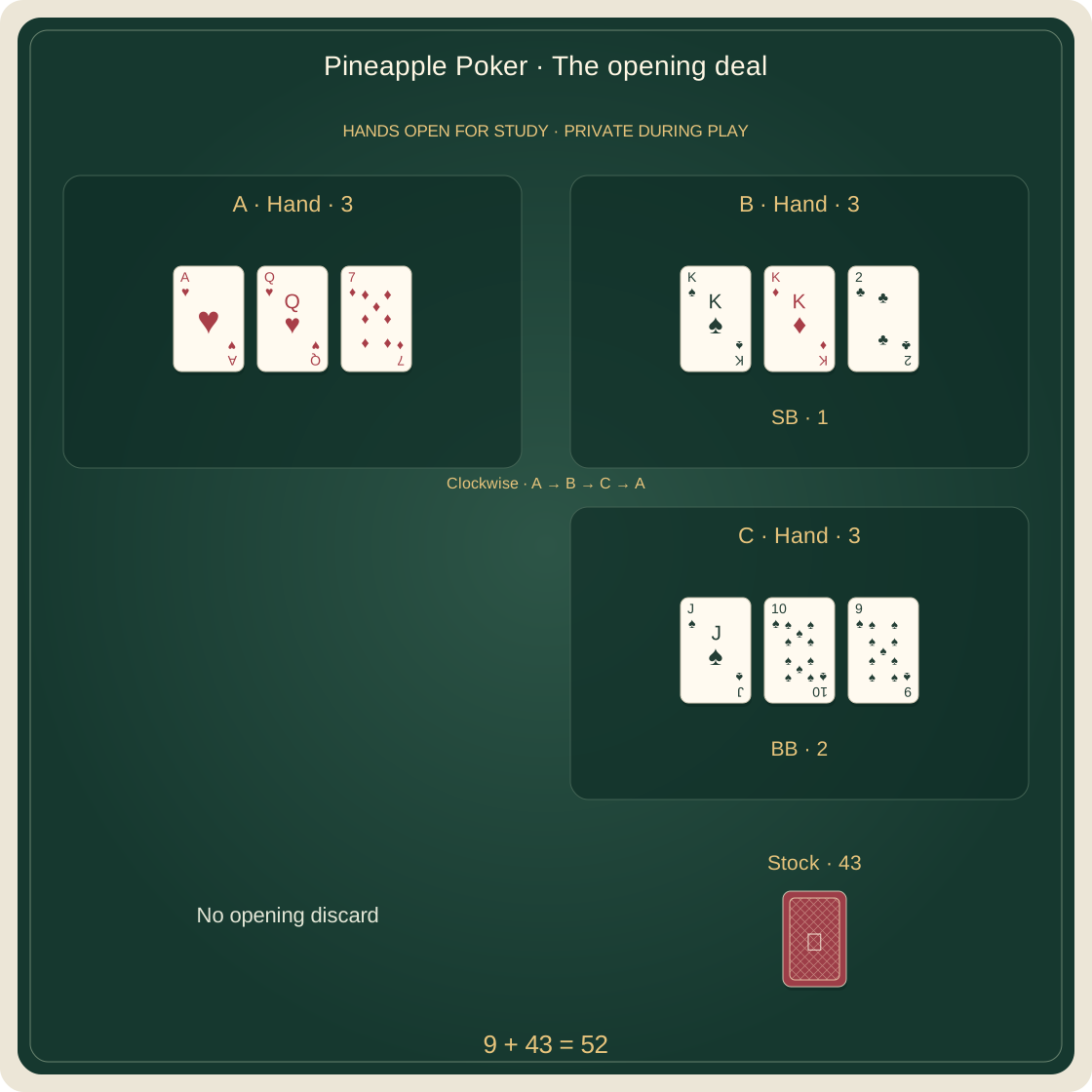
Use 52 without jokers, a dealer button and equal starting chips. Clockwise: left of button posts small blind, next big blind, usually twice as much. Deal 3 private cards each, one at a time; everyone discards 1 face down before betting. Keep muck separate from stock. At two players button posts small blind, acts first preflop and last later. Button rotates left after the hand. Our example has blinds 1/2 and stacks 100.
02 /
What happens on your turn
Preflop starts left of the big blind. Call by matching the current bet, raise its total or fold and forfeit the hand; big blind may check if nobody raises. A check is allowed only with nothing owed. Once active non-all-in players have matched the bet and had their chance to act, burn 1 and expose flop 3. Bet from the first active seat left of button. Then burn 1, turn 1, bet; burn 1, river 1, bet. Burns and the third private card never return. If only one player remains, award the pot immediately.
03 /
Minimum raises and all-in
Minimum opening bet is the big blind. A full raise must increase the current total by at least the previous full bet or raise increment. With blinds 1/2, raising to 6 increases by 4, so next full raise is to at least 10. You may put your whole remaining stack all-in even if short; that short increase does not reopen raising for someone who already acted, unless the total increase they now face reaches a full raise. Only chips already on the table may be used during the hand.
04 /
The showdown and all hand ranks
| Hand | Example |
|---|---|
| Straight flush, including royal | 10♥ J♥ Q♥ K♥ A♥ |
| Four of a kind | 9♠ 9♥ 9♦ 9♣ A♠ |
| Full house | K♠ K♥ K♦ 2♣ 2♦ |
| Flush | A♥ Q♥ 9♥ 5♥ 2♥ |
| Straight | 5♠ 6♦ 7♣ 8♥ 9♠ |
| Three of a kind | 7♠ 7♥ 7♦ A♠ Q♣ |
| Two pairs | A♠ A♥ K♣ K♦ Q♠ |
| One pair | Q♠ Q♥ A♣ K♦ 9♠ |
| High card | A♠ K♦ 9♥ 7♣ 3♠ |
Choose any best 5 from the 7 available: use 0, 1 or 2 private cards, unlike Omaha’s exact-two rule. Compare category, then relevant ranks and kickers lexicographically; suits never break a pot tie. Ace may be high or low only in A–2–3–4–5; that is a five-high straight, not an ace-high one. The two unused cards do not break ties.
05 /
All-in pots and ties
Independent all-in example with the same final hands, but C does not fold: A contributes 20, B 50, C 50. Main pot 3 × 20 = 60 is open to all; side pot 2 × 30 = 60 only to B and C. A wins main with flush; B beats C in side with three kings. Total paid 120. Return unmatched excess rather than creating a one-player pot. Tied best hands split each eligible pot; our odd-chip agreement gives the first eligible winner clockwise from button the extra chip.
06 /
When the round and match end
At showdown show both remaining private cards to claim a pot. Last river aggressor shows first; if all checked, first active seat left of button shows. A hand ends after pots are paid, not necessarily the session. Agree a fixed number of deals or a last-player-with-chips tournament before starting. If someone keeps the third card beyond the agreed discard deadline, stop and apply the table’s declared error procedure before exposing more board cards; do not choose the discard using later information.
07 /
A complete worked example
Player A
A♥ Q♥ 7♦
Player B
K♠ K♦ 2♣
Player C
J♠ 10♠ 9♠
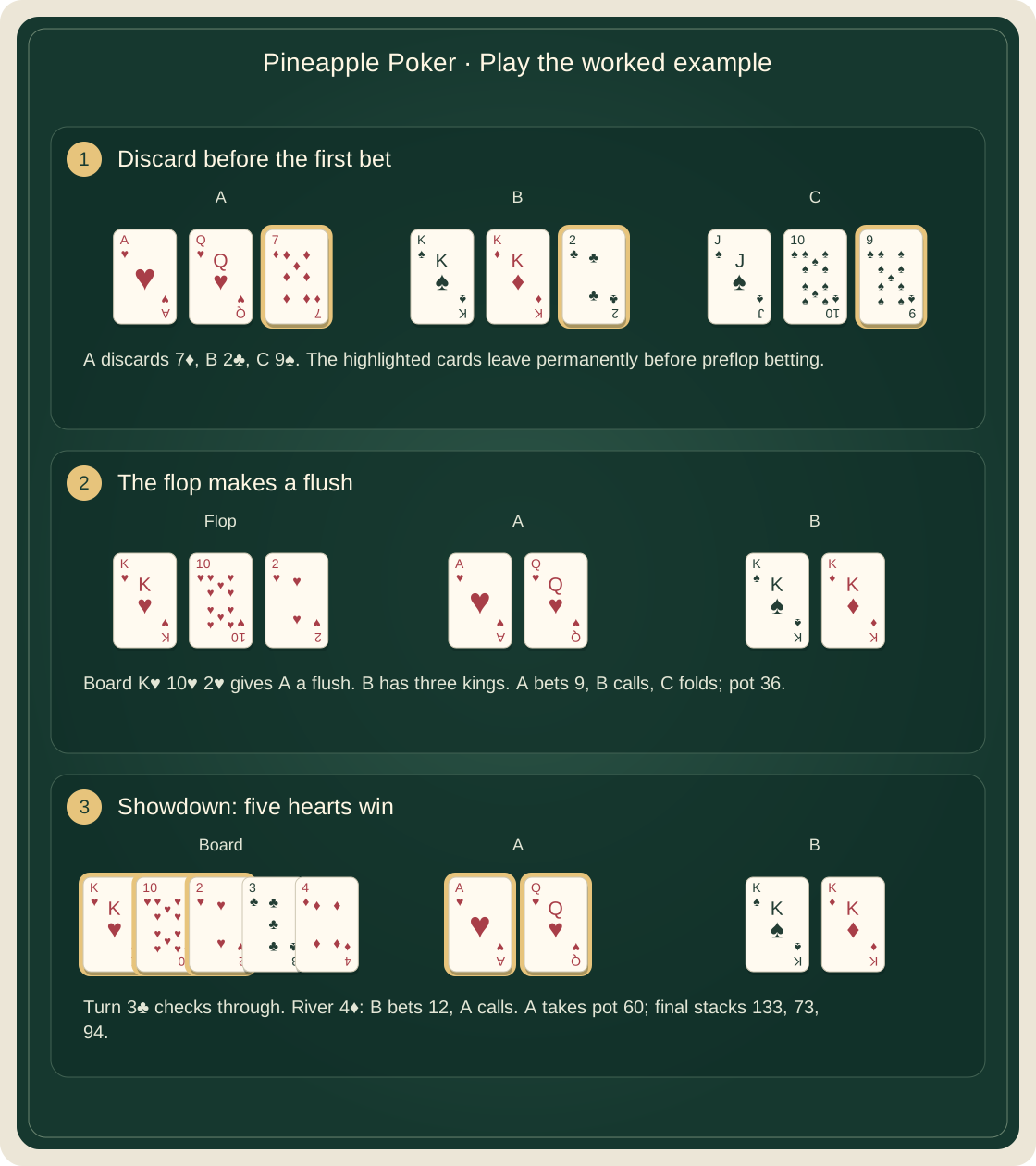
A is button, B posts 1, C posts 2; all start 100. Before betting discard A 7♦, B 2♣, C 9♠. A raises to 6, B adds 5, C adds 4: pot 18. Flop K♥ 10♥ 2♥: B checks, C checks, A bets 9, B calls 9, C folds J♠ 10♠; pot 36. Turn 3♣: B and A check. River 4♦: B bets 12, A calls 12; pot 60. A’s A♥ Q♥ plus three board hearts make ace-high flush, beating B’s three kings. A receives 60; stacks A 133, B 73, C 94 still total 300.
← On a small screen, scroll the diagram horizontally. →
08 /
Check your understanding
Must both private cards be used?
Reveal the answer
No. Use 0, 1 or 2, whichever makes the best five.
Can the discarded card come back at showdown?
Reveal the answer
No. It is permanently out of this hand.
09 /
History and other versions
Pineapple is a community-card poker branch related to Hold’em. Its origins are less securely documented than its rules; this guide does not assign an inventor. Even classic discard timing differs: some rooms wait until preflop betting finishes. Crazy Pineapple keeps three until after flop betting; Tahoe keeps three through showdown but permits at most two in the final five. Open-face Chinese Pineapple is a different game, not the board-and-blinds game taught here.
10 /
Mistakes to avoid
Do not mix the classic discard deadline with Crazy Pineapple. Do not require exactly two private cards or rank suits to decide the winner. Keep contribution records by betting round so a call is only the missing amount. A strong hand cannot win a side pot it did not fund; separate eligibility before comparing cards.
11 /
A reminder for the table
This table’s late-discard rule: correct a missing discard before the first betting action; once betting starts, a hand still holding the third card is dead. Keep its committed chips in the pot. This strict teaching agreement prevents choosing with information obtained after the deadline; live-room procedures can differ.
Common questions
Do I need a special deck?+
Use one ordinary 52-card pack without jokers. No special or proprietary cards are required.
Do suits break a tied poker hand?+
No. Compare the best five ranks; identical best hands share eligible pots.
Is this Crazy Pineapple?+
No. Here the discard precedes preflop betting; Crazy keeps the extra card through the flop betting round.