← On a small screen, scroll the diagram horizontally. →
01 /
Your first round
Receive 7 cards and split them into a back hand of 5 and a front hand of 2. Compare back with banker’s back, front with banker’s front. Win both comparisons to win the round; win exactly one to push, returning the stake. If neither wins, lose. Matching ranks count as a banker win in that comparison, not an automatic loss of the entire round.
02 /
Cards, seats and the deal
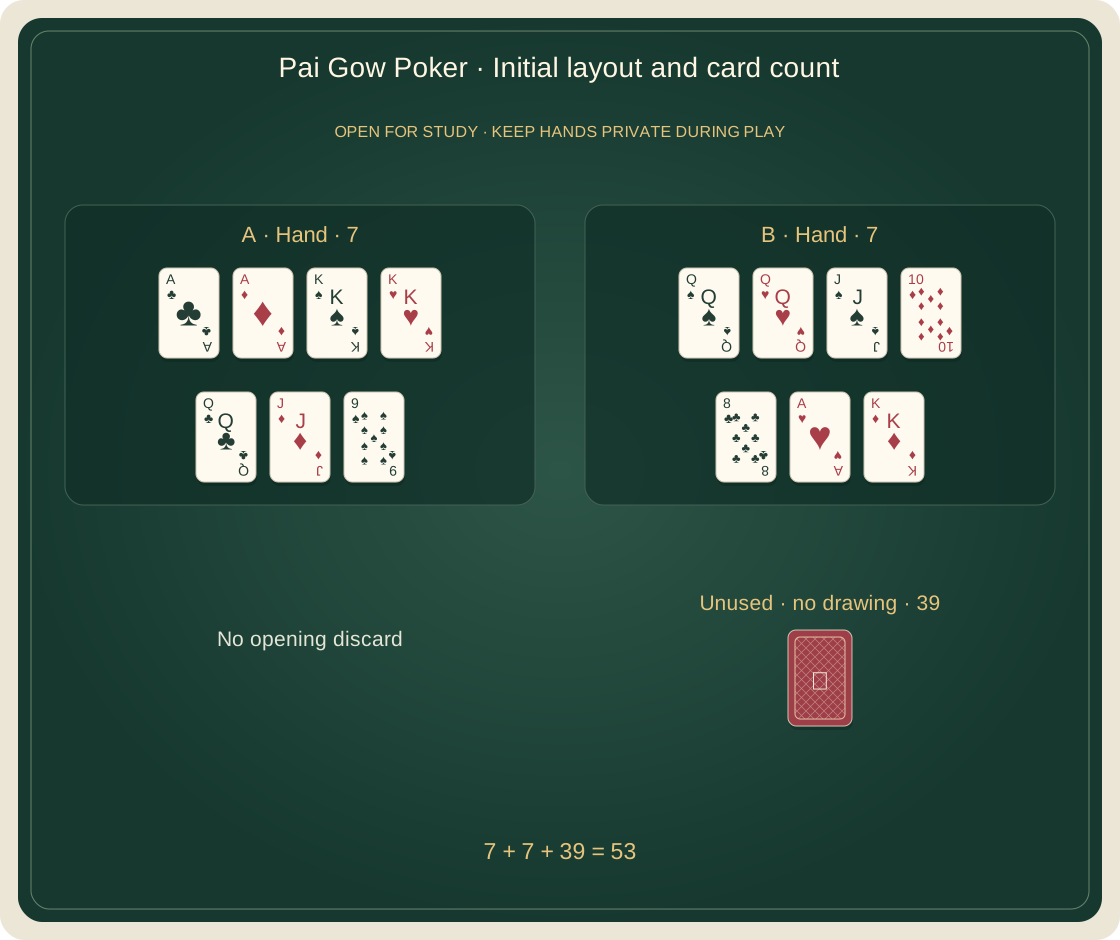
Use 52 ordinary cards plus 1 joker, 53 total. Choose a banker; our home lesson has 1–6 other players, up to 7 hands total. Before dealing, each other player records a fixed stake of 20 units; banker must cover all stakes. Shuffle, cut and deal 7 each face down clockwise. All remaining cards are unused, with no exchanges, community cards or later drawing. A two-hand lesson uses 14 + 39 = 53.
03 /
Setting five cards and two legally
Use every card once. Front may contain only a pair or high cards: two suited cards are not a flush, two consecutive cards not a straight. Back must rank at least as high as front. For example, a front pair of 7 needs a back pair of at least 7 or a higher category. With no pairs, compare highest ranks then next ranks. Do not put your strongest pair in front if it leaves only a weaker pair behind.
04 /
What the joker may represent
The joker is not freely wild. In front it is an ace. In back it is an ace unless used to complete a straight, flush, straight flush or royal flush. It cannot become a second king merely to pair a lone king. Four real aces plus the joker form five aces, above a royal flush. Declare its role when showing the hand; it never supplies an extra physical card.
05 /
Back-hand rankings, strongest first
Compare categories first, then the ranks forming the category, then unused kickers from high to low. Suits never break a tie. Our traditional wheel A–2–3–4–5 is below A–K–Q–J–10 but above K–Q–J–10–9; among non-royal straight flushes the wheel is highest. No K–A–2 wraparound. Some modern tables make the wheel lowest; settle that before dealing.
- Five aces: four aces and joker.
- Royal flush: A–K–Q–J–10 of one suit.
- Straight flush: five consecutive ranks of one suit.
- Four of a kind: four equal ranks and a kicker.
- Full house: three equal ranks and a pair.
- Flush: five cards of one suit, without a straight.
- Straight: five consecutive ranks, without a flush.
- Three of a kind: three equal ranks and two kickers.
- Two pair: two pairs and a kicker.
- One pair: two equal ranks and three kickers.
- High card: none of the categories above.
06 /
What happens on your turn
Set both hands privately, face down; the banker also commits before seeing player hands. Once everyone locks their split, reveal the banker, then compare each player independently. There is no check, call, raise or fold after seeing cards in this home protocol. A casino instead requires the banker’s published house way and its own dealing and surrender procedures; our chosen split is not claimed to be that universal procedure.
07 /
Scoring and settlement
| Back | Front | Round result |
|---|---|---|
| Player wins | Player wins | Win |
| Player wins | Banker wins, including copy | Push |
| Banker wins, including copy | Player wins | Push |
| Banker wins, including copy | Banker wins, including copy | Loss |
On a 20-unit stake, winning returns the 20 and earns 20 − 1 = 19 net after 5% commission. Push returns 20 with net 0 and no commission. Loss costs 20. Our paper ledger records player +19, banker −20 and service +1 on a win; that service unit keeps accounting balanced. With several players, settle each against the same banker hand, not against each other.
08 /
When the round and match end
An incorrect card count or front stronger than back fouls the hand and loses the stake under this profile. At a teaching table correct mistakes before hands are locked and exposed; a wrong deal discovered beforehand is void and redealt. After settlement gather every hand and unused card, shuffle and start a fresh independent round. There is no built-in points target; for a session agree on its length and compare net results, including losses and commission.
09 /
A complete worked example
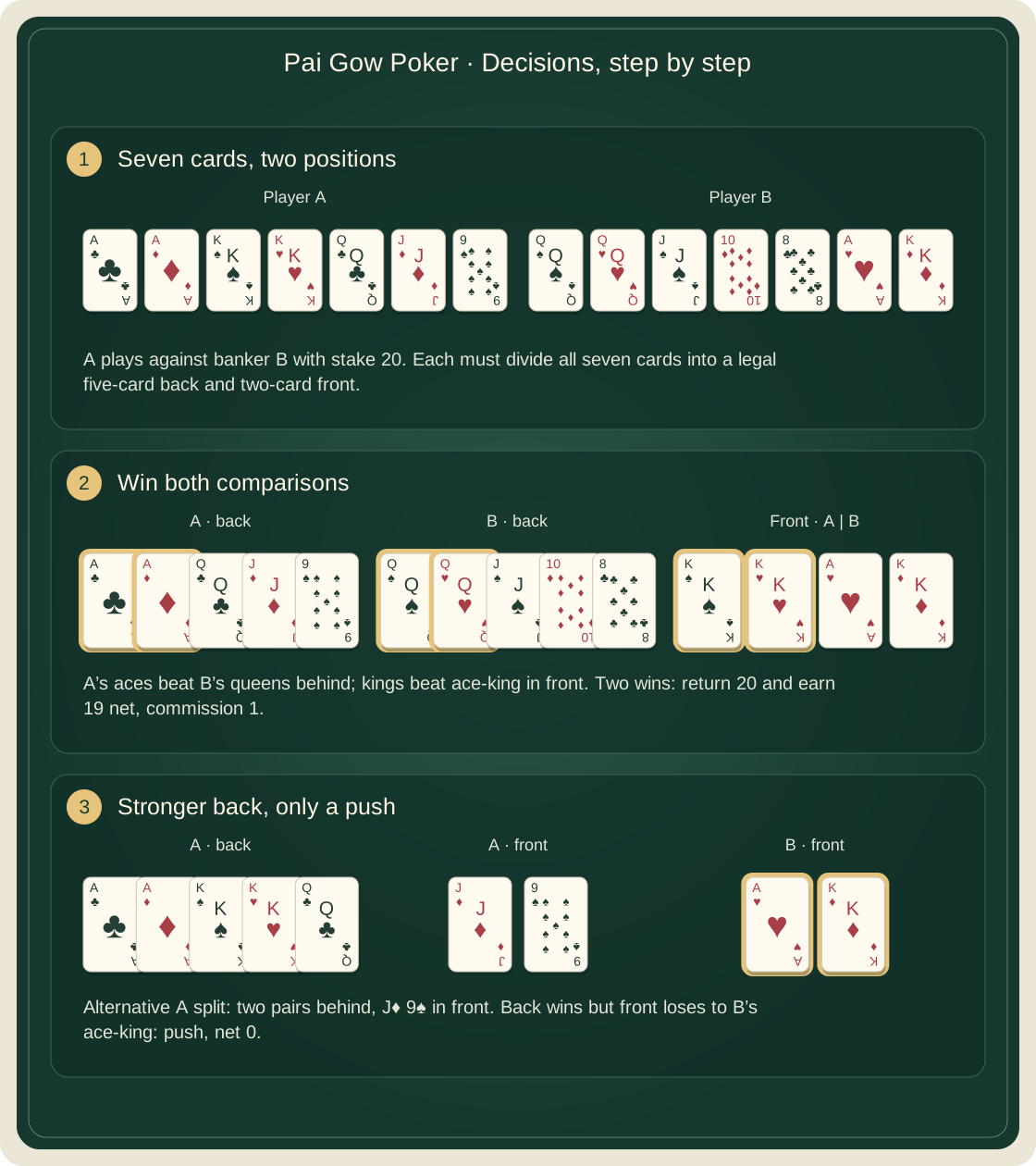
A is the player, B the fixed banker. Stake 20 was agreed before dealing. Neither hand contains the joker. Both splits below are committed before either is revealed; the unused 39 cards do not participate.
Player A
A♣ A♦ K♠ K♥ Q♣ J♦ 9♠
Player B
Q♠ Q♥ J♠ 10♦ 8♣ A♥ K♦
| Player | Back · five | Front · two |
|---|---|---|
| A | A♣ A♦ Q♣ J♦ 9♠ | K♠ K♥ |
| B | Q♠ Q♥ J♠ 10♦ 8♣ | A♥ K♦ |
A’s pair of aces beats B’s pair of queens in back. In front, A’s kings beat B’s unpaired ace-king. Both win: return stake 20, then award 19 net after commission 1. Now consider a separate alternative using the same A cards: back A♣ A♦ K♠ K♥ Q♣, front J♦ 9♠. The back improves to two pair, but front loses to ace-king; the result becomes push, net 0. This proves why comparing only the back is insufficient, without claiming one split is optimal against every banker.
← On a small screen, scroll the diagram horizontally. →
10 /
Check your understanding
Your back wins; both fronts are ace-king. Win, push or loss?
Reveal the answer
Push. The front copy goes to the banker; you won exactly one comparison. No commission applies.
Can joker and a lone king become a pair of kings?
Reveal the answer
No. Pairing a king is not an allowed wild role; the joker is an ace unless completing a permitted five-card straight or flush category.
11 /
History and other versions
The card game is generally credited to Sam Torosian at the Bell Card Club in California in 1985. It borrows a two-hand comparison structure from Chinese domino Pai Gow but uses poker cards and its own rankings. Face-up, commission-free, fully wild-joker and bonus-wager editions change material rules. Their advertisements and payouts cannot replace the classic main-hand comparison described here.
12 /
A reminder for the table
Agree on wheel ranking and commission, set the stake before dealing and count seven cards. Make a legal split, commit before seeing opponents, then compare both positions separately. Count copies for the banker, classify win/push/loss and record net payment. A better-looking back hand is useful only if the complete result improves.
Common questions
Does one copied comparison lose the whole round?+
No. A copy loses that comparison. If the other comparison wins, the overall result is push.
May both hands contain pairs of the same rank?+
Yes under the at-least-as-high rule, provided all cards are distinct and the five-card hand contains its three remaining cards. An incorrect number of cards still fouls the split.
Are flush suits ranked against one another?+
No. Compare the five ranks in descending order. If all match, it is a copy and the banker wins that comparison.