← On a small screen, scroll the diagram horizontally. →
01 /
Your first round
Empty your hand first. Each trick normally takes one card from every player; highest in the led suit wins and leads next. If you lack that suit, drawing may enlarge your hand before you can play. Trick counts do not determine the winner. A player going out ends the deal immediately, even partway through a trick.
02 /
Cards, seats and the deal
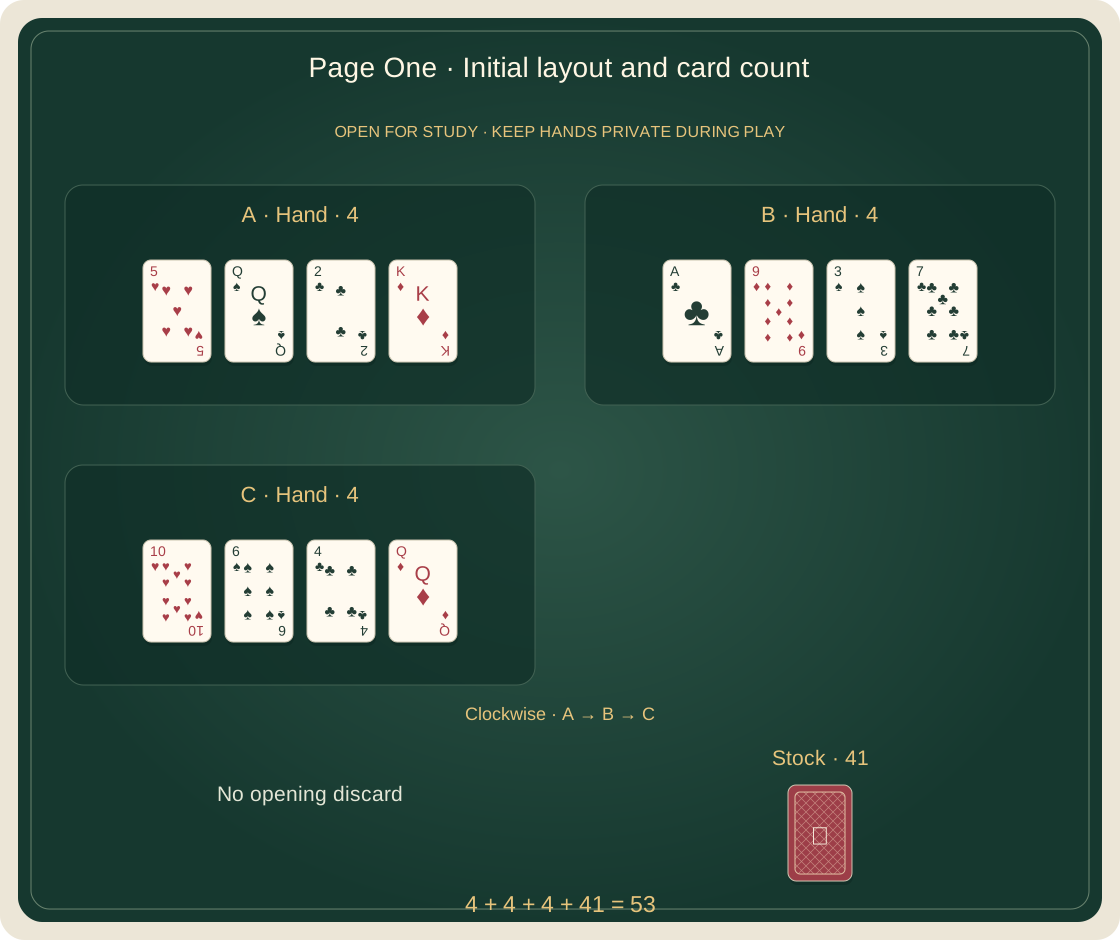
Use 52 ordinary cards plus 1 joker: 53 total. A is high, followed by K, Q, J, 10 down to 2; suits have no trump hierarchy. Deal 4 each singly clockwise from dealer’s left; that neighbour leads. Remaining cards form stock, with no opening discard. For three players, 12 + 41 = 53. Keep completed tricks separate from the current trick and from stock.
03 /
What happens on your turn
Leader chooses any card. Each follower must play the led suit if held, except for the joker privilege below. Without that suit, draw one at a time; keep unsuitable draws and immediately play the first suitable one. Do not merely discard off-suit or stop after a fixed number of draws. With no joker in the trick, compare only cards of the led suit; the winner gathers the trick aside and leads again.
04 /
Joker lead versus joker response
The single joker may be played to any trick, even while you hold the led suit, and wins it. A joker drawn while seeking a response may be played immediately. If it is led, the next player chooses any ordinary card; that card sets the suit the others must follow. A joker played later does not reset the led suit. In this profile it may be your last card; holding it does not force its use instead of drawing when void.
05 /
The call and its penalty
Say Page One when your play leaves exactly 1 card. A hand of 2 before playing becomes 1 after playing: that is the call, not an announcement with 2 still held. Missing it costs 5 draws if noticed before the next player plays or draws. If your second-last card won a trick, announce before leading the last; otherwise take the penalty, or that completed trick when no stock is available. Drawing and then playing back down to 1 requires a fresh call.
06 /
When the stock runs out
Refill exhausted stock only by shuffling previous completed tricks. Never recycle the unfinished trick or anyone’s hand. If a player cannot follow and both stock and completed tricks are empty, the deal is a draw. For a short penalty stock, our table uses available cards, recycling completed tricks if possible, up to the required penalty; never create cards. Larger tables run out more often.
07 /
When the round and match end
The first empty hand wins immediately; there is no penalty score for cards left in this selected single-deal game. Gather all cards and rotate the deal clockwise for another game. Five-card deals, a compulsory joker when void, banning a joker finish, and the later American matching game are separate variants. Do not combine their rules in the middle of play.
08 /
A complete worked example
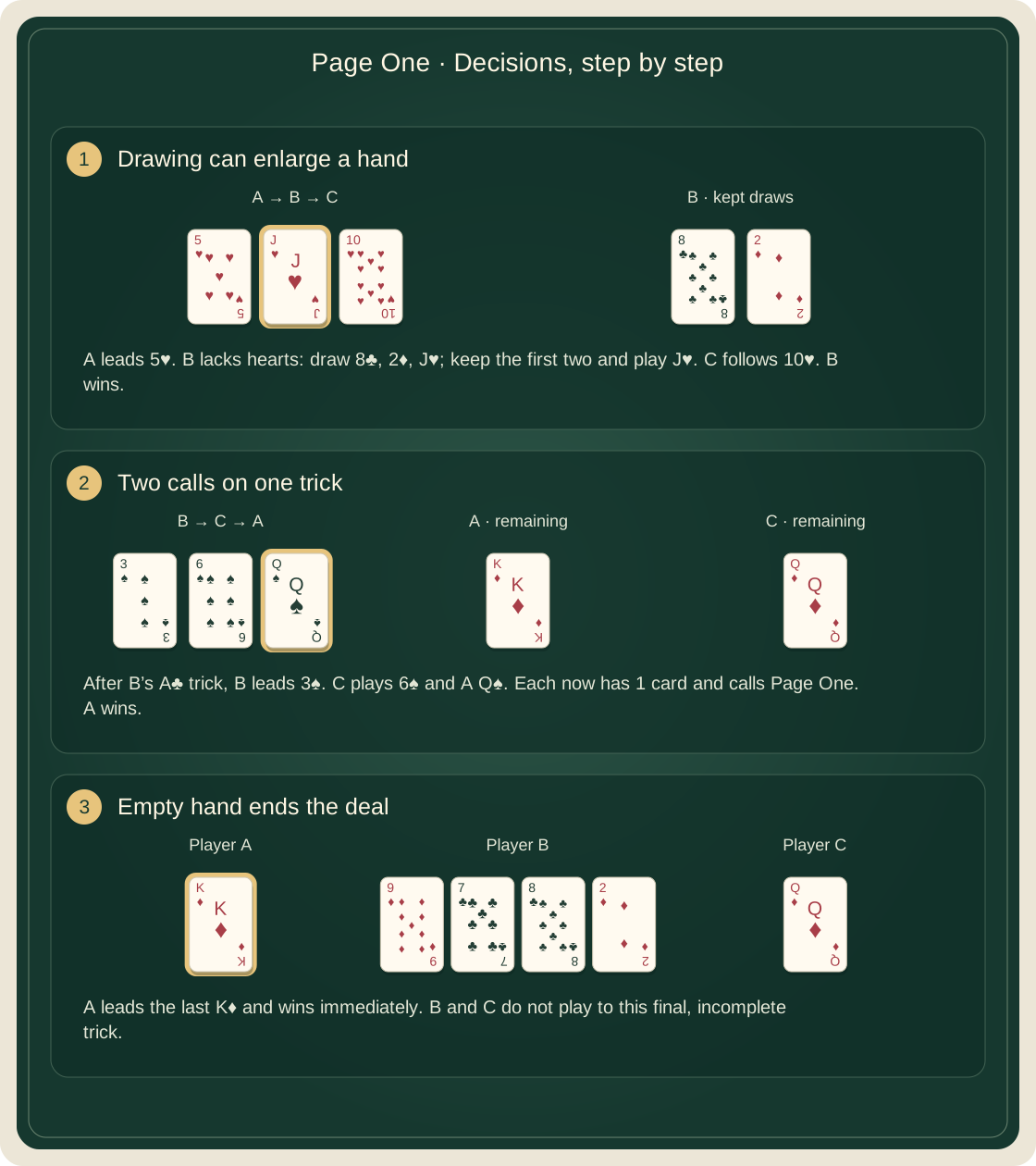
Three players act clockwise A–B–C; C deals. B has no heart, so after A’s 5♥, B draws 8♣, then 2♦, then J♥ and must play J♥. The first two draws stay in B’s hand. The table lists each seat’s card, with the leader shown separately; read each trick clockwise from that leader.
Player A
5♥ Q♠ 2♣ K♦
Player B
A♣ 9♦ 3♠ 7♣
Player C
10♥ 6♠ 4♣ Q♦
| Step | Leader | Player A | Player B | Player C | Winner |
|---|---|---|---|---|---|
| 1 | A | 5♥ | J♥ | 10♥ | B |
| 2 | B | 2♣ | A♣ | 4♣ | B |
| 3 | B | Q♠ | 3♠ | 6♠ | A |
| 4 | A | K♦ | — | — | A |
J♥ beats 10♥ and 5♥, so B leads A♣ next and wins again. B then leads 3♠; C plays 6♠ leaving 1 and calls Page One. A plays Q♠ leaving 1 and also calls. A wins that trick, leads the final K♦ and immediately wins the deal: the last row is intentionally incomplete. B holds 4 cards and C holds Q♦. No joker was needed; it remains somewhere in unused stock.
← On a small screen, scroll the diagram horizontally. →
09 /
Check your understanding
Joker leads, next card K♦. Must the third player follow diamonds?
Reveal the answer
Yes, if held; otherwise draw for a response. The second card set diamonds, but the joker will win the completed trick.
You hold one card, draw one that fits and play it. Call again?
Reveal the answer
Yes. Your hand returned to one card, so a new Page One call is required.
10 /
History and other versions
Accounts from Japanese players distinguish this older game, actively played in the 1950s and 1960s, from American Page One that spread from the 1970s. Sharing a name does not make their turn rules interchangeable. This article preserves the older follow-suit-and-draw mechanism; the sources do not establish a reliable single inventor.
11 /
A reminder for the table
Deal, keep the stock and completed tricks apart, then lead and follow. Draw until a legal response when void; apply the joker’s actual position in the trick. Call whenever one card remains. End on the first empty hand, not on a target trick total, and resolve a genuinely empty stock before inventing a discard rule.
Common questions
Is the joker a permanent trump suit?+
No. It is one special winning card. A joker response does not change the existing suit obligation.
Must the last trick be completed?+
No. The first empty hand wins immediately. Later seats do not play merely to decide who would have won that trick.
Are points for leftover cards required?+
Not in this profile. It has a single-deal winner or a draw on the stated stock deadlock. A multi-deal point scheme must be agreed separately.