← On a small screen, scroll the diagram horizontally. →
01 /
Your first round
Receive 4 private cards. Across 4 betting rounds the board grows to 5 cards. At showdown choose exactly 2 private plus exactly 3 board cards for a 5-card hand. Win the eligible pot with the best hand or when everyone else folds. You cannot play the board alone, use one private card or use three private cards.
02 /
The rules used here
For this teaching session use 2–6 players, 100 chips each, blinds 1/2, no ante or rake and 8 deals. No rebuys during the session; a zero stack is eliminated. All chips are counters, not money. Agree on these session conditions before dealing: they are not an official Omaha tournament format. The pot-limit and hand-construction rules remain unchanged.
03 /
Cards, seats and the deal
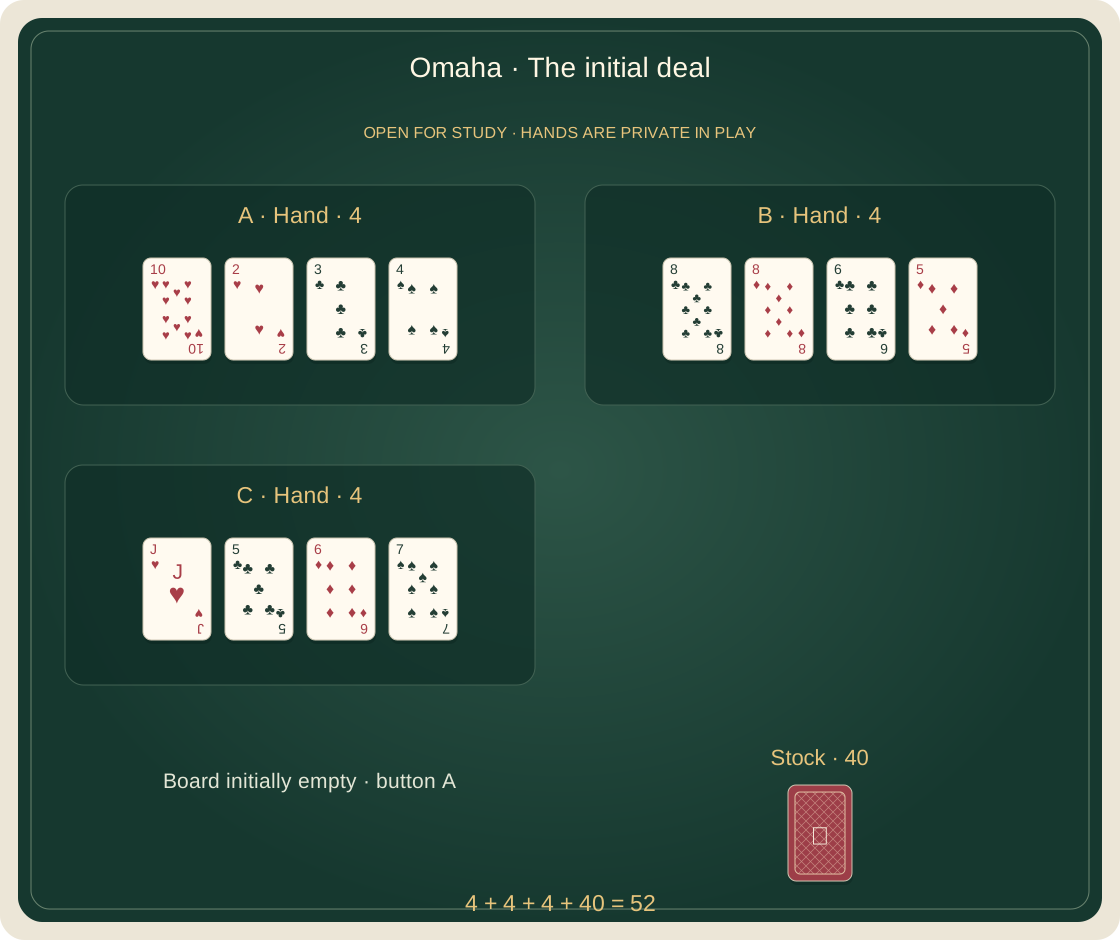
Use 52 cards without jokers. Choose the button by agreement. With at least three players, the next two clockwise post small blind 1 and big blind 2. Deal 4 each singly clockwise from the small blind; look only at your own cards. With three players, 12 are dealt and 40 remain before any board or burn. The button marks position, even with a separate dealer.
04 /
Preflop, flop, turn and river
Preflop begins left of the big blind; that blind may raise when action returns. After betting, burn one unseen card and expose the 3-card flop. Burn before the single turn and single river too. Each board stage has a new betting round, starting with the first active player clockwise from the button. Do not replace burns or return folded cards to stock.
05 /
What happens on your turn
Fold gives up the hand and all claims to pots, but posted chips stay. Check passes without paying only when nothing is owed. Bet opens a wager; call matches the current amount; raise increases it. A round closes once every non-folded, non-all-in player has had a chance to respond and matched, or all checked. If everyone but one folds, award the pot without dealing further cards.
06 /
How to calculate a pot-size raise
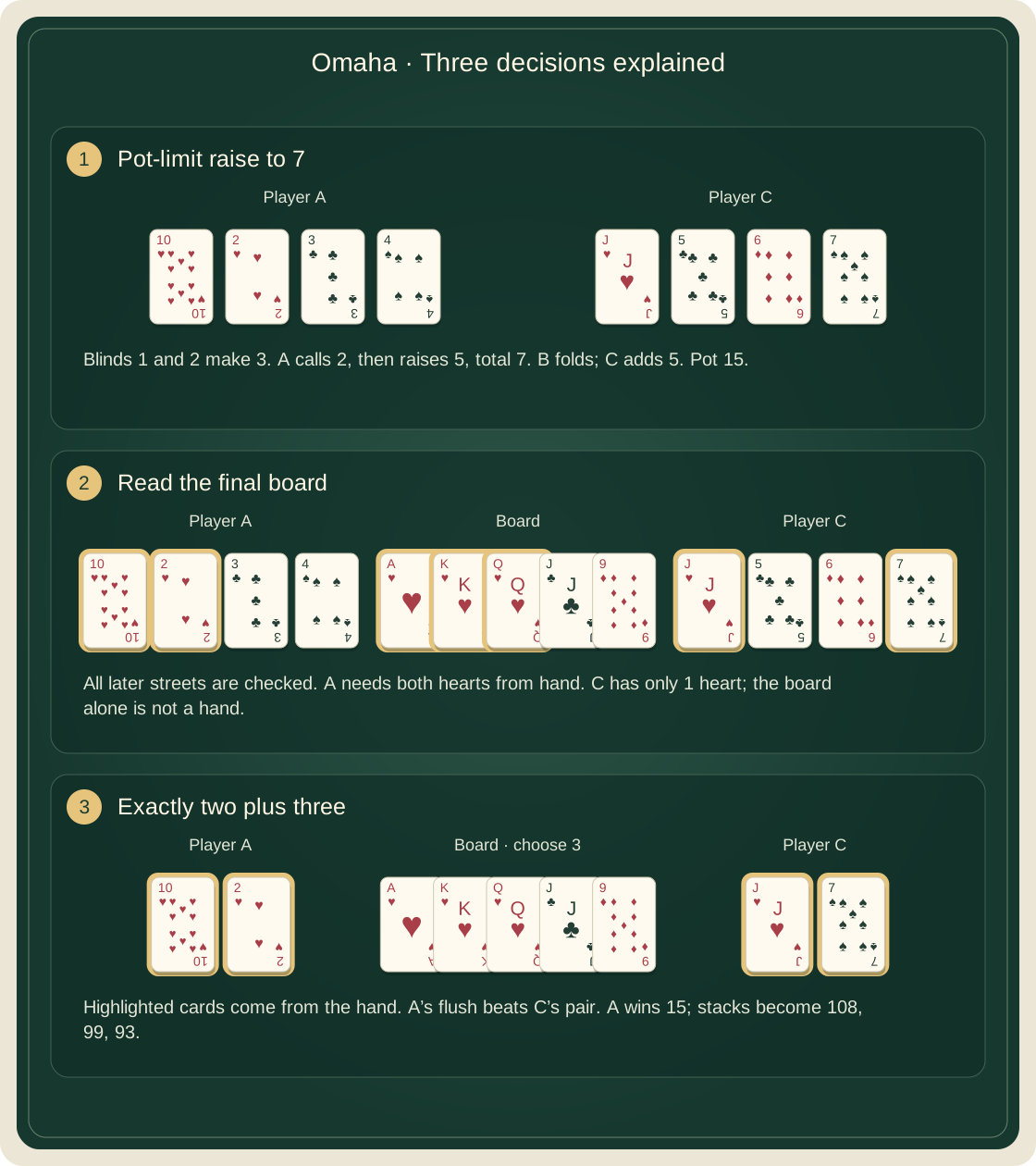
An opening bet is at least the big blind and at most the pot. Facing a bet, first calculate the call; the pot after that call is the largest extra raise. Your total payment now is call plus that extra amount. Initially blinds 1 + 2 make 3. An uncommitted player calls 2, making 5, then raises at most 5: a total contribution of 7, not 5.
07 /
Minimum raises and short all-ins
A full raise is at least the last full bet or raise increment in that betting round. From a big blind of 2, a first raise must reach at least 4; raising to 7 makes the next full increment 5. A short all-in may be legal but does not by itself reopen a raise for players who already acted. Reopening requires the full increment against that player, including accumulated short raises.
08 /
All-in and side pots
An all-in player puts in all remaining chips and remains eligible only at the contribution levels they covered. Make separate pots for successive contribution levels; folded players’ chips stay in them but cannot win. Return an uncalled excess. If all remaining players are all-in, finish the board with the normal burns and no further betting, then evaluate each pot among its eligible hands.
09 /
Hand ranking, strongest first
Compare categories first, then the ranks making that category and remaining kickers downwards. Suits never break ties. A is high except in A–2–3–4–5, the lowest straight; wrapping through K–A–2 is illegal. Only the chosen five cards count.
- Straight flush, including royal flush — Five consecutive ranks in one suit; a royal flush is the ace-high case.
- Four of a kind — Four equal ranks plus a kicker.
- Full house — Three equal ranks plus a pair.
- Flush — Five cards of one suit, without a straight.
- Straight — Five consecutive ranks, without a flush.
- Three of a kind — Three equal ranks and two different kickers.
- Two pairs — Two separate pairs and a kicker.
- One pair — One pair and three different kickers.
- High card — No category above: compare the five ranks in descending order.
10 /
Showdown and tied hands
If betting reached showdown, the last river bettor or raiser shows first; after checks, first active clockwise from the button shows. Reveal all private cards to claim a pot and identify the best exact combination. Equal five-card hands split each eligible pot. Our odd chip goes to the tied winner first clockwise after the button. Unused private cards never break a tie.
11 /
When the round and match end
After each complete deal move blinds clockwise, preserving the big-blind sequence when someone leaves: next surviving seat after the previous big blind pays it. This can leave a dead small blind or button. With two remaining, button posts small blind, acts first preflop and last afterwards. After 8 deals compare stacks; most chips wins, equal stacks share the place. A lone survivor wins early.
12 /
A complete worked example
Three players start with 100 chips each. A has the button, B posts 1 and C posts 2. All private cards are opened only for study. A raises to the maximum 7, B folds and C calls 5 more: contributions 7 + 1 + 7 = 15.
Player A
10♥ 2♥ 3♣ 4♠
Player B
8♣ 8♦ 6♣ 5♦
Player C
J♥ 5♣ 6♦ 7♠
Burn 2♠, deal flop A♥ K♥ Q♥. Both check. Burn 8♠, turn J♣, both check. Burn 10♠, river 9♦, both check. The pot stays 15. There are 12 private cards, 5 board cards, 3 burns and 32 stock cards, totaling 52.
A uses 10♥ 2♥ from hand and A♥ K♥ Q♥ from board: ace-high flush. C has only 1 heart and cannot borrow a fourth board heart; the best legal hand is J♥ 7♠ with A♥ K♥ J♣, a pair of jacks. A wins 15. Final stacks: A 108, B 99, C 93, total 300. B’s folded cards remain unavailable and cannot improve either opponent.
← On a small screen, scroll the diagram horizontally. →
13 /
Check your understanding
Do three board hearts and one private heart make a flush?
Reveal the answer
No. Exactly 2 private cards must be used. With only 1 private heart you cannot make a heart flush, even if the board later has 4 hearts.
Why is the opening maximum seven?
Reveal the answer
The pot is 3. A first calls 2, making 5, then may raise by 5: total contribution 7. This is a raise to 7, not by 7.
14 /
History and other versions
Omaha emerged as a modern community-card poker form and became established in casino and tournament play during the late twentieth century. The defining exact-use rule separates it from Hold’em despite the similar board. Four-card High, Hi-Lo and larger private hands need distinct rule profiles. This guide does not assign a certain sole inventor or copy a casino’s special misdeal code.
15 /
Mistakes to avoid
A lone suited ace does not make a flush on a three-suited board. A board straight is not automatically yours. Count exactly the required private and shared cards before comparing hands. Do not confuse the maximum additional raise with your total payment. For our teaching table, correct an exposed or misdealt starting hand before action by reshuffling the whole deal; never swap a chosen board card.
16 /
A reminder for the table
Post blinds, deal private cards, finish preflop betting. Burn and expose each board stage, betting after each. Resolve folds and side pots as needed. At showdown construct the exact hand and award each eligible pot. Confirm chip totals, move the button and blinds, shuffle the full pack and continue only if the agreed session has not ended.
Common questions
Can I use all the board cards?+
No. Always use exactly 2 private and 3 board cards, even if the board already looks like a strong hand.
Is the pot split with a low hand?+
Not in Omaha High. Hi-Lo is a different variant with its own qualification and splitting rules.
Does every all-in reopen raising?+
No. For a player who already acted, the increase faced must reach a full raise increment; a short all-in alone is insufficient.