← On a small screen, scroll the diagram horizontally. →
01 /
Context and selected form
British Napoleon, shortened to Nap, differs from Japanese Napoleon. Published rules are documented in the October 1875 issue of The Bazaar under H. E. Heather’s name. We choose the basic British ladder, not later Misère, Blücher or floater variations. Use 52 cards without jokers, A K Q J 10 9 8 7 6 5 4 3 2. Our session is eight deals, including passed-out deals; highest token balance wins and tied balances share the win.
02 /
Deal and auction
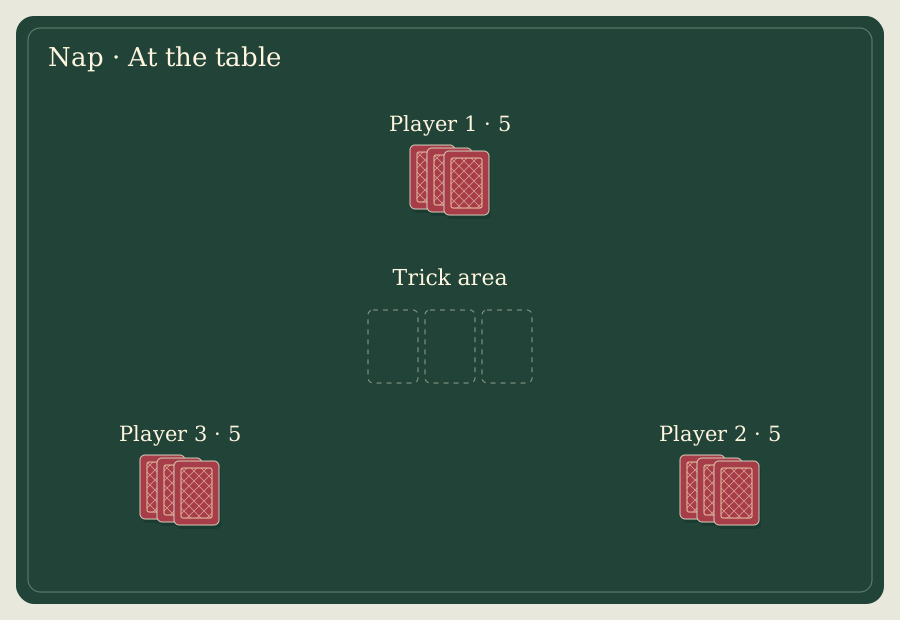
Choose first dealer randomly, deal clockwise, rotate left. Our teaching table shuffles every deal rather than using the traditional limited-shuffle practice. Cut on the right and give five each, three then two; unused cards stay hidden and never enter play. Dealer’s left starts a single clockwise auction. Each passes or bids strictly higher and speaks only once. Bids: Three promises at least 3 tricks, Four at least 4, Nap all 5; Wellington also all 5 but may only overcall an existing Nap. All pass: zero scores, next dealer.
03 /
Five tricks
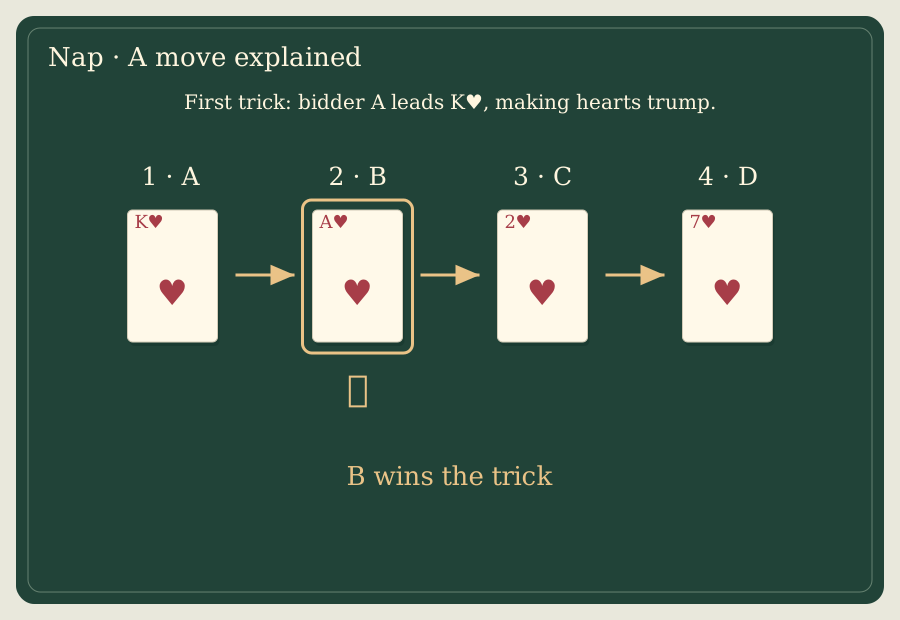
Winning bidder leads any card and its suit becomes trump for the whole hand. This card is played to the first trick, not an indicator set aside. Everyone follows suit if able; if void, any card is legal, without compulsory trumping or overtrumping. Highest trump wins, otherwise highest led-suit card. Winner leads next; no draw or exchange. All other players defend together without sharing hand information. Play all five tricks.
04 /
Settlement and example
Use unlimited accounting units rather than money or finite stacks: negative balances are allowed. A successful bidder receives from each opponent 3 for Three,4 for Four,5 for Nap,10 for Wellington. A failed bidder pays each the same amount. Extra tricks do not increase payment.
05 /
Worked example
Example: four play and a Four bidder wins all five tricks. Each opponent pays 4, so bidder records+12 and others−4 each;12−4−4−4=0. Winning only three would instead give−12 and+4 to each defender. Gather cards, rotate dealer and continue to the agreed end.
← On a small screen, scroll the diagram horizontally. →
06 /
Keep additions separate
Reduced packs, bids of Two or Misère, Blücher, doubled Nap payments, purchases, pooled stakes and a floater change the profile. In particular this guide pays a Nap the same 5 units per opponent on success or failure, not a doubled reward.
Common questions
Can Wellington be the first bid?+
No. Someone must already have bid Nap.
May the bidder choose trumps without leading one?+
No. The opening card itself establishes trumps.