← On a small screen, scroll the diagram horizontally. →
01 /
A teaching bridge game without an auction
Minibridge teaches partnership trick play and dummy control before introducing bridge bidding. Educational organisations, including the English Bridge Union, use it for beginners and schools. It is a teaching format, not merely a smaller pack or a two-person version of bridge. This guide follows the EBU part-score/game stage with trumps and no trumps; slam declarations are outside this introductory profile. Exact scoring matters because making a high target earns a larger bonus than casually collecting the same tricks.
02 /
Four compass seats, thirteen cards each
Use 52 cards without jokers, 4 players: North/South partner against East/West. Rank A K Q J 10 9 8 7 6 5 4 3 2. Choose first dealer by high-card cut, redraw ties, then rotate clockwise. Shuffle, right cuts, deal singly clockwise, 13 each; no stock. Sort privately by suit. Count high-card points: A 4, K 3, Q 2, J 1, others 0. All hands must total 40. These points choose declarer; they are not points awarded for capturing those cards.
03 /
Announce points and expose dummy
Starting with dealer, announce each hand’s points clockwise. Partnership with more than 20 becomes declaring side; at 20–20 redeal. Higher-point partner is declarer, the other dummy. If equal, earlier point announcer is declarer. Dummy exposes all 13 cards, grouped by suit, before contract choice. Declarer sees both partnership hands and decides target; dummy does not advise. Defenders keep hands hidden. This replaces the auction completely: no bids by defenders, no doubles, redoubles or vulnerability in this teaching score.
04 /
Choose a part-score or a game
Choose clubs, diamonds, hearts, spades or no trump. Part-score always needs at least 7 tricks. Game needs 9 in no trump, 10 in hearts/spades, 11 in clubs/diamonds. Announce before any opening lead. A combined 25 high-card points is a useful game guideline, not a guarantee; count likely winners and a combined trump length of at least 8 when considering a suit. Move dummy’s trumps to the side facing declarer’s left. Winning extra tricks later does not retrospectively upgrade a part-score to game.
05 /
Declarer controls both partnership hands
Defender on declarer’s left makes the opening lead; dummy plays second. Proceed clockwise, 1 card each. Declarer chooses dummy’s card only when dummy’s turn arrives, and plays their own hand at its separate turn. Follow suit if able; otherwise discard or optionally trump. No compulsory heading or overtrumping. Highest trump wins, else highest led-suit card. Winner leads next from that same hand: a dummy win means lead from dummy, chosen by declarer. Keep each player’s played cards separately, upright for a partnership win and sideways for a loss. Count 13 tricks at the end.
06 /
Bonus follows the announced target
If target met, score every trick above 6: 20 each in clubs/diamonds, 30 each hearts/spades, or 40 for first plus 30 for each later in no trump. Add 50 for announced part-score or 300 for announced game. Count overtricks by the same rate. If target missed, declaring pair scores 0 and defenders score 50 per undertrick, without any other bonus. Record pairs separately, not as a transfer. After an agreed complete dealer rotation or fixed number of deals, highest partnership total wins. A wrong point count is corrected before contract choice; a play error at a learning table is restored where possible before continuing.
07 /
A dummy trump wins, a game earns its bonus
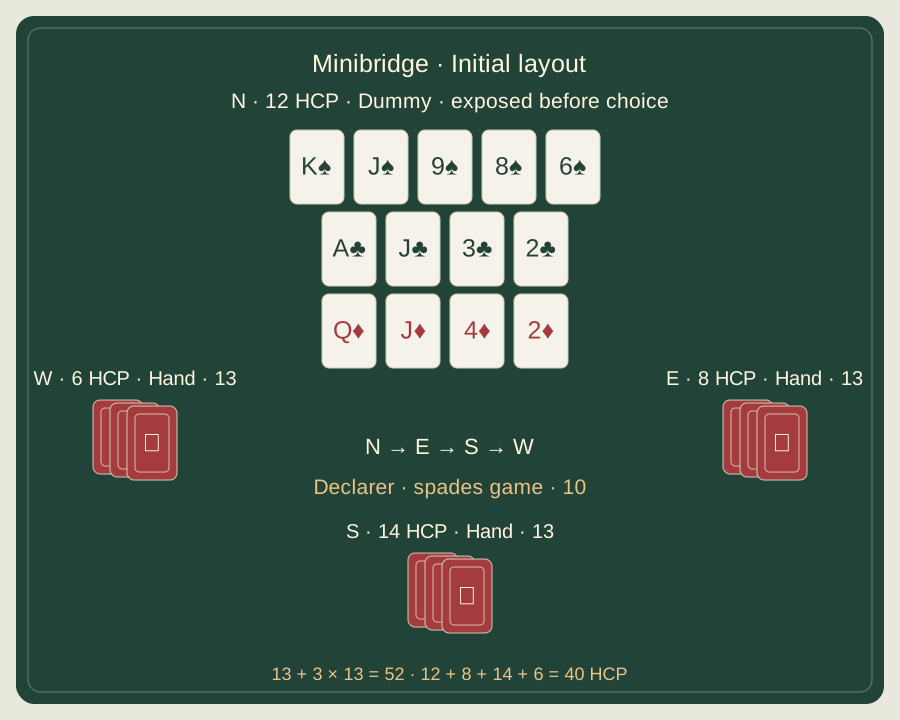
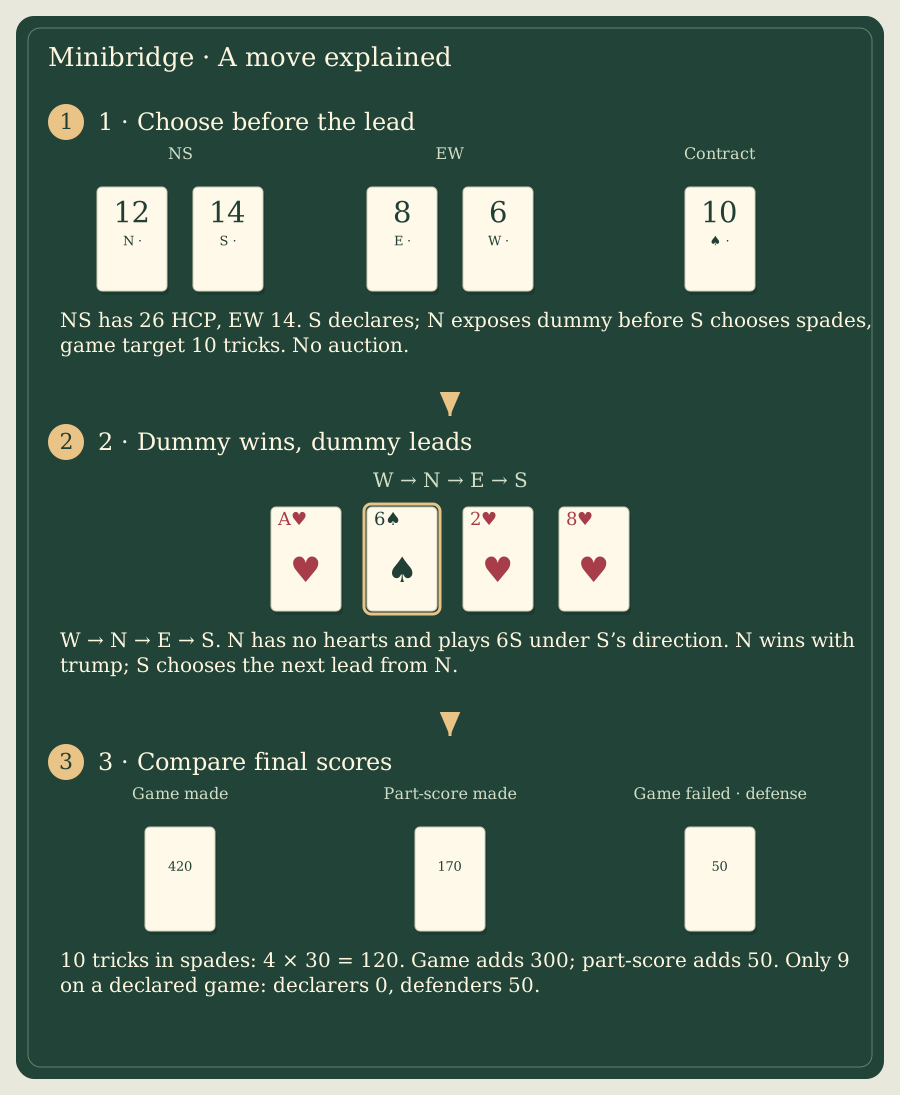
N has 12 points, E 8, S 14, W 6: total 40. N/S have 26; S declares and N becomes dummy. With 8 spades together, S announces spade game, target 10. W leads A♥. N has no hearts, so S directs 6♠ from dummy; E follows 2♥, S 8♥. Dummy wins and must lead next. A separate completed result of 10 tricks scores 4 × 30 + 300 = 420. The same tricks in an announced part-score give 4 × 30 + 50 = 170. If game makes only 9, defenders get 50 and declarers 0. High-card points did not themselves guarantee the game.
← On a small screen, scroll the diagram horizontally. →
Common questions
Is there an auction?+
No, announced high-card points choose the declaring side.
When is dummy exposed?+
Before declarer chooses the contract in this format.
Do extra tricks automatically make game?+
No, game must have been declared before play.