← On a small screen, scroll the diagram horizontally. →
01 /
Italian rummy with a movable table
Machiavelli belongs to the Italian manipulation-rummy tradition. Existing combinations are shared material: rearranging them can unlock cards that seemed impossible to play. The name evokes clever manoeuvring, but does not establish that the historical writer invented the game. We use the no-joker form with long starting hands; Tahiti, Guadalupe and joker versions have separate dealing and drawing rules.
02 /
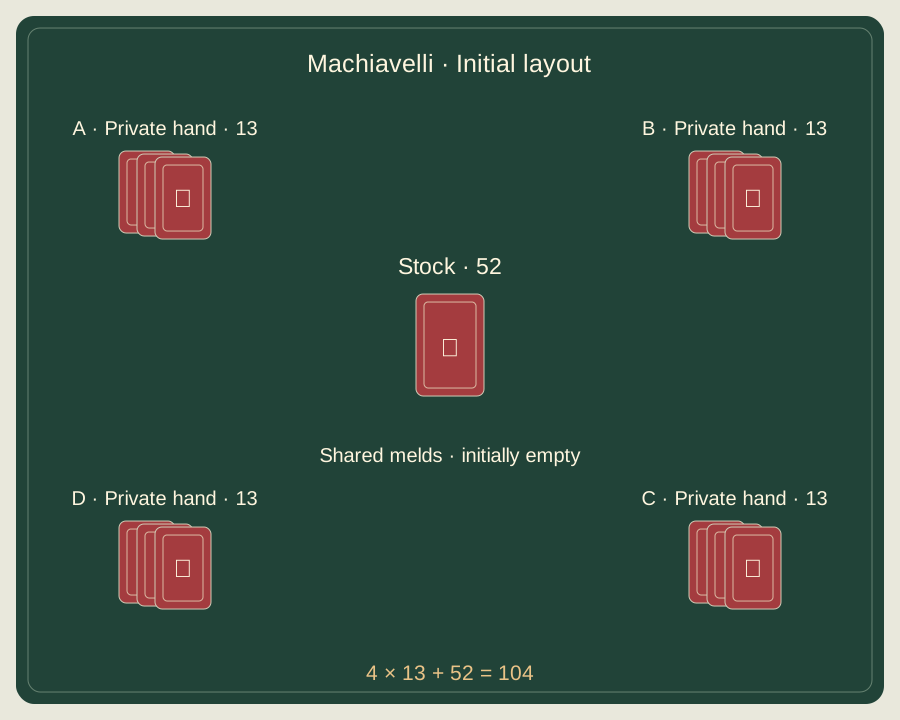
Thirteen each, no discard pile
For 2–5 players combine 2 ordinary packs without jokers: 104 cards. Choose a dealer randomly and rotate clockwise. Deal 13 cards singly to each player, keep the remainder face down as stock, and leave the common table empty. With 4 players, 52 are in hands and 52 in stock. Begin left of dealer and play clockwise. There is no discard pile, trump, bidding or opening point threshold. Agree a fixed number of dealer rotations for a match.
03 /
Every final combination must be valid
A set contains 3 or 4 equal ranks of different suits. Two identical cards cannot share that set, even though the pack contains duplicates. A run contains at least 3 consecutive cards of one suit. Ace can be low or high, never in the middle: A 2 3 and Q K A are valid, K A 2 is not. Each physical card belongs to exactly one meld. You may create several melds, split a long run or borrow from existing sets only if every resulting meld remains valid.
04 /
Play cards or draw, never both
On a turn either add one or more hand cards to the common table, rearranging freely, or draw 1 stock card and end the turn. A drawn card cannot be played immediately. Adding is optional even if legal. You may use anyone’s melds without first making a private opening. Table cards cannot enter your hand, and mere rearrangement without adding a hand card is not a legal play. Do not discard at turn end. Leave clear gaps between the final combinations.
05 /
An unfinished puzzle must be undone
Before manipulating, remember the original table; a photograph or a written layout can help a home game restore it. If you cannot finish with every table card in a legal meld, put the table back exactly, return your added cards to hand and draw 3 stock cards as the penalty instead of the normal draw. Do not leave a loose card for the next player to fix. This rollback penalty also applies if your attempted new meld cannot be completed.
06 /
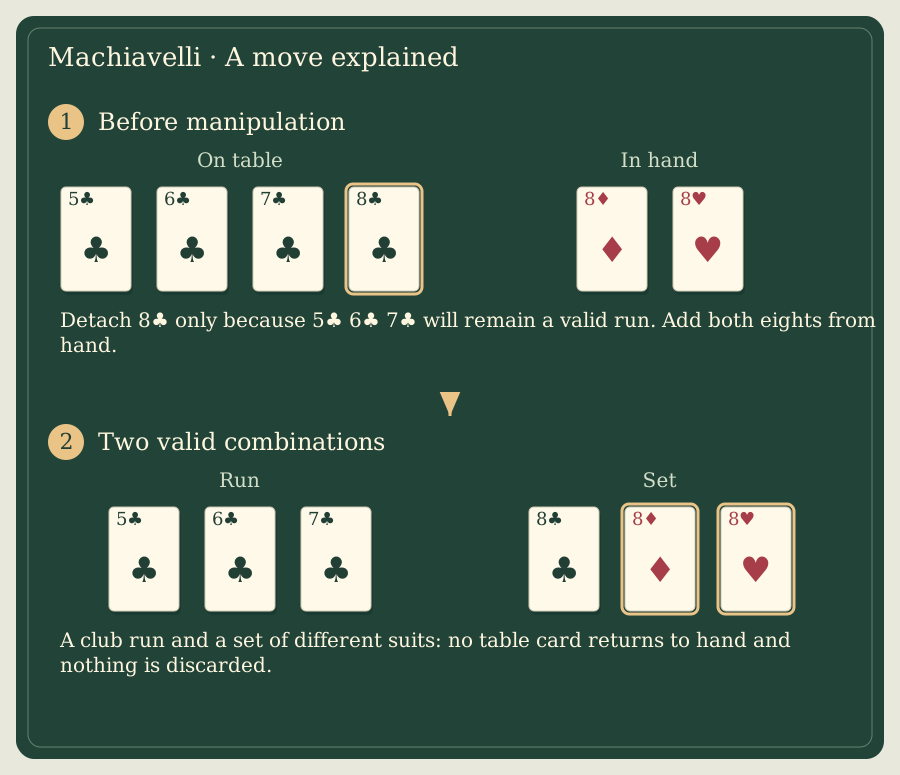
Free an eight without breaking a run
Table run: 5♣ 6♣ 7♣ 8♣. Your hand has 8♦ and 8♥. Remove 8♣ from the run and combine it with your pair: the table now has 5♣ 6♣ 7♣ and 8♣ 8♦ 8♥. Both melds contain 3 valid cards, and you added 2. If the original run had only 6♣ 7♣ 8♣, removing 8♣ would leave an invalid pair unless you supplied another valid rearrangement. The illustration shows a local position, not an opening deal.
← On a small screen, scroll the diagram horizontally. →
07 /
Empty hands and a finite stock
The first empty hand wins immediately. Others score 1 penalty point per remaining card, regardless of rank; no knocking or deadwood limit. For an exhausted stock, our stated session convention is: drawing passes, a failed manipulation takes only available penalty cards, and a full circuit with no successful addition ends the deal. Then everyone counts remaining cards, without an empty-hand winner. Add penalties across the agreed dealer rotations; lowest total wins, ties share. This exhaustion convention fills a gap in published Machiavelli summaries.
Common questions
May I play after drawing?+
No; drawing ends your turn.
Can table cards return to hand?+
No; rearrange them into valid table melds.
Are jokers included?+
Not in this selected profile.