← On a small screen, scroll the diagram horizontally. →
01 /
A patience with competing traditions
La Belle Lucie belongs to the fan family of patience games. Lady Cadogan included it in her nineteenth-century collection; the French name alone does not identify its inventor. Older manuals disagree about allowing a final rescue of a buried card. This guide chooses the stricter game without that rescue, so the shuffle counter and the exposed cards completely determine what is legal.
02 /
Lay out every card
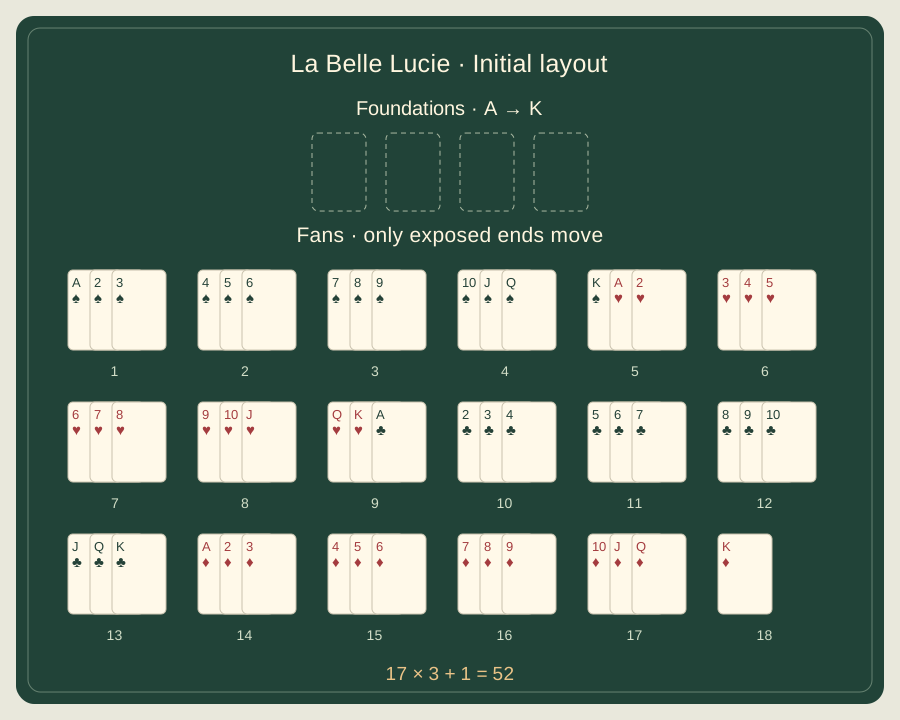
Shuffle 52 cards without jokers. Deal 17 face-up fans of 3 cards and a final fan of 1: 18 fans in total. Overlap each fan so all ranks remain visible; only its top, uncovered card is playable. Leave room for 4 initially empty foundations. There is no hand, stock, waste or reserve. Aces are low, followed by 2 through 10, J, Q, K.
03 /
Move a single exposed card
An exposed ace starts a foundation. Build each foundation upward in its own suit to the king. Between fans, build downward in the same suit, one rank at a time. Thus 8♣ can go on 9♣, but never on 9♠. Move only a single exposed card, even when a whole sequence looks correctly ordered. Empty fans stay empty, including for kings. Foundation cards stay home; ranks never wrap around.
04 /
Two reshuffles, no rescue draw
When no useful legal move remains, collect only the tableau cards, shuffle them and redeal face up in fans of 3; a remainder makes a shorter final fan. Leave foundations untouched. You may do this 2 times after the opening deal, giving 3 deals altogether. Do not restore cards already home. After the final deal there is no merci: a buried card cannot be extracted. A voluntary move that merely blocks another card is not progress.
05 /
Uncover the card you need
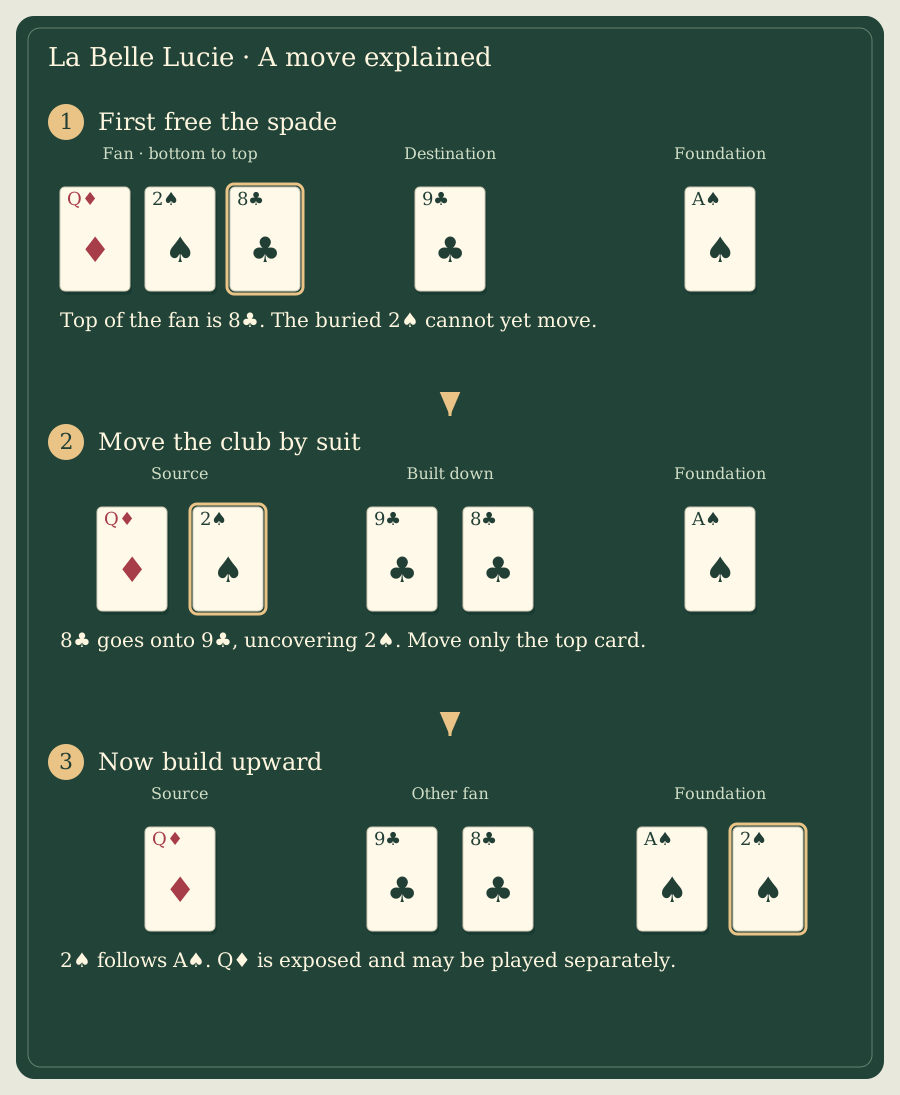
Consider a local position: one fan, bottom to top, holds Q♦, 2♠, 8♣; another has exposed 9♣, while A♠ is already home. Move 8♣ onto 9♣. Now 2♠ is exposed and can follow A♠ onto its foundation. Q♦ becomes accessible. You could not have moved 2♠ before removing 8♣, nor moved both together. The diagram shows this position rather than pretending to be the opening deal.
← On a small screen, scroll the diagram horizontally. →
06 /
Winning and avoiding dead ends
Win by moving all 52 cards to the foundations. If you are stuck after both redeals, the patience has failed; partial foundations do not count as a win. Before covering a fan, inspect its buried cards: putting a higher card over a lower one of its own suit may lock both until the next shuffle. Empty space is not storage. A final rescue draw and kings in empty spaces are separate variants, never silent exceptions.
Common questions
Can a king fill an empty fan?+
No; empty fans remain unusable until a redeal.
Are ordered runs movable?+
No, only the exposed card moves.
Is the final rescue allowed?+
Not in this profile; agree that variant before dealing.