← On a small screen, scroll the diagram horizontally. →
01 /
Golf as a patience game
Golf Solitaire is a solo game of removing available cards in adjacent ranks. Its shared name with multiplayer Golf comes from counting low scores over holes, not from identical play. Early patience literature records a related layout as One Foundation; later rulebooks and software disagree about kings. We explain the strict king-stops version throughout. A queen may accept a king, but a king cannot accept a queen. Easier versions allow that return move, and others also connect ace and king. Decide which version you are recording before comparing results.
02 /
The complete initial layout
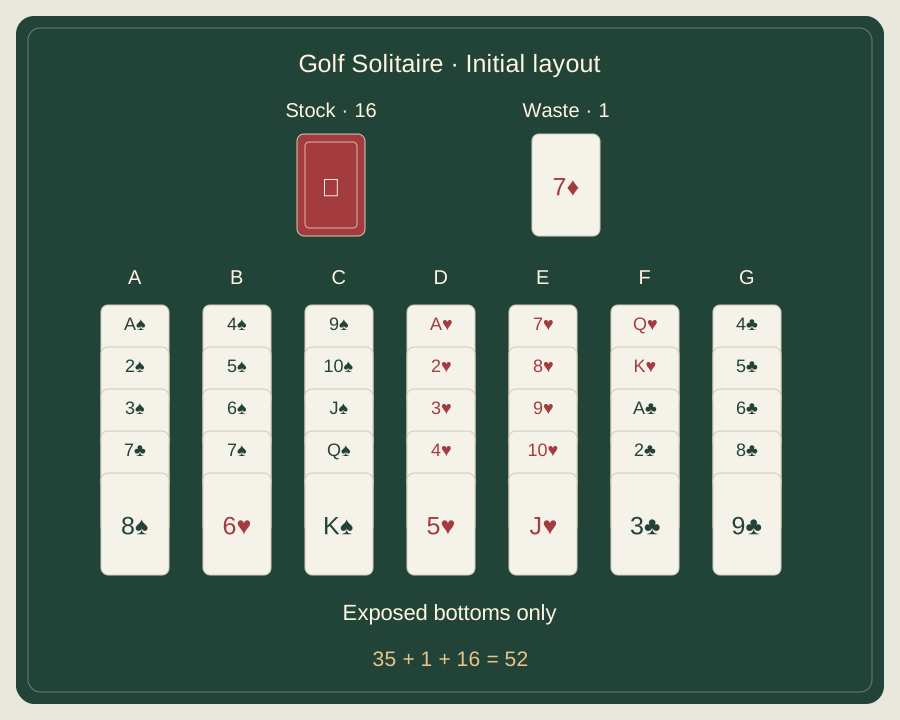
Use 1 ordinary 52-card pack without jokers. Deal 7 columns of 5 cards, all face up, overlapping vertically so each rank remains readable. Deal across the rows rather than building a single column at a time. The tableau contains 35 cards. The remaining 17 form the stock; turn its top card face up beside it as the waste, leaving 16 in the stock. The waste is the only destination for plays, not a source of reusable cards. Only the bottom, completely uncovered card of each column is initially playable. The picture shows every tableau card rather than a symbolic fan.
03 /
Build up or down, one card at a time
Move an uncovered tableau card onto the waste if its rank is exactly 1 step higher or lower than the current top. Ignore suit and colour; equal ranks do not match. The order is A, 2, 3, 4, 5, 6, 7, 8, 9, 10, J, Q, K. Change direction freely during a chain. Removing a column’s bottom card exposes the card immediately above it. Never take a covered card through the cards below, move a group, transfer between columns or refill an empty column. A card placed on the waste cannot return to the tableau. You may stop a chain to draw from the stock, but check the newly exposed options first.
04 /
Aces, kings and stock draws
There is no wrap between K and A. An ace on the waste accepts only a 2. A queen can accept J or K; once K is on top, no tableau card can follow in this strict version. Turn the next stock card onto the waste to restart. Each draw uses 1 card and covers the old top permanently; it need not be adjacent in rank. Do not choose a card deeper in the stock, reverse its order or redeal the waste. When the stock is empty, keep playing any legal tableau cards on the current waste. Empty stock alone does not end a playable chain.
05 /
Winning and keeping a golf score
Clear all 35 tableau cards to win the deal; unused stock cards need not be played. Otherwise stop when no tableau move is possible and no stock remains. Score 1 point for every card left in the tableau. For this scorecard, a cleared tableau scores −1 for every stock card left; clearing with no stock left scores 0. For example, leaving 4 tableau cards scores +4, while clearing with 3 stock cards unused scores −3; together those holes total +1. Record 9 holes and aim for the lowest sum. Comparing players fairly requires identical deals or enough shuffled holes to reduce the influence of luck.
06 /
A chain that reverses direction
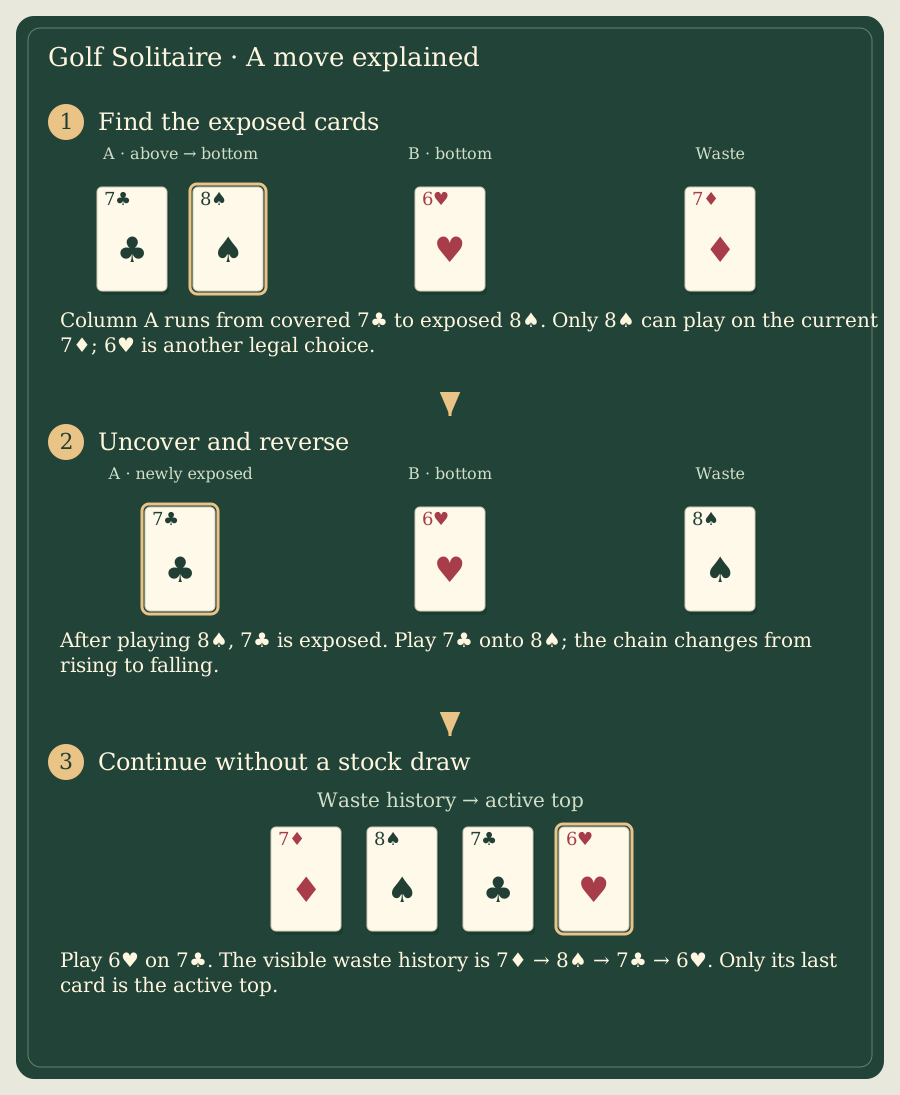
The waste is 7♦. The exposed bottom of column A is 8♠, with 7♣ immediately above it; column B has an exposed 6♥. Play 8♠ onto 7♦: this uncovers 7♣. Now play 7♣ onto 8♠, then 6♥ onto 7♣. The chain rises and then falls, legally. You could not play the covered 7♣ before removing 8♠, even though you could read its rank. In the full table illustration these cards occupy those exact accessible positions. Before choosing among legal cards, look at what each removal exposes; a short move can unlock a longer chain.
← On a small screen, scroll the diagram horizontally. →
Common questions
May I play a queen on a king?+
Not in this strict profile. A king stops the chain; a stock draw is needed unless the tableau is already clear.
Can I refill an empty column?+
No. Empty columns stay empty and no cards move between columns.
Does empty stock immediately end the deal?+
No. Continue legal tableau plays on the current waste. Stop only when blocked, or win by clearing the tableau.