← On a small screen, scroll the diagram horizontally. →
01 /
Players and cards
This patience for 1 player uses 2 mixed packs, 104 cards without jokers. Build 8 foundations A–K by suit, two of each suit. Identical copies are interchangeable, but an equal rank cannot stack on itself. Select the ordinary profile with single-card moves, descending suited columns and one stock pass.
02 /
Deal and opening
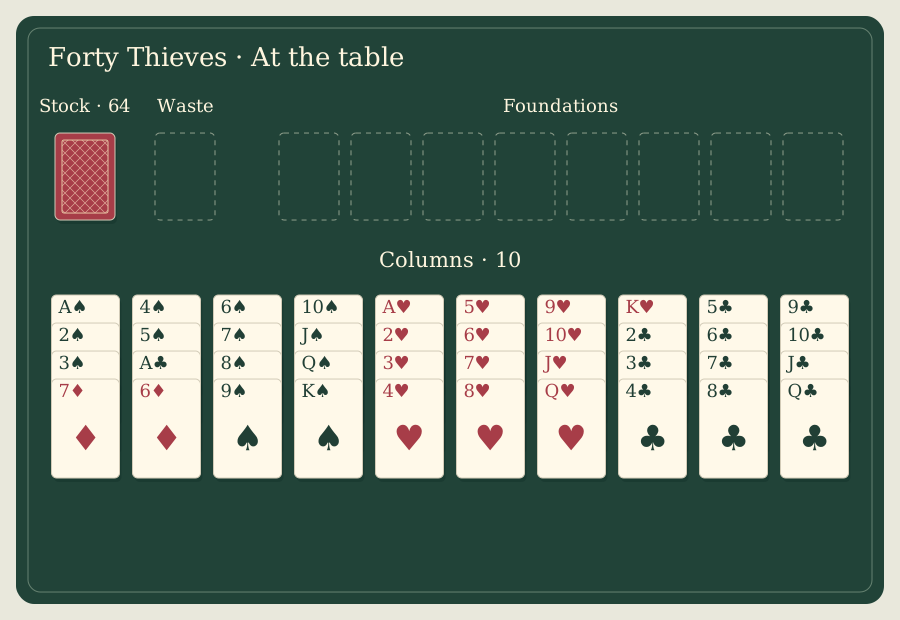
Shuffle and deal 10 columns of 4 exposed overlapping cards, 40 total. The other 64 form hidden stock. Foundations and waste begin empty; do not extract aces beforehand. Only each column’s top card is available: seeing a lower card does not make it playable. Never inspect hidden stock.
03 /
Playing a turn
A column or waste top may move to a foundation or column. An occupied column requires exactly one rank lower of the same suit: 6♦ on 7♦. Colour alternation is not used. Any available card may fill an empty column. Move singly; never simply lift a whole run. A run transfer is legal only as a sequence of valid single-card actions using available spaces.
04 /
Stock, waste and foundations
Whenever desired turn 1 stock card onto the common waste; only its top is available. Removing it exposes the previous card. Never take from waste’s interior or select stock cards. Once stock empties, do not turn waste back: there are no redeals. A foundation starts A then 2–3–4–5–6–7–8–9–10–J–Q–K in suit. Choose a fitting foundation between the two of a suit, without skipping ranks. This profile does not return foundation cards.
05 /
Scoring
No score is required. For personal comparison record foundation cards out of 104, not a promised monetary payout. Each complete foundation holds 13; eight contain the whole set. Waste and stock must empty. Identical copies in separate foundations are still distinct physical cards.
06 /
Ending the game
Win with all 104 cards on foundations. Empty stock alone is not defeat: waste top and columns remain available. If no legal transfer can help, the attempt is blocked. Do not rescue it by shuffling part of waste: that is a different variant. Start anew or separately allow undos for searching; there is no draw.
07 /
History and selected variant
Also called Big Forty and Napoleon at St. Helena, the game carries a disputed story about Napoleon playing it in exile; checked accounts do not establish that as biography. Its name refers to the forty initial tableau cards. Relatives such as Josephine may allow run transfers or different deals; strict single-card actions are retained here.
08 /
Worked example
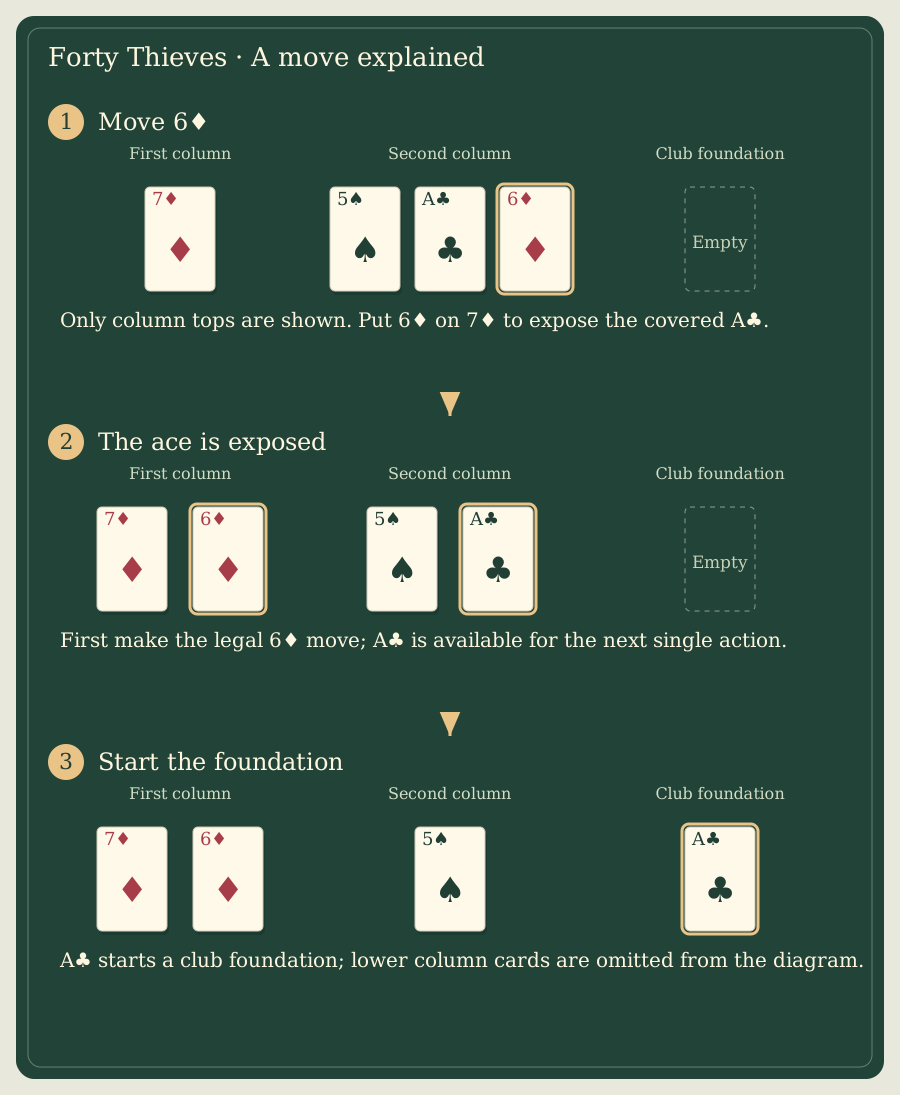
One column exposes 7♦; another exposes 6♦ covering A♣. Move 6♦ onto 7♦. A♣ is now free and starts an empty club foundation on the next action. Its original pack does not matter: a foundation requires rank and suit, not card back. The diagram shows only two column tops, not the full opening layout.
← On a small screen, scroll the diagram horizontally. →
Common questions
May I move a whole run?+
Only when it decomposes into legal single-card moves.
May identical cards stack?+
No, a column needs one rank lower.
Is a second stock pass allowed?+
No, then use only the remaining waste and columns.