← On a small screen, scroll the diagram horizontally. →
01 /
Aim and equipment
This profile is for 2 players or 4 fixed partners seated opposite. Use 40 Spanish cards: A, 2–7, sota, caballo, rey. With ordinary suits remove 8, 9, 10; map J to sota, Q to caballo and K to rey. Diamonds represent coins, hearts cups, clubs batons and spades swords. Capture values are A=1, numerals their value, J=8, Q=9, K=10. Score captures, coins, setenta and sweeps.
02 /
Setup and deal
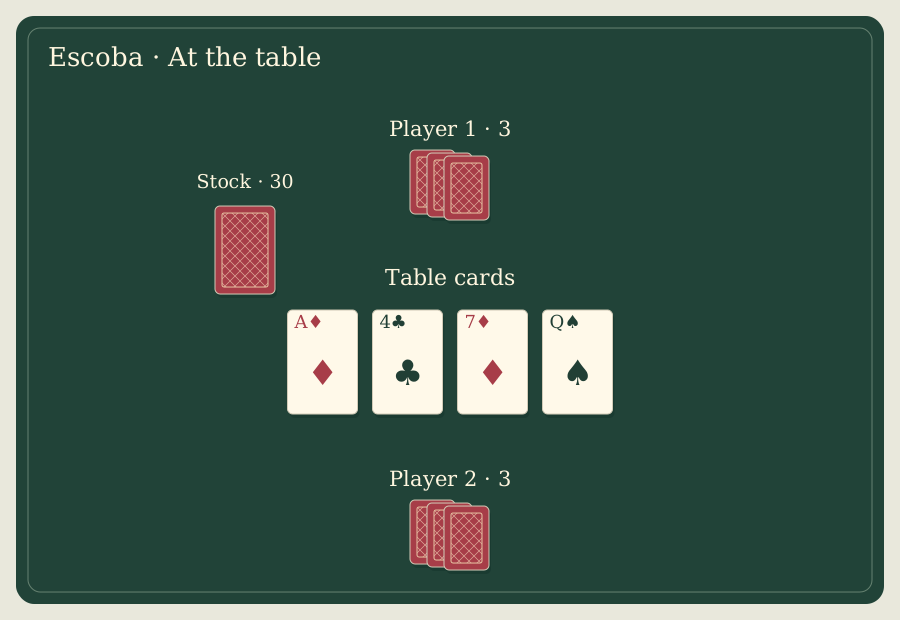
Choose the first dealer randomly; deal and turns rotate right. The left neighbour cuts. Deal 3 concealed cards each singly anticlockwise, then 4 face up centrally. Keep the remainder for later hand batches, not individual draws. If all four initial cards total 15, dealer captures them and records one escoba; if 30, two. Do not replace those centre cards. Dealer’s right starts.
03 /
Legal actions
Play one hand card. If it totals exactly 15 with selected table cards, capture that entire group including your played card into your concealed collection. Choose one of several alternatives; one card cannot make several separate captures in succession. You may choose a hand card that captures nothing, but if the played card can make 15, capture is compulsory. Without a total it remains face up. Clearing every table card earns an escoba; mark it with a face-up card in your captures.
04 /
Declarations
When every hand is empty, deal another 3 each without replenishing the centre. Continue through the pack and final hands. The last capturer takes remaining table cards; that cleanup is not an escoba. Partners share captures and score. The full pack’s capture values total 220: final leftovers total 10, 25, 40 or 55, useful for checking arithmetic.
05 /
Scoring
Each escoba scores 1. Another 1 each goes to most cards, most coins, holding the 7 of coins, and best setenta. Ties of 20–20 cards or 5–5 coins award nothing. For setenta choose your best card of each suit and add special values: 7=21, 6=18, A=16, 5=15, 4=14, 3=13, 2=12, J Q K=10. Missing a suit makes setenta invalid. Highest total wins; equality or both invalid means no point. These values never determine captures. There are no extra all-coins or all-sevens bonuses here.
06 /
Ending the game
Score the whole deal before checking the target of 21. If one side reaches it, they win; if both do, higher total wins. If tied, play complete further deals until unequal. Mid-deal escobas do not end the match. Reshuffle everything and rotate dealer between deals. Before the next turn, correct a mistaken total by restoring cards and choosing a legal action, our teaching agreement instead of tournament penalties.
07 /
Context and variants
The name means broom and refers to clearing the table. Escoba belongs to the capture family of Italian Scopa and is played in Spain and South America. We select the traditional numerical setenta described by Pagat. Fournier publishes different scoring with a sevens majority and extra awards; those are not mixed in. No reliable inventor or precise origin year is established.
08 /
Worked example
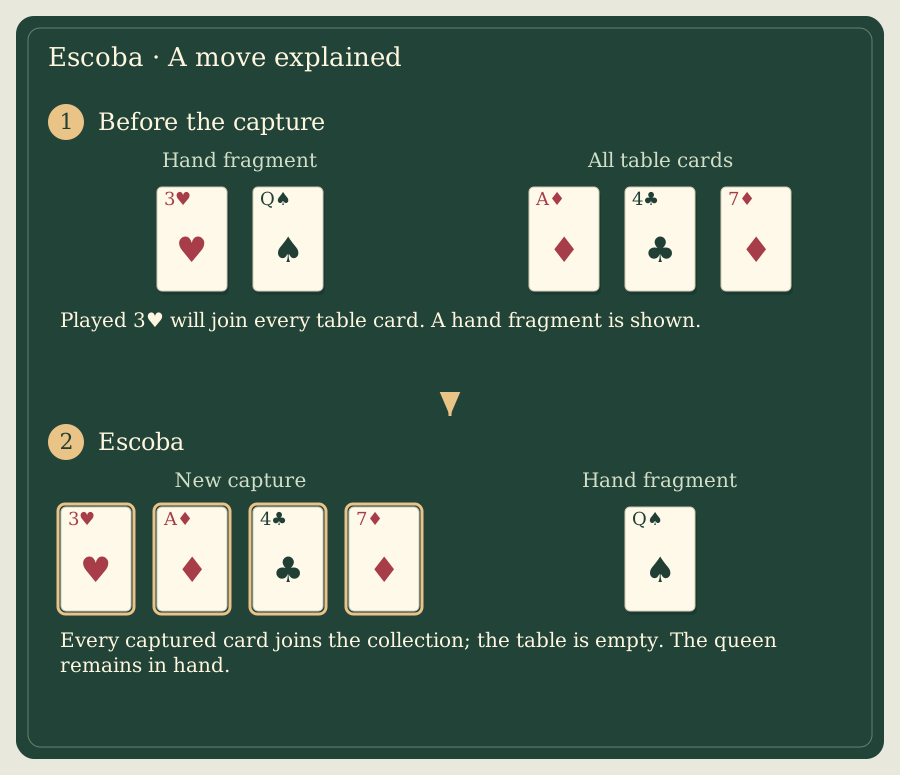
The table holds A♦, 4♣ and 7♦. Play 3♥: 3+1+4+7=15, take all four cards and mark 1 escoba. With an additional Q♠ on the table it would remain and there would be no escoba. At deal end, 22 cards, 6 coins, the 7 of coins, best setenta and 2 escobas score 1+1+1+1+2=6 points.
← On a small screen, scroll the diagram horizontally. →
Common questions
Do pictures use their printed numbers?+
No: J=8, Q=9, K=10 in this mapped diagram.
Does final cleanup earn an escoba?+
No: it collects leftovers without a sweep bonus.
May I take part of a capture?+
Choose one complete group totalling 15 including the played card.