← On a small screen, scroll the diagram horizontally. →
01 /
Switching the second cards
Blackjack Switch was designed by Geoff Hall as a separate blackjack variant. Two compulsory wagers buy a second-card exchange, balanced by 1:1 naturals and dealer 22 usually pushing. We select a common American profile: 6 decks, hole-card check and H17. This is not the Russian no-hole-card version; optional Super Match and surrender are disabled.
02 /
Dealing two hands
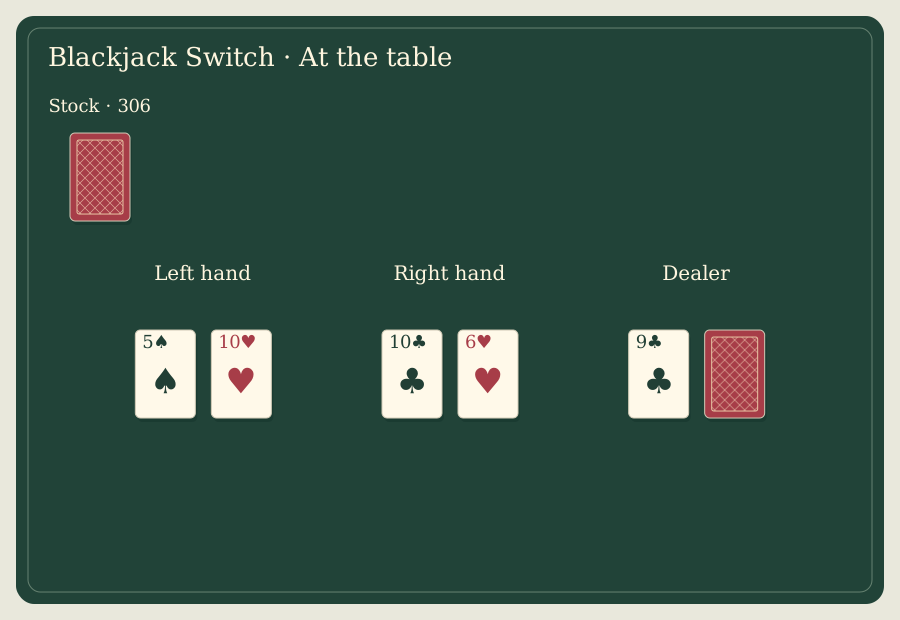
Shuffle 6 packs of 52 without jokers: 312 cards. Dealer and 1–6 players. Each makes equal wagers on two spots, here 2 and 2 from an initial 100 notional chips. Deal 2 face-up cards per spot, dealer one up and one down. Preserve first/second card order. A counts 1 or 11 without busting, J/Q/K 10, others face value; above 21 loses immediately for the player.
03 /
Insurance and checking
With dealer A up, insurance up to half each original wager is offered before switching: at most 1 per spot here. It pays 2:1 for dealer natural and loses otherwise. With A or 10-value upcard dealer checks the hole card before switching or other decisions. Dealer natural makes ordinary hands lose; only original naturals A+10-value push. Otherwise continue. Insurance does not grow with later doubles or splits.
04 /
What may switch
In order from dealer’s left, keep both hands or exchange only their second cards. First cards stay; no arbitrary cards or exchanges with another player. Make one choice before drawing, splitting or doubling these hands. No later switching. An A+10 created by switching is ordinary 21, not a natural despite having two cards. An untouched original natural keeps its status.
05 /
Playing both hands
Finish the first hand, then the second. Hit singly or stand; at 21 stop drawing. Double on any first 2 by adding an equal stake, taking exactly one card and standing. Double after non-ace splits is allowed. Equal-value initial cards may split with another equal stake; resplit non-aces to 4 hands from each original. Split A only once, one card each without later hit or double. All split-hand 21s are ordinary. Without funds for an option, use normal hit/stand.
06 /
Dealer’s special 22
Dealer reveals: hit below 17 and soft 17, stand on hard 17 and every 18–21. Final 22 pushes all unbusted ordinary hands, returning the whole wager including doubles; original natural wins. At 23 or more all survivors win. At 17–21 compare totals; equal totals push, except original natural beats dealer’s ordinary 21.
Every win, including natural, pays 1:1 profit. Switched 21 pushes dealer’s ordinary 21 or 22, without natural privilege. Already busted players lose even when dealer reaches 22.
07 /
Teaching session
For home play shuffle the whole shoe each round and play 10 rounds. A participant without 4 for the two compulsory bets stops; extra actions use available chips only. Compare gains against initial 100, preserving ties. This finish is an agreement, not a universal tournament. Do not combine this profile with 3:2 naturals or ordinary bust-on-22 rules.
08 /
Switch and two pushes
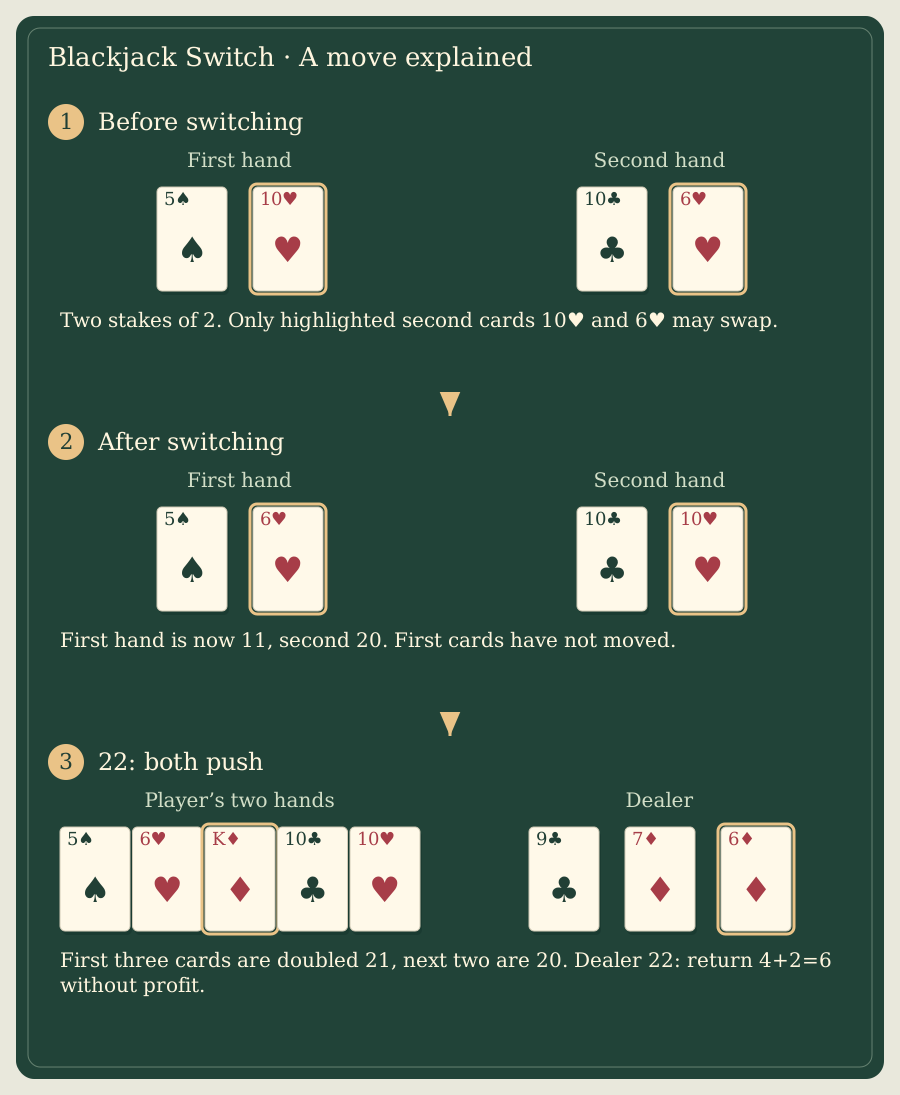
First hand 5♠–10♥, second 10♣–6♥, stake 2 each. Exchange only 10♥ and 6♥: obtain 5♠–6♥ for 11 and 10♣–10♥ for 20. Double first to 4, draw K♦ for 21; second stands. Dealer reveals 9♣–7♦ and draws 6♦: 22. Both push, returning 4+2=6 without profit. An untouched natural against that same 22 would instead win 1:1.
← On a small screen, scroll the diagram horizontally. →
Common questions
May first cards switch?+
No, only the second cards of the two original hands, once.
Are all 21s naturals?+
No: after switching, splitting or drawing they are ordinary 21.
Does dealer 22 rescue a player bust?+
No, only hands of 21 or less can push.