← On a small screen, scroll the diagram horizontally. →
01 /
Two tableaux against one bank
Baccarat Banque here means Baccarat à deux tableaux: one banker’s hand faces independent right and left hands. It is not automatic-draw Punto Banco or Chemin de Fer’s loss-driven bank rotation. The two-tableau form is documented in the nineteenth century; a proven medieval Italian origin is not established. We select a home, notional-chip, no-commission profile based on Pagat’s detailed account.
02 /
Packs and banker
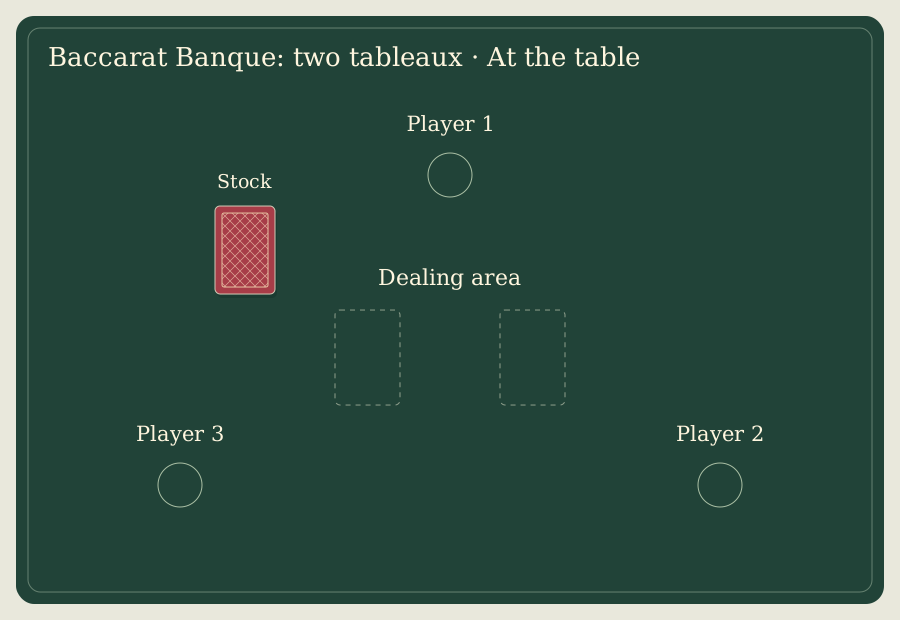
For 3–11 participants shuffle 3 standard packs without jokers: 156 cards. One banker, others on two sides with at least one on each. Start everyone with 100 notional chips. Volunteers announce their funded bank; the largest becomes banker. This is capital at risk, not a fee. Resolve equal offers by lot. Others may shuffle, banker shuffles last, and a selected participant cuts.
03 /
Stakes and coverage
Before cards, announce available bank capital. Accept wagers anticlockwise from banker’s right; ordinary bets here back your own side, while à cheval divides a wager equally between sides. Combined accepted stakes cannot exceed the fund: reject excess or reduce it to the remaining cover before dealing. Thus the bank can pay even if both sides win; there is no proportional short payment.
Calling banco offers the whole bank and has priority. Two claimants on opposite sides each cover half; with more claimants, earlier positions take priority. A losing banco caller has banco suivi priority next coup. Accepted wagers cannot change after cards appear.
04 /
Three hands and naturals
Each side has an active player making decisions for its wagers. First is earliest in order; keep that player after a win, rotate within the side after a loss, and retain after a tie in this profile. Banker deals concealed: right, left, self, repeated, giving 2 each. A=1, 2–9 face value, 10/J/Q/K=0; retain the sum’s last digit. Each inspects their own cards. If any hand has a two-card 8 or 9, reveal all three and settle both sides immediately: nobody draws.
05 /
Drawing order
Without naturals, right active player decides first, then left. At 0–4 draw a third card; at 6–7 stand; at 5 choose. Third cards are face up; original pairs remain hidden. After both decisions banker freely chooses draw or stand at any own total 0–7: no mandatory Punto Banco table, nor discretion restricted to five. Banker sees the actions and third cards, not the concealed pairs. Each hand has at most 3 cards; then expose all.
06 /
Two separate settlements
Compare banker separately with each side. Higher side receives one stake profit plus its original stake; higher banker collects that side’s stake; equality returns it without profit. The sides do not compete with each other. Settle à cheval halves independently. Here there is no commission, natural bonus or tie bet. Letting winnings ride creates a new stake subject to bank coverage again. Banker retains the seat after a loss if the fund remains positive and they continue.
07 /
Bank and session end
For a complete home profile, the session lasts one bank: until voluntary retirement after at least one coup, bankruptcy, or fewer than 9 cards before a new coup. That last rule explicitly ensures enough cards for three full hands. Never recycle mid-coup. Unrisked bank capital belongs to banker and returns to their personal balance. Compare final personal totals with the original 100: highest wins, ties share victory. Continuing means a fresh bank and shuffle.
08 /
Right wins, left ties
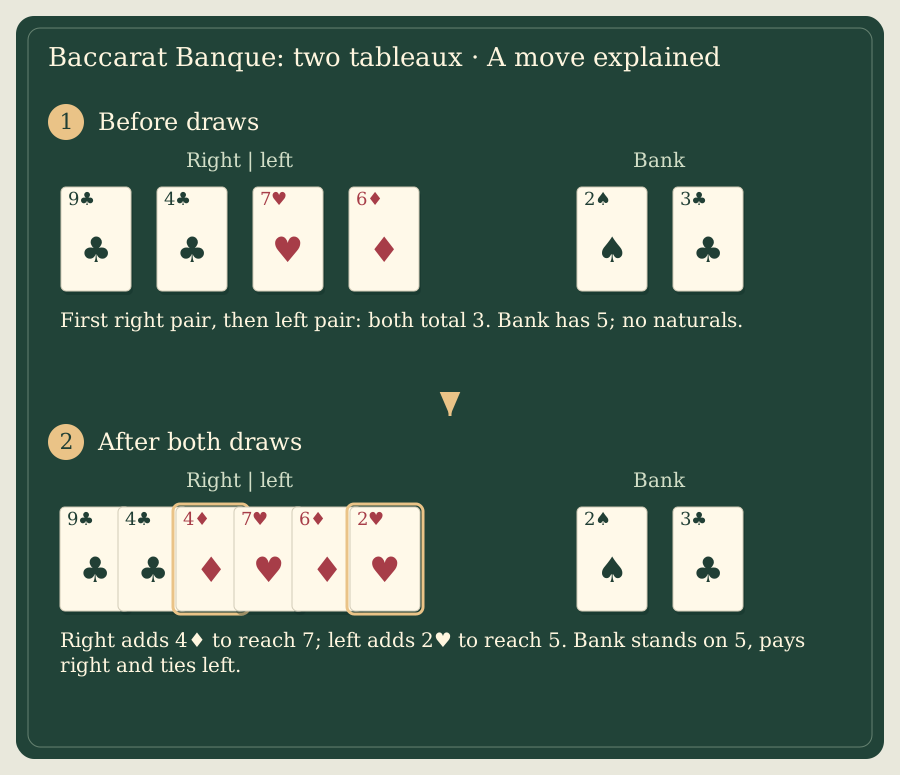
Bank fund 10; right stakes 5, left 3: total 8 is covered. Right has 9♣+4♣=3, left 7♥+6♦=3, bank 2♠+3♣=5. No naturals. Right draws 4♦ to reach 7; left draws 2♥ to reach 5. Banker chooses to stand on 5. Right earns 5, left receives its 3 back without profit; bank fund falls to 5. One banking hand produces different results against the two sides.
← On a small screen, scroll the diagram horizontally. →
Common questions
Must banker draw on 2?+
In this selected à deux tableaux profile, any non-natural total is discretionary.
Do the two sides compare with each other?+
No, each compares only with the one bank hand.
What if bets exceed the fund?+
Reject excess before cards; accepted stakes must be fully covered.