← On a small screen, scroll the diagram horizontally. →
01 /
Setup
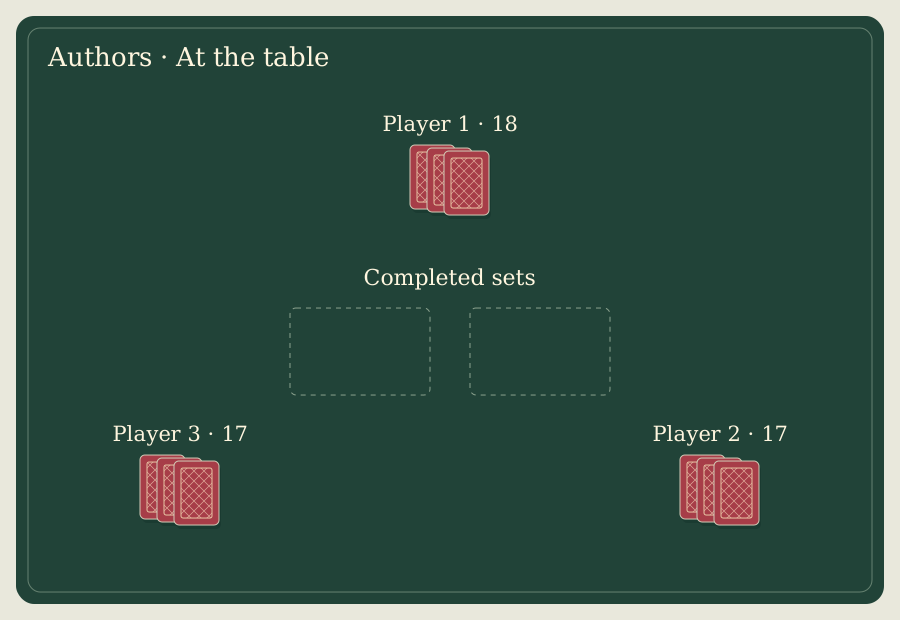
Three to six players use 52 cards without jokers. Shuffle and deal the whole pack clockwise, one at a time, as evenly as possible. Some players may receive one extra card. A book consists of all four cards of a rank: four sevens, four queens and so on.
Lay completed books in front of their owner; they cannot be requested again. The player left of the dealer asks first. Suit and rank ordering are irrelevant.
02 /
Requests and turns
Name another player and a rank you already hold. For example: “Olga, give me your jacks.” Olga must transfer every jack in her hand. A successful requester asks again, addressing either the same opponent or someone else.
If the opponent has none, the turn moves to the requester’s next neighbour on the left. Nobody draws: there is no stock. Put a completed quartet aside immediately. Skip players with empty hands; they receive no replacement hand.
03 /
Winning
Continue until all thirteen books are on the table. Most books wins; in this guide, tied leaders share the win. For a series, award one point per book and agree on the number of deals beforehand.
The first empty hand does not end the entire game: others may still hold incomplete books. Do not confuse books won with cards remaining in hand.
04 /
A request that continues
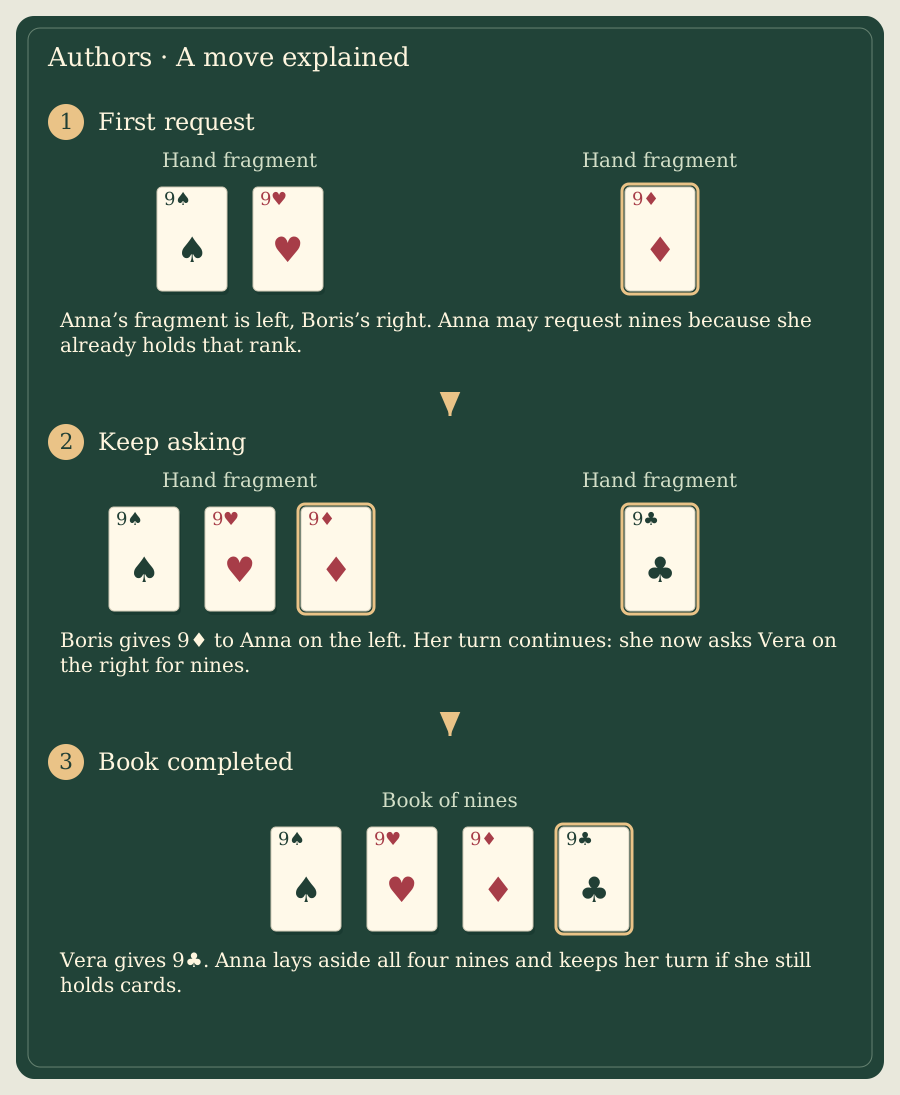
Anna has 9♠ and 9♥, Boris has 9♦, and Vera has 9♣. Anna asks Boris and receives the diamond. Her turn continues, so she may now ask Vera. Taking the last nine completes a book; Anna lays it aside and keeps asking.
If Boris had held no nines, the turn would have passed to Anna’s left. Asking for aces without holding an ace would be illegal, even after a successful request. Remembering another player’s interest can identify whom to ask on a later turn.
← On a small screen, scroll the diagram horizontally. →
05 /
From literary cards to an ordinary pack
The New York Historical dates the first Game of Authors publication to 1861, by G. M. Whipple and A. A. Smith in Salem, Massachusetts. Themed cards grouped writers with titles of their works. Many later editions used different numbers of cards and thematic groups.
This version applies that collecting principle to ordinary ranks. Authors belongs alongside Go Fish and quartet games, but removing the stock changes where information comes from. Do not import a draw rule or a different turn-passing rule without an agreement.
Common questions
Can I ask for a rank I do not hold?+
No. This version requires at least one card of the requested rank.
How does it differ from Go Fish?+
Every card is dealt, so an unsuccessful request never leads to a draw.