← On a small screen, scroll the diagram horizontally. →
01 /
The game at a glance
Use the ordinary pack plus both jokers. Single-card order rises 3 4 5 6 7 8 9 10 J Q K A 2, then black joker, then red joker. Suits do not rank. A set has at least 2 cards of one declared rank; twos and jokers may substitute for lower cards. A pure set beats an impure set of the same declared rank and size; otherwise higher rank wins. Number of wild cards does not break a tie between impure sets.
02 /
Prepare and deal
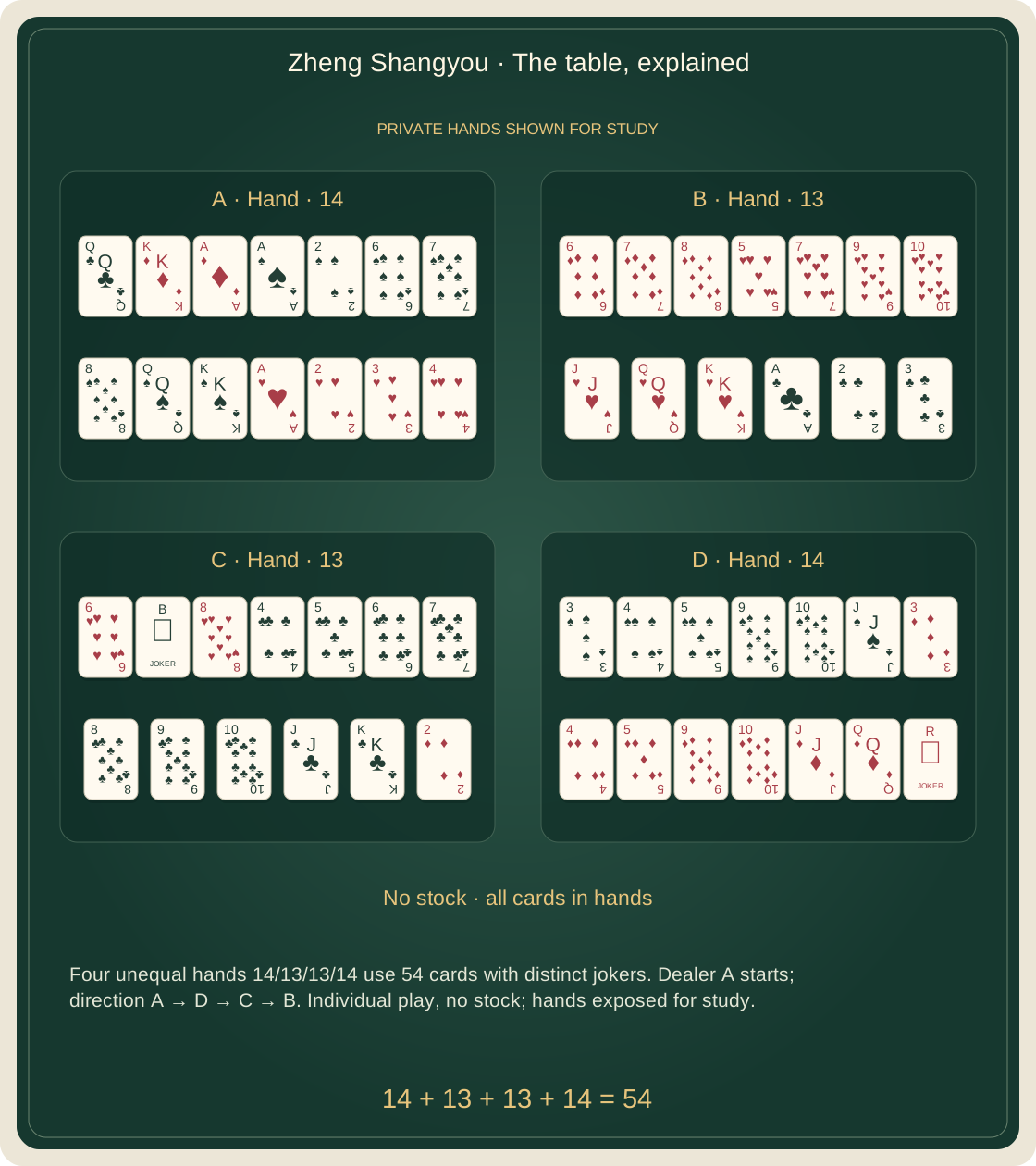
Choose dealer randomly for the first deal. Deal every card singly counterclockwise, starting with dealer. Unequal hand sizes are allowed. With four, dealer A and D receive 14 each, B and C 13 each; no stock remains. Dealer leads any legal combination, not necessarily the smallest card. In later deals the previous third-place finisher deals and starts, after the exchange described below.
03 /
How play proceeds
After the lead, play the same number of cards in the SAME pattern and beat the last play, or pass. A passer may re-enter later in the same climb. A new higher play resets the consecutive-pass count. When everyone else still holding cards passes, clear the played cards; the last player to play leads any pattern anew. Skip empty hands. If that last player has already gone out, the next player to their right with cards leads. A four-card set is not a bomb over an unrelated pattern.
04 /
Rules that change your decision
A single run has at least 3 consecutive ranks from 3 through A. NEVER use 2, naturally or wild, in a single run. Jokers may fill gaps and are assigned a suit if declaring a suited run. Any suited run beats any mixed run of equal length, even if lower. Within each class compare top rank first, then purity only on equal rank. A multiple run needs at least 3 consecutive ranks with an equal multiplicity of at least 2; matching length alone is insufficient. Twos may fill its gaps only if each rank still has a natural card or joker.
05 /
Finish and scoring
Session convention: check the target after every finishing place is determined. Continue until only one hand remains, recording every finishing place. First gains 2 points, second 1, others 0; first reaching 11 wins, or highest total if several reach it in the same deal. If tied highest, play another deal. Before the next deal’s play, last and next-to-last each expose their highest card. Previous winner chooses one, runner-up takes the other. Winners each return any unwanted card; previous next-to-last chooses first from these returns, last takes the other. Counts stay unchanged.
06 /
A worked example
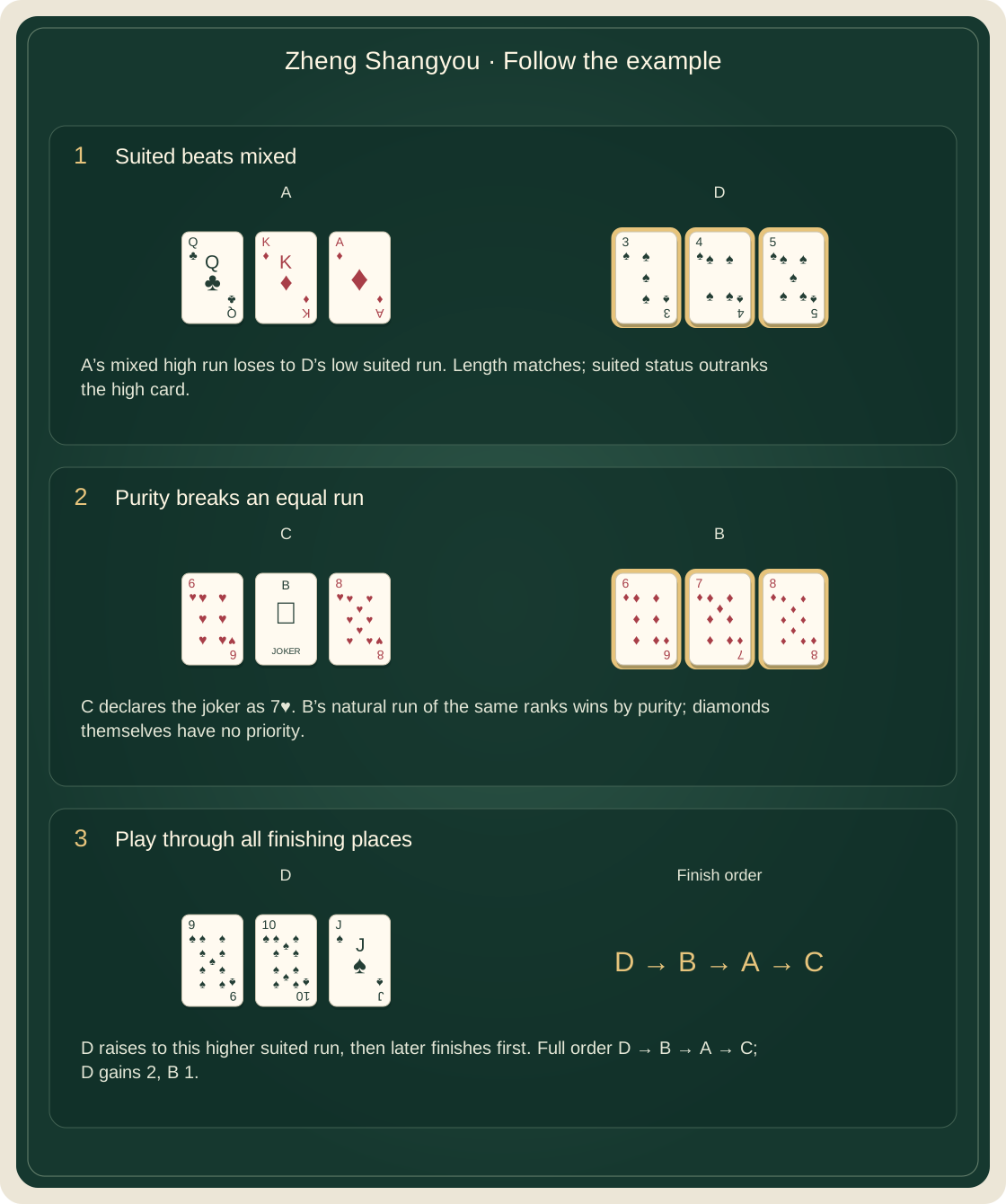
A leads mixed Q♣ K♦ A♦. D’s suited 3♠ 4♠ 5♠ beats it despite lower ranks. C uses 6♥ black joker 8♥, naming the missing heart seven. B’s natural 6♦ 7♦ 8♦ beats C by purity, not by diamonds. D later raises to 9♠ 10♠ J♠; the others pass and D regains the lead. The complete saved replay ends D, B, A, C: points 2, 1, 0, 0 in that order. A is next dealer and also next-to-last, so must contribute a highest card in the next exchange.
| Play | Player | Cards / pass |
|---|---|---|
| 1 | A | Q♣ · K♦ · A♦ |
| 2 | D | 3♠ · 4♠ · 5♠ |
| 3 | C | 6♥ · Black joker · 8♥ |
| 4 | B | 6♦ · 7♦ · 8♦ |
| 5 | A | Pass |
| 6 | D | 9♠ · 10♠ · J♠ |
| 7 | C | Pass |
| 8 | B | Pass |
| 9 | A | Pass |
← On a small screen, scroll the diagram horizontally. →
07 /
What to watch at the table
Save flexible high cards to regain control, but seek opportunities to lead awkward low cards. Do not spend twos in a single run: they are illegal there. When several interpretations are possible, announce the represented ranks and suited status before the next player responds. A pass need not mean a weak hand; it can preserve a combination for a later lead.
08 /
Choose the rules before starting
Some tables put twos naturally into runs, unlike this profile. Four-player partnerships combine individual points; six-player teams use a different team schedule and target 50. Those change the exchange incentives as well as scoring. Our complete individual rules use neither teams nor additional bombs, attachments, mandatory lowest-card openings or suit strength from Big Two.
09 /
History and related games
The Chinese name evokes striving upstream. This belongs to a broader Asian climbing-game family alongside regional games with different patterns and ranks. A contributor-taught version reached British players under the name Pits, referring to the losing positions that must give up strong cards. Keeping that documented profile explains its distinctive run hierarchy and exchange.
10 /
Check your understanding
Can a low suited run beat a high mixed run?
Show answer
Yes, if both have the same length; suited status is compared first.
Can a two fill a missing card in a single run?
Show answer
No. Single runs exclude twos even as wild cards.
Common questions
Does passing lock me out?+
No. You may respond again if play returns to you.
Do suits break equal singles?+
No, a matching rank cannot beat an equal single.
Does play stop at the first winner?+
No. Determine all places for scoring, next dealer and exchange.