← On a small screen, scroll the diagram horizontally. →
01 /
The game at a glance
Play alone with an ordinary pack and no jokers. A is low and K high. The tableau descends by rank while alternating red and black; hearts and diamonds are red, clubs and spades black. The foundations instead rise within one suit. A card buried under other cards is not automatically available for a foundation, even if visible.
02 /
Prepare and deal
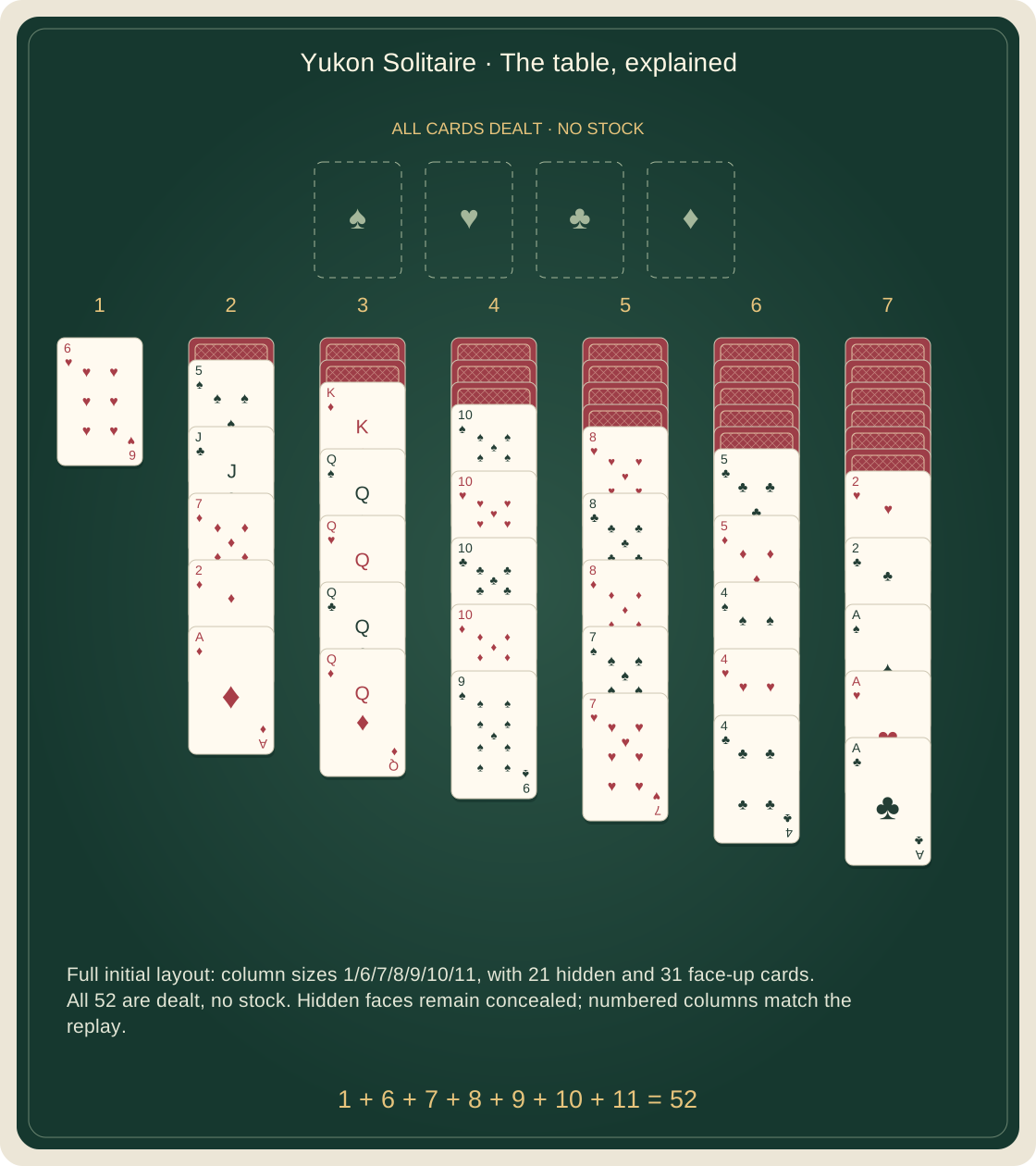
Make the ordinary Klondike triangle of 28 cards in 7 columns, leaving only each column’s last card face up. Deal the remaining 24 face up, adding 4 to each column except the first. Column sizes are 1, 6, 7, 8, 9, 10, 11. Hidden counts are 0, 1, 2, 3, 4, 5, 6: 21 hidden and 31 exposed. Start four empty foundations. There is no spare draw pile.
03 /
How play proceeds
Choose any face-up card and move it with ALL cards below it toward the free end of that column, preserving their order. Its new support must be exactly one rank higher and opposite colour. The transported group itself need not form a sequence. You cannot lift a face-down card or leave some covering cards behind. When a hidden card becomes the uncovered end, turn it up immediately.
04 /
Rules that change your decision
An empty column accepts only K or a group headed by K. It is not a free cell for any card. Only the free end card of a column can move alone to a foundation: start with A, then 2 through K of that exact suit. Do not send an entire group to a foundation. A top foundation card may come back to a legal tableau destination, one card at a time, if it helps rearrange a blockage.
05 /
Finish and scoring
Win when all 52 cards occupy the foundations, with 13 in each. There is no waiting for a new stock card and no redeal. If useful moves are exhausted, the current attempt is blocked; start a new shuffled deal if desired. Repeating the same reversible moves is not progress. Undo and hints are learning tools, not additional legal card moves.
06 /
A worked example
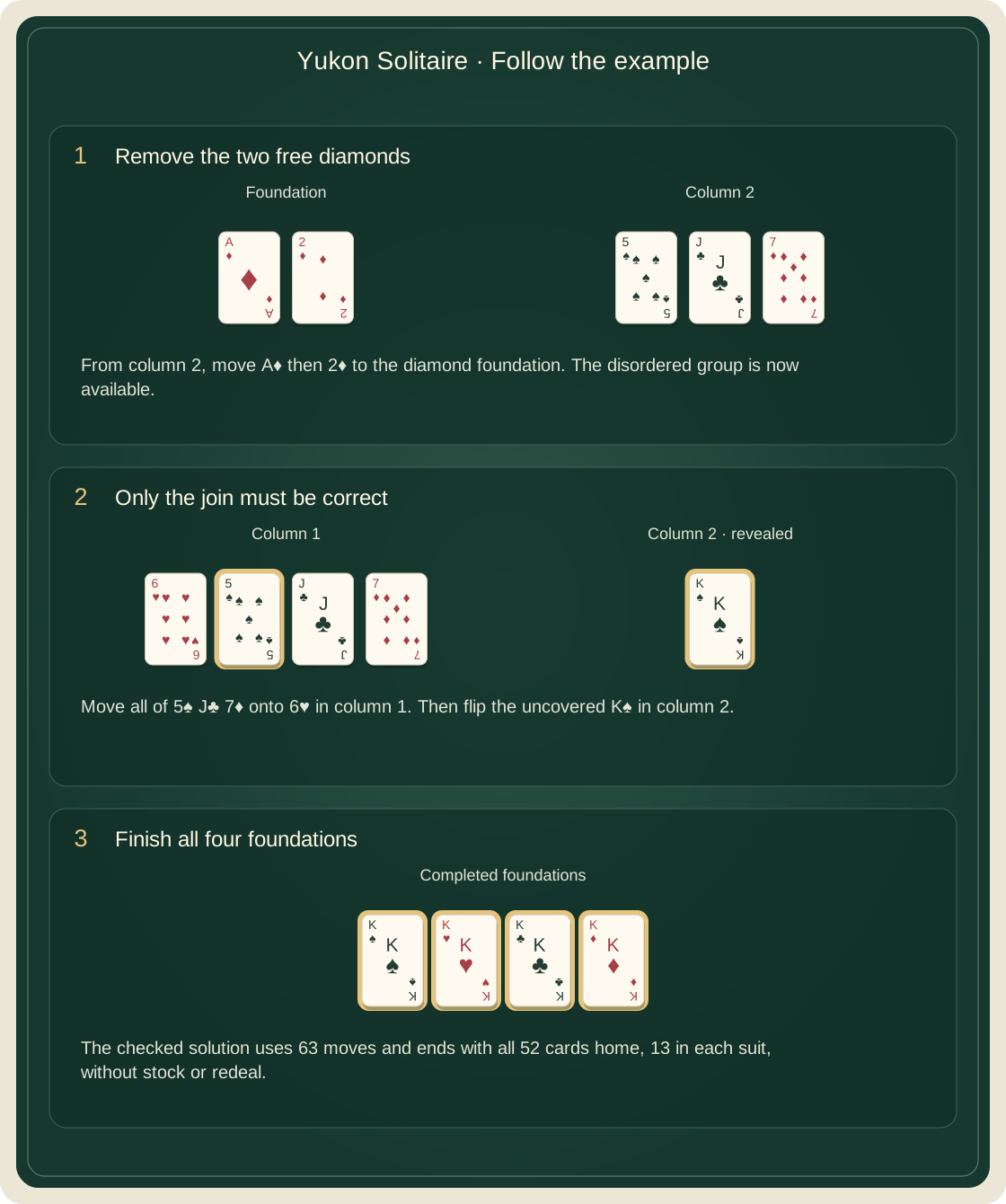
In the illustrated deal, send A♦ and then 2♦ from column 2 to their foundation. This exposes 7♦, but moving it alone would leave J♣ covering 5♠. Instead lift the entire group 5♠ J♣ 7♦ onto column 1’s 6♥. The join is legal although the group is disordered. Hidden K♠ in column 2 is now revealed. The opening table and diagrams show the change; the saved full solution finishes in 63 legal moves without redealing.
| Step | Move |
|---|---|
| 1 | Column 2: A♦ → foundation |
| 2 | Column 2: 2♦ → foundation |
| 3 | Column 2 → 1: 5♠ · J♣ · 7♦ |
| 4 | Column 7: A♣ → foundation |
| 5 | Column 7: A♥ → foundation |
| 6 | Column 7: A♠ → foundation |
| 7 | Column 7: 2♣ → foundation |
| 8 | Column 7: 2♥ → foundation |
| 9 | Column 7: 2♠ → foundation |
| 10 | Column 7: 3♦ → foundation |
| 11 | Column 7: 3♣ → foundation |
| 12 | Column 6: 4♣ → foundation |
← On a small screen, scroll the diagram horizontally. →
07 /
What to watch at the table
Look beyond the free end cards. A buried face-up card may be the key to freeing a whole hidden layer. Before moving a group, inspect what it exposes and what it covers at the destination. An empty column is valuable only when a king can use it. Avoid moving a useful support to a foundation too early if the tableau still needs it.
08 /
Choose the rules before starting
Russian Solitaire builds tableau groups by suit rather than alternate colour; it is not the same rule. Alaska changes permitted rank direction. Digital versions differ in foundation returns, automatic moves and scoring. This guide permits legal single-card foundation returns but adds no stock, reserve cells or arbitrary empty-column fills.
09 /
History and related games
Yukon sits in the North American named branch of Klondike-related patience games. Its name evokes the same northern geography, but the play is defined by the no-stock deal and permissive group movement. Russian Solitaire and Alaska use related layouts with different building rules, making the choice of variant important even when the starting table looks familiar.
10 /
Check your understanding
Must the moving group be in order?
Show answer
No. Only its join with the destination must obey rank and colour.
Can an exposed buried ace go straight home?
Show answer
No. Remove its covering cards first; only the free end can enter a foundation.
Common questions
Is there a stock?+
No. Every card starts in the tableau.
What fills an empty column?+
A king or a complete group headed by a king.
Are hidden cards available?+
Only after uncovered and turned face up.