← On a small screen, scroll the diagram horizontally. →
01 /
The game at a glance
Use an ordinary pack with two distinguishable jokers. A is worth 1; 2–10 their printed number; J, Q and K each 10; jokers 0. Suits matter for runs, not for comparing hand totals. Low totals are good. A joker in hand has no penalty value even if it could substitute for a costly card in a run.
02 /
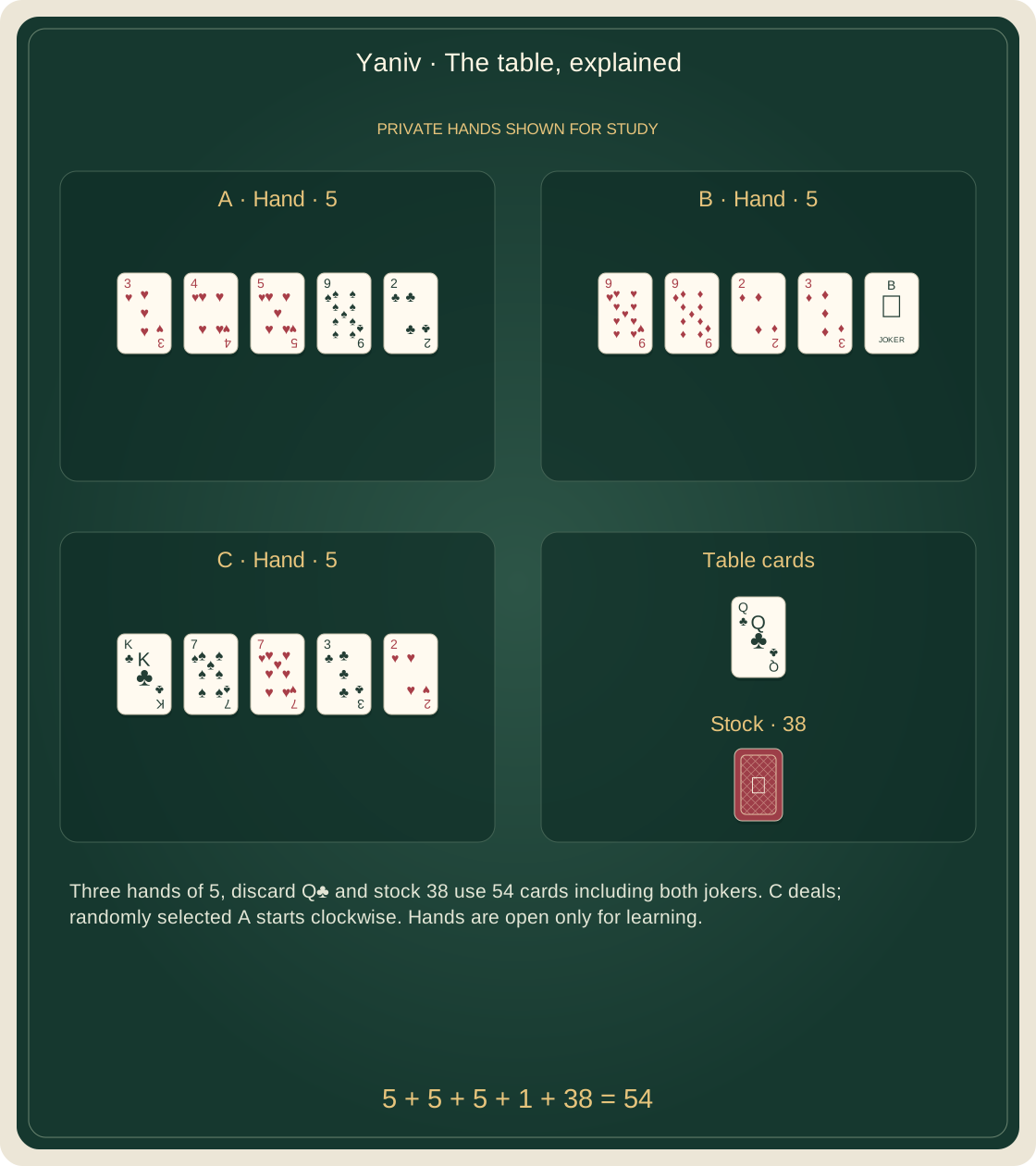
Prepare and deal
Shuffle and deal 5 cards each clockwise, individually. Turn the next card up as the first discard; the rest is the closed stock. Choose the initial starter randomly before inspecting hands. In later rounds the lowest hand from the previous round starts, not necessarily the caller; resolve ties clockwise from the caller’s left. With three players the initial stock has 38 cards.
03 /
How play proceeds
At the START of your turn either call or discard one legal combination and take exactly one card. Discards allowed: a single card; at least 2 equal-rank cards; or at least 3 consecutive cards of one suit. In a run A is low, never after K; a joker may represent a missing rank. Place a run in rank order. One turn cannot discard unrelated groups together. After any discard you still draw, so emptying the hand does not end the round.
04 /
Rules that change your decision
Draw from stock or take an END card from the previous player’s discard, as it stood before your own discard. You cannot take your just-discarded card. For equal-rank sets, middle cards are also protected; order can matter. With an empty stock, shuffle older discards into a new stock, leaving the entire most recent discard accessible. Only a run uses a joker as a substitute in this profile; do not invent joker-filled equal-rank sets.
05 /
Finish and scoring
Calling requires a hand worth at most 5 at the beginning of your turn, and replaces that turn. Strictly lowest caller adds 0; everyone else adds hand value. If anyone ties or undercuts, Asaf makes caller add 30 plus hand value; all others still add their hands. Apply one exact-score reduction per round: 100 → 50, 200 → 100. Above 200 is eliminated; continue until one survives. If all would be out, our agreed tie-break retains the lowest total only, or all tied lowest for another round.
06 /
A worked example
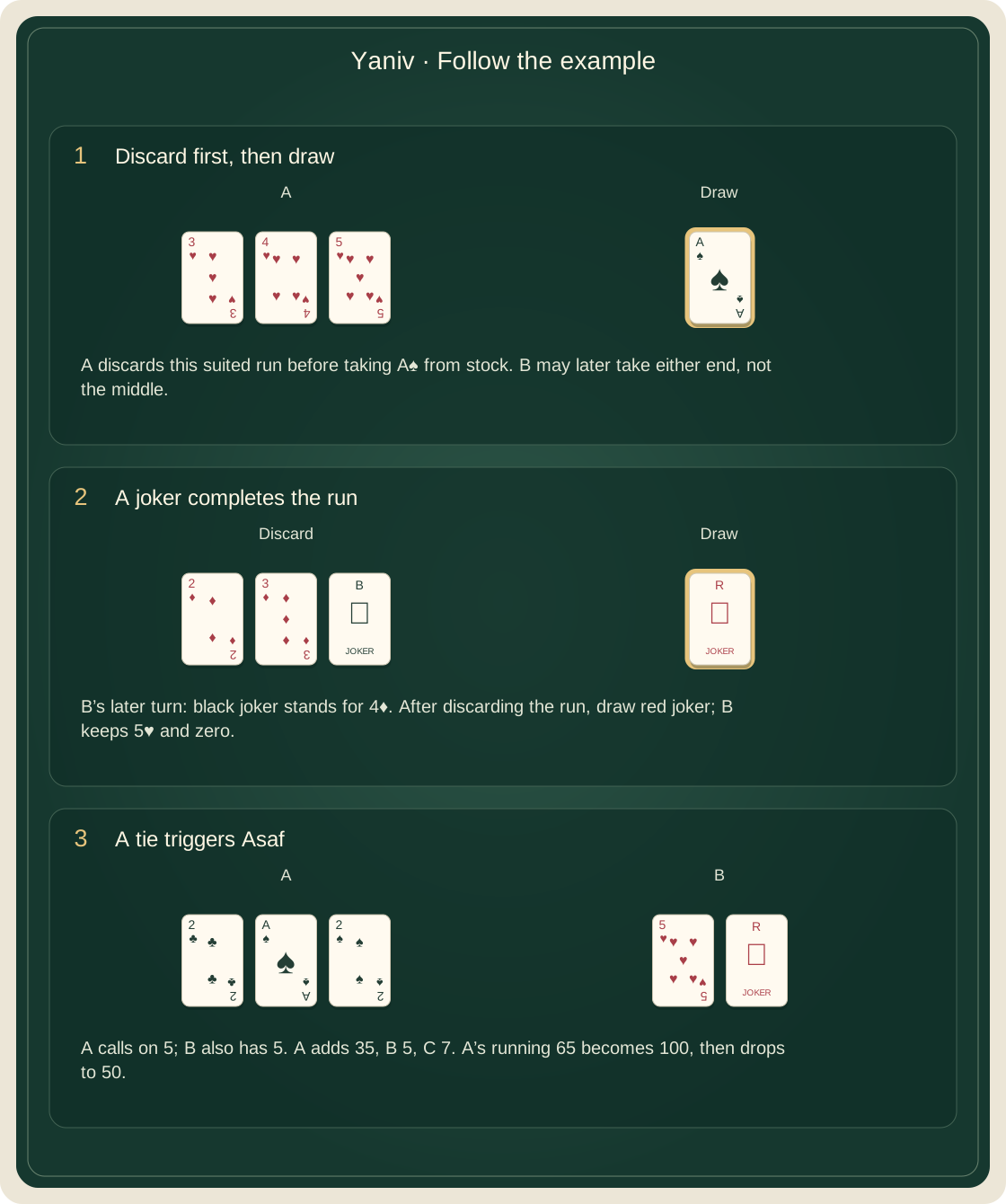
A discards 3♥ 4♥ 5♥ before drawing A♠. B discards two nines and takes the exposed end 5♥. Later B discards 2♦ 3♦ black joker as a run ending in the missing four, then draws the red joker. After the complete turn log A calls on 5; B also has 5, C has 7. Asaf gives round additions 35, 5, 7. Starting totals 65, 190, 194 become 50, 195, 201 after the exact reduction. C is out; B starts next by the clockwise tie rule.
| Turn | Player | Discard / call | Take |
|---|---|---|---|
| 1 | A | 3♥ · 4♥ · 5♥ | A♠ · stock |
| 2 | B | 9♥ · 9♦ | 5♥ · previous discard |
| 3 | C | 7♠ · 7♥ | A♦ · stock |
| 4 | A | 9♠ | 2♠ · stock |
| 5 | B | 2♦ · 3♦ · Black joker | Red joker · stock |
| 6 | C | K♣ | A♣ · stock |
| 7 | A | Yaniv | — |
← On a small screen, scroll the diagram horizontally. →
07 /
What to watch at the table
Removing several cards at once reduces your hand size, but taking a visible card reveals information. Watch which low cards opponents keep, and whether your call would lose on a tie. A zero-point joker can be worth keeping instead of using in a run. Do not assume the smallest number of cards is the smallest total.
08 /
Choose the rules before starting
Thresholds of 7 and different elimination limits are common elsewhere. Some tables allow any card from a discarded set or a rapid slam-down; this profile does neither. Extra packs change duplicate-card possibilities, so this guide keeps one pack. Agree the call threshold, penalties, exact-score reductions and all-eliminated tie-break together before dealing.
09 /
History and related games
Yaniv belongs to the draw-and-discard tradition also known through Nepalese Jhyap and Dhumbal. Israeli players and travellers helped spread the Yaniv name internationally. Related names do not guarantee identical rules: direction, jokers, call limits and penalties differ. The familiar rummy combinations are discarded, not permanently laid down as melds.
10 /
Check your understanding
Can A call immediately after drawing a low card?
Show answer
No. A must wait until the beginning of the next own turn.
Is a tied minimum safe?
Show answer
No. The caller must be strictly lower than every opponent.
Common questions
Which card can I take from a run?+
Only either end, never a protected middle card.
Is calling mandatory when low?+
No. You may continue with a normal discard-and-draw turn.
Do I draw before discarding?+
No, discard first; calling is the separate alternative.