← On a small screen, scroll the diagram horizontally. →
01 /
The game at a glance
Use 52 ordinary cards without jokers. Every suit ranks A K Q J 10 9 8 7 6 5 4 3 2. A, K, Q, J on diagrams correspond to Belgian indices often printed as 1, R, D, V. There are 13 tricks, with no card-point values. Players keep individual accounts even when a temporary partnership wins.
02 /
Prepare and deal
Choose dealer randomly, then rotate left. Shuffle before the session; between deals gather and cut rather than reshuffle in this profile. Right neighbour cuts. Deal packets 4, 4, 5 each. Turn the final card up: it identifies provisional trumps and remains part of dealer’s 13 cards, never an extra indicator outside the pack. Dealer takes it up after the auction. No card exchange follows.
03 /
How play proceeds
Dealer’s left begins bidding. Pass withdraws permanently. Vraag asks for a partner to take at least 8 with the turned suit; Meegaan accepts. Only an unaccepted proposer may convert to Solo, promising 5 alone. Higher contracts appear below. Only forehand may initially wait, reserving solely a later acceptance if another proposes and the others pass; otherwise waiting must end in pass. All pass, or wait followed by all passes: same dealer redeals. Continue until the accepted proposal stands or all other eligible bidders withdraw.
04 /
Rules that change your decision
Holding 3 or 4 aces obliges Troel at the first bidding turn unless already overcalled by a higher contract. With 3, the fourth ace’s holder partners you and MUST lead that ace; its suit is trump. With 4, call the highest heart you lack: its holder partners and leads it, hearts trump. Otherwise forehand leads first, except Solo Slim where declarer leads. Follow suit whenever possible; without it any card is legal. No forced cut or overtake. Highest trump or, without trump, highest led suit wins and leads next.
| Low → high | Contract | Goal | Trump | First lead |
|---|---|---|---|---|
| 1 | Vraag + Meegaan | ≥8 | Turned suit | Forehand |
| 2 | Solo | ≥5 | Turned suit | Forehand |
| 3 | Abondance | ≥9 | Chosen after auction | Forehand |
| 4 | Abondance in Troef | ≥9 | Turned suit | Forehand |
| 5 | Misère | 0 | No trump | Forehand |
| 6 | Troel | ≥8 | Called ace / heart | Called holder |
| 7 | Open Misère | 0 | No trump | Forehand |
| 8 | Solo Slim | 13 | Chosen after auction | Declarer |
Abondance in Troef is only an overcall of another Abondance. For Abondance and Solo Slim, declare the chosen suit after the others pass, just before play. Troel is overcalled only by Open Misère or Solo Slim.
05 /
Finish and scoring
Complete 13 tricks and settle the chosen contract in units, not card points. In a partnership contract EACH loser pays the quoted amount to EACH winner; this is not a single team payment. A soloist collects from or pays each of the three others. Misère succeeds only with no tricks; Open Misère exposes only declarer’s hand AFTER the first trick. Equal Misère or Open Misère bids may coexist and settle independently, with each bidder paying or collecting against every other player.
| Contract | Units per opponent |
|---|---|
| Vraag + Meegaan | 1 + over/undertricks against 8 |
| Solo | 1 + over/undertricks against 5 |
| Abondance / Abondance in Troef | 8 |
| Misère | 10 |
| Troel | 2 + 2× over/undertricks against 8 |
| Open Misère | 16 |
| Solo Slim | 24 |
For Vraag/Meegaan, Solo and Troel only, taking all 13 doubles the calculated value. Undertricks are missing tricks from the target; overtricks are extra tricks beyond it. Other contracts pay the fixed value, independent of the margin.
06 /
A worked example
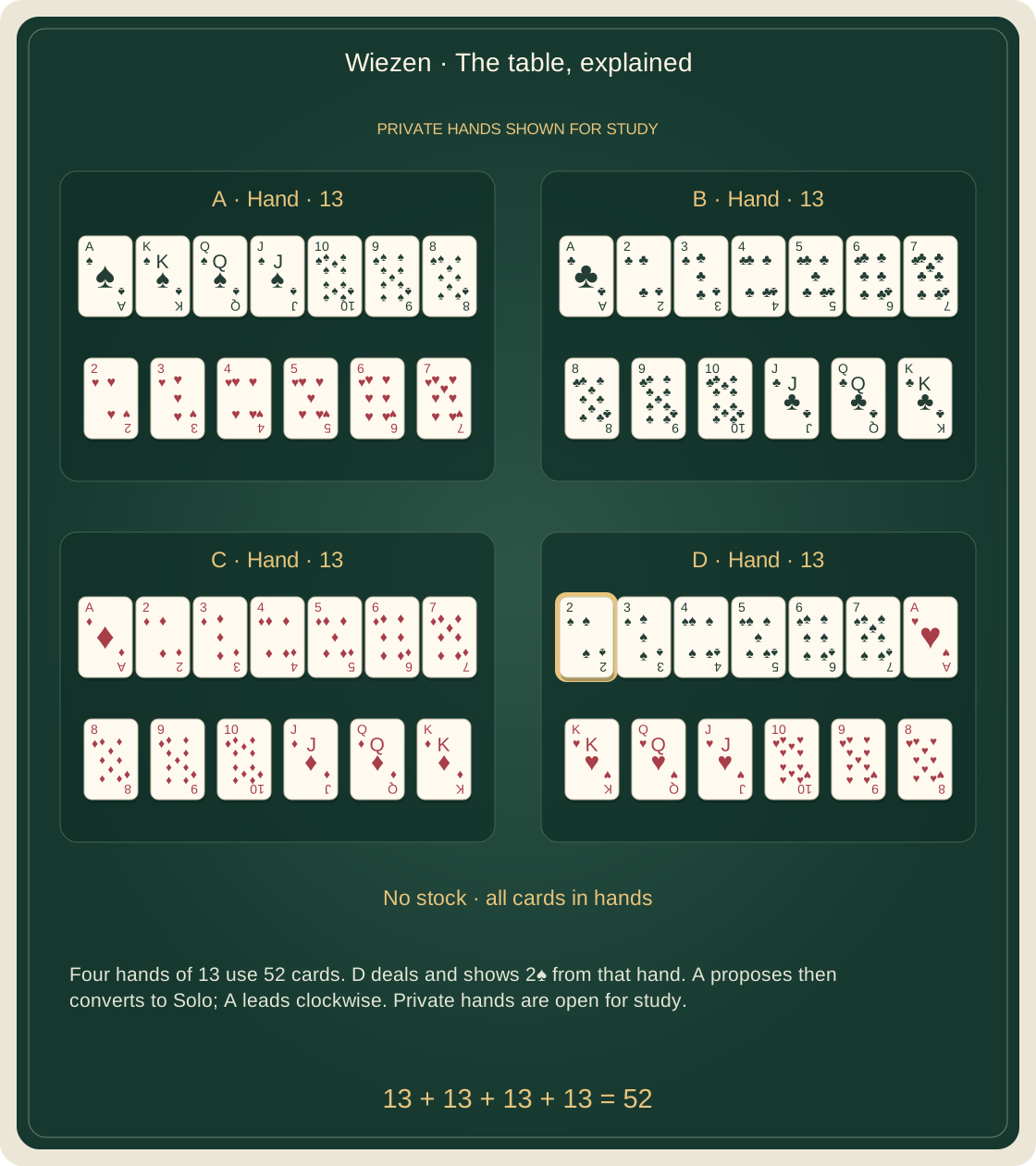
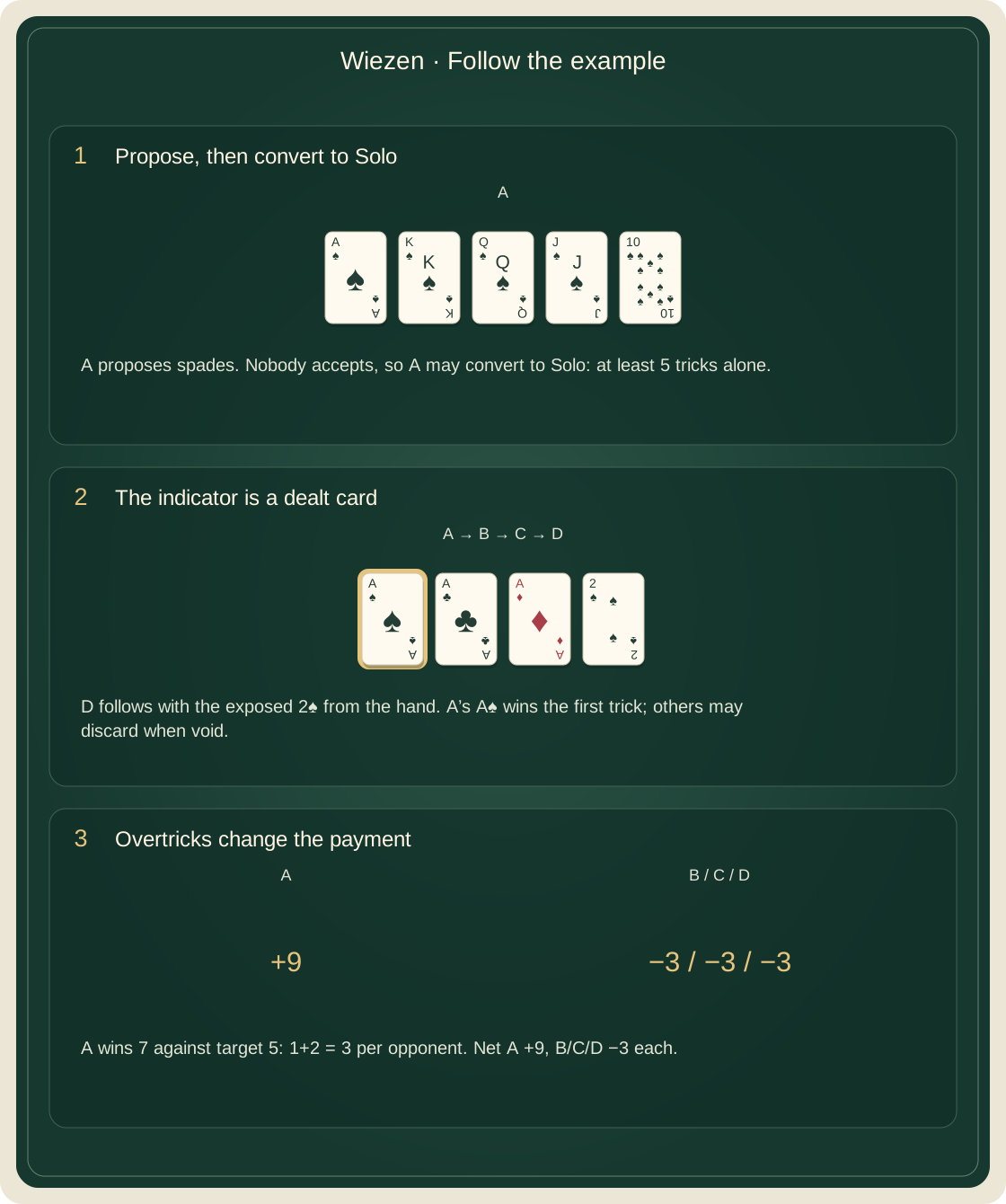
D’s exposed 2♠ sets spades. A proposes; nobody accepts, so A converts to Solo for 5. A holds the highest 7 spades and six small hearts. A leads the spades, winning 7 tricks; D then wins the remaining 6 with hearts. Solo succeeds with 2 overtricks. Value is 1+2 = 3 from each opponent: A +9, B −3, C −3, D −3. Their combined ledger is 0; D’s greater number of tricks than B or C does not exempt D from paying.
| Trick | Order | Cards | Winner |
|---|---|---|---|
| 1 | A → B → C → D | A♠ · A♣ · A♦ · 2♠ | A |
| 2 | A → B → C → D | K♠ · 2♣ · 2♦ · 3♠ | A |
| 3 | A → B → C → D | Q♠ · 3♣ · 3♦ · 4♠ | A |
| 4 | A → B → C → D | J♠ · 4♣ · 4♦ · 5♠ | A |
| 5 | A → B → C → D | 10♠ · 5♣ · 5♦ · 6♠ | A |
| 6 | A → B → C → D | 9♠ · 6♣ · 6♦ · 7♠ | A |
| 7 | A → B → C → D | 8♠ · 7♣ · 7♦ · A♥ | A |
| 8 | A → B → C → D | 2♥ · 8♣ · 8♦ · K♥ | D |
| 9 | D → A → B → C | Q♥ · 3♥ · 9♣ · 9♦ | D |
| 10 | D → A → B → C | J♥ · 4♥ · 10♣ · 10♦ | D |
| 11 | D → A → B → C | 10♥ · 5♥ · J♣ · J♦ | D |
| 12 | D → A → B → C | 9♥ · 6♥ · Q♣ · Q♦ | D |
| 13 | D → A → B → C | 8♥ · 7♥ · K♣ · K♦ | D |
| A | B | C | D | |
|---|---|---|---|---|
| Net result | 9 | -3 | -3 | -3 |
← On a small screen, scroll the diagram horizontally. →
07 /
What to watch at the table
Count likely tricks in the selected contract, not just aces or total strength. A hand excellent for avoiding tricks may be poor for Solo. Remember that the exposed trump belongs to dealer and can appear in normal play. Partnership is defined by acceptance or Troel, not by opposite seats. No defender may reveal a private hand merely because Open Misère was bid.
08 /
Choose the rules before starting
Other club rules use Solo 6, different Troel leads or higher partnership targets. Kleurenwiezen also adds suit-ranked contracts and is a distinct profile. Optional Small Misery discards cards, and Pico aims at exactly one trick; both are outside this selected table. Agree the number of deals before the session; this profile compares individual net totals after that rotation rather than imposing a universal points target.
09 /
History and related games
Wiezen is the Flemish name for Whist, but its auction belongs to the Boston-related family rather than the fashionable fixed-partner Whist of earlier European salons. Belgian players developed several local contract lists. The visible trump and changing alliances explain why Wiezen, Solo Whist and Kleurenwiezen remain related but separate entries.
10 /
Check your understanding
Can an ordinary opening bid be Solo?
Show answer
Not here. First propose; Solo is the conversion of an unaccepted proposal.
Is the turned card outside the hand?
Show answer
No. It is one of dealer’s cards and remains playable.
Common questions
Must a void player trump?+
No, any card is legal when unable to follow.
Are partners always opposite?+
No, acceptance or the Troel call determines the temporary partnership.
Does Open Misère expose everyone?+
No, only each declarer after the first trick.