← On a small screen, scroll the diagram horizontally. →
01 /
The game at a glance
Retain A K Q J 10 9 8 7. Highest are always K♥ (Maxi), 7♦ (Belli), 7♣ (Spritzer), in that order. Below them comes the Hauptschlag, the card matching both selected rank and suit; then the other cards of the selected rank, called Blinde, equal in strength. Next come remaining trumps in normal A K Q J 10 9 8 7 order. Plain suits use that normal order too.
02 /
Prepare and deal
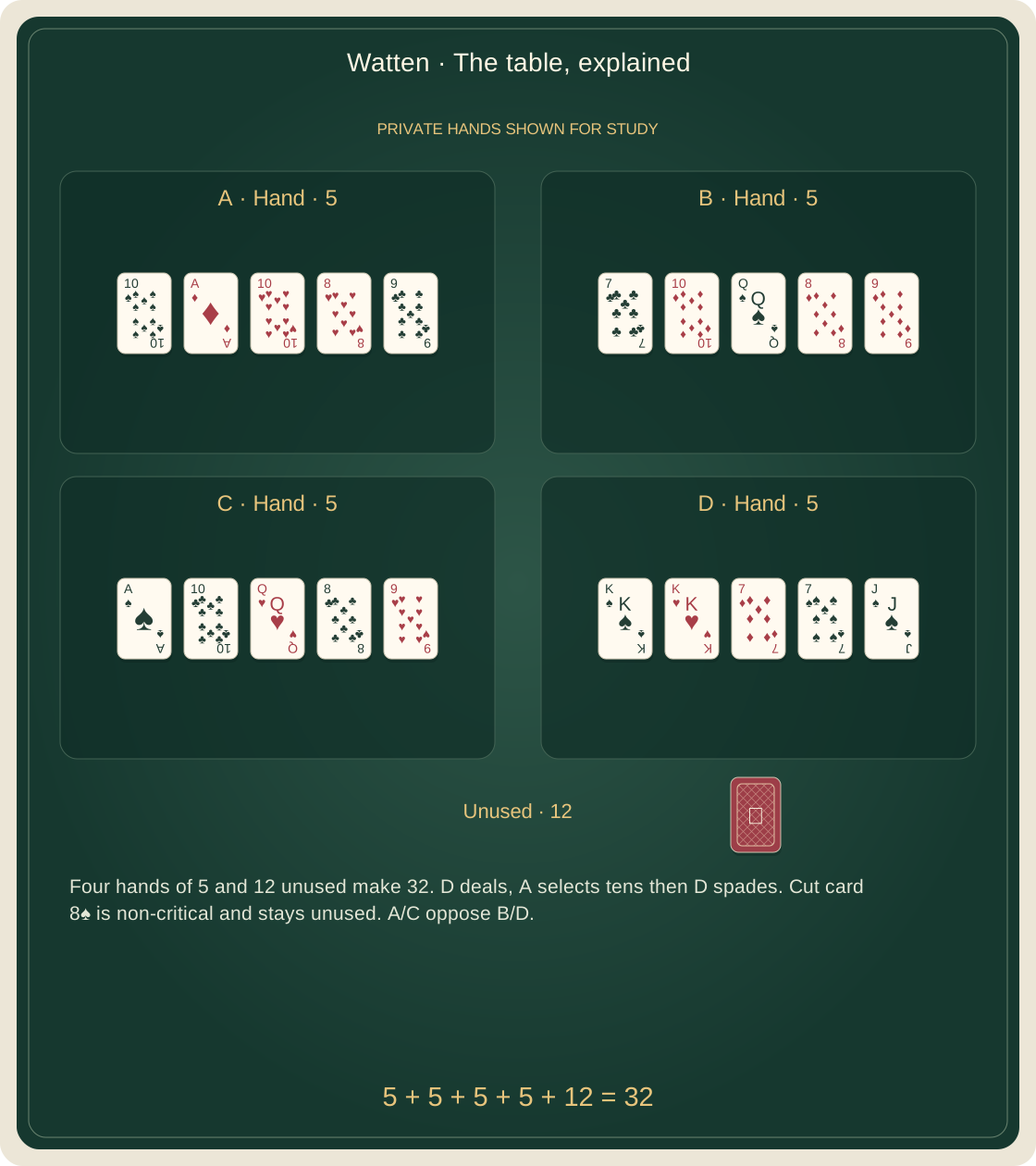
Dealer’s right cuts. A critical shown at the cut may be kept by the cutter; the next critical may go to dealer, a third to cutter. These count within, not in addition to, the 5-card hands; reduce the first packet accordingly. Deal 3 then 2 each, leaving 12 unused cards. Only forehand, left of dealer, and dealer inspect initially. Forehand names the Schlag rank, then dealer names the trump suit. Now partners may inspect. Deal passes left.
03 /
How play proceeds
Forehand leads, play clockwise, winner leads again. Normally ANY card is legal: neither following suit nor beating is required. Highest critical wins; otherwise Hauptschlag, then highest Blinde tier, then highest ordinary trump, then highest led-suit card. Equal Blinde are won by the one played earliest, not by suit. A critical never loses its permanent place merely because its rank was selected as Schlag.
04 /
Rules that change your decision
Exception: lead the Hauptschlag to the FIRST trick and optionally call “Trumpf oder Kritisch”. Until a critical beats it, anyone holding a critical or a card of the trump suit must play one of those. An off-suit Blinde alone does not force compliance. Once a critical beats Hauptschlag, later players are free. If Hauptschlag is itself a critical, there is no separate Hauptschlag and this call is unavailable.
05 /
Finish and scoring
First team with 3 tricks wins the current stake, normally 2. After rank and suit selection either side may propose 3. Refusal ends play and awards the previous 2; acceptance makes 3 binding. Only the accepting side may next raise to 4, then sides alternate. Refusal always concedes the previous accepted value. Playing on counts as accepting. First to 11 wins; a side already at 9 or 10 cannot propose raises, though it may accept.
06 /
A worked example
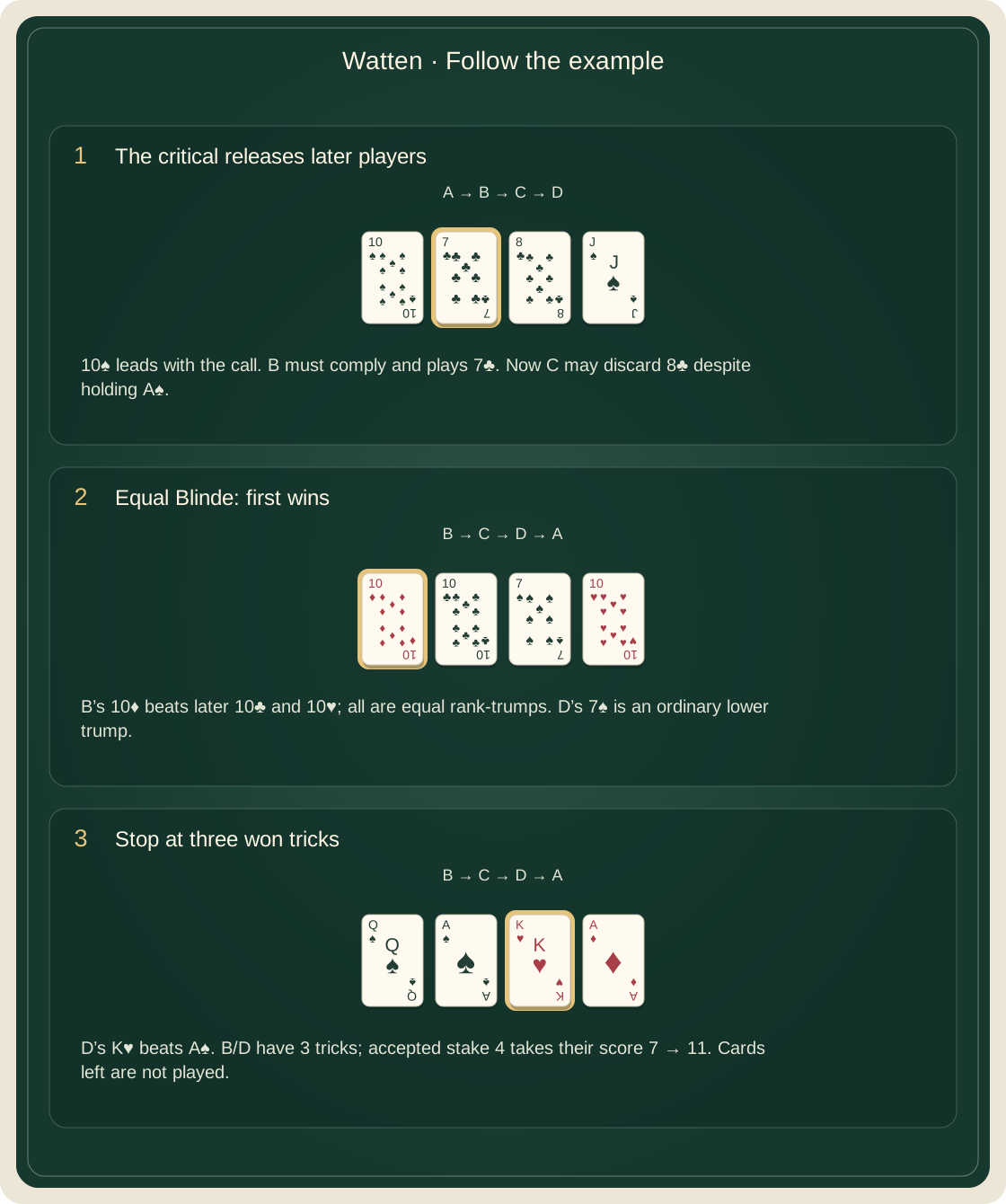
A selects tens, D selects spades. A leads 10♠ with the special call. B’s 7♣ beats it; C may now discard 8♣ despite holding A♠. Next B’s 10♦ beats later 10♣ and 10♥ because Blinde tie. In the next trick D’s K♥ beats C’s A♠. B/D have 3 tricks and stop. Both raises to 3 then 4 were accepted: their score moves from 7 to 11, winning the match.
| Trick | Order | Cards in order | Winner |
|---|---|---|---|
| 1 | A → B → C → D | 10♠ · 7♣ · 8♣ · J♠ | B |
| 2 | B → C → D → A | 10♦ · 10♣ · 7♠ · 10♥ | B |
| 3 | B → C → D → A | Q♠ · A♠ · K♥ · A♦ | D |
← On a small screen, scroll the diagram horizontally. →
07 /
What to watch at the table
Count critical cards first, then the selected rank; ordinary aces may be far down the hierarchy. Announce a raise clearly and wait for the answer. Bavarian partners may talk and use agreed signals after the choices, but cannot inspect an opponent’s private cards. Knowing that a teammate has already won can justify preserving a critical card.
08 /
Choose the rules before starting
Tyrolean and South Tyrolean profiles may use Weli, different critical ranks or secret information. Targets of 15 also exist, changing the no-raise threshold. Some Bavarian tables treat the leader’s partner differently under the special call. None of these are silently included here; select a complete regional profile before play.
09 /
History and related games
Watten belongs to the living card traditions of Bavaria and the Alpine regions of Austria and northern Italy. Its regional diversity is visible in card packs, signalling and the role of secret choices. A Bavarian rule should therefore not be presented as universal throughout the Alps.
10 /
Check your understanding
Must C follow after the critical beats Hauptschlag?
Show answer
No. The special restriction has ended for later players.
Which equal Blinde wins?
Show answer
The earliest played, unless a stronger tier beats them all.
Common questions
Must I follow ordinary suits?+
No, except the precisely limited first-trick call.
Can a critical be replaced by a selected rank?+
No, critical cards keep their permanent superiority.
What happens on a refused raise?+
The proposing team receives the previously accepted stake.