← On a small screen, scroll the diagram horizontally. →
01 /
The game at a glance
The objective is to beat the dealer’s best poker hand. Each side receives 2 private cards and shares 5 community cards. Use the best 5 of the available 7: you may use both, one or neither private card. Suits never break ties. A can be high or the low end of A-2-3-4-5, but cannot wrap a sequence around the king.
02 /
Prepare and deal
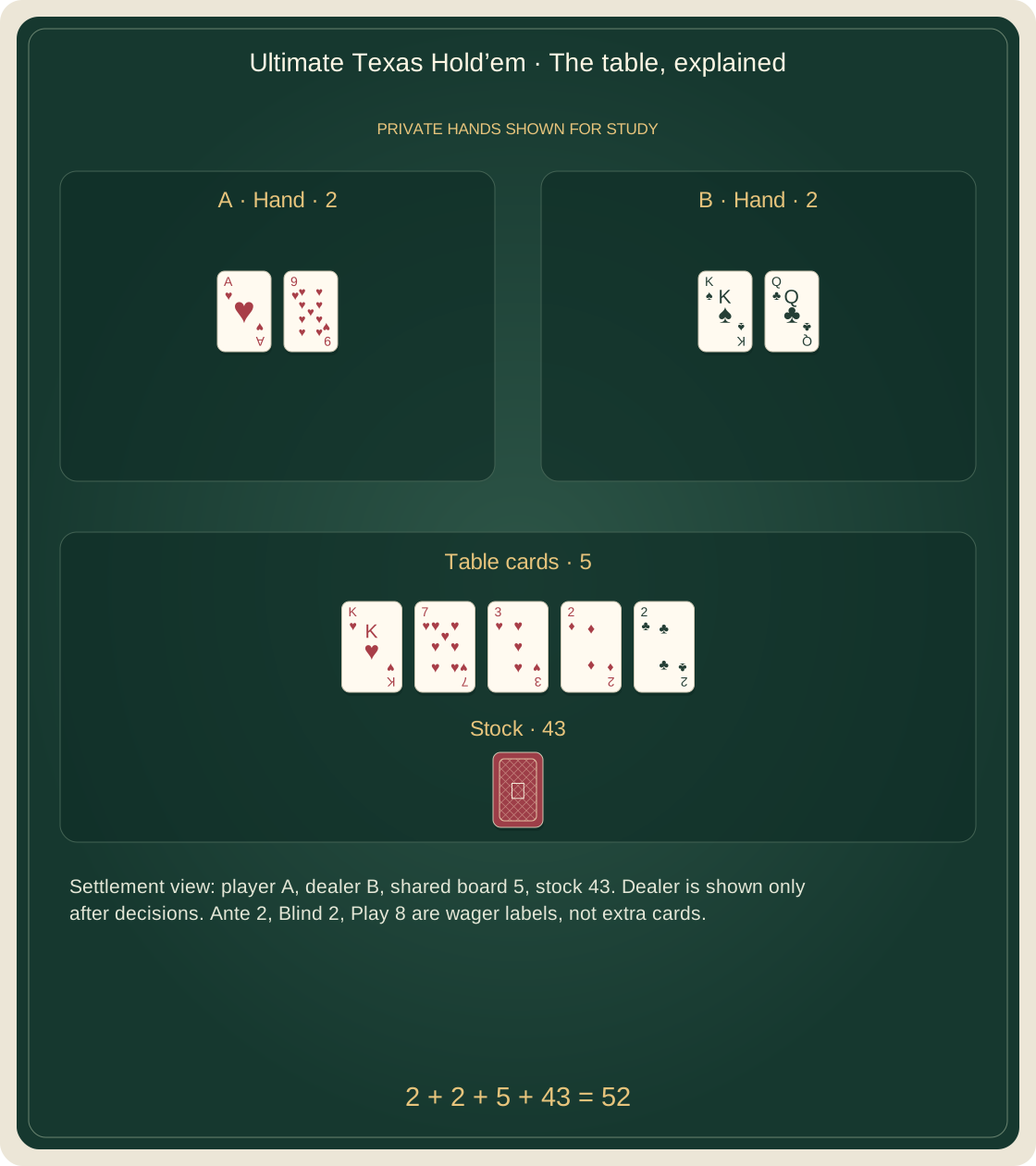
Before cards, place equal Ante and Blind. Shuffle, deal private cards face down, and keep the dealer’s hand concealed. A teaching deal can simply reserve the board without burn cards; an operator may use a different dealing procedure. The example’s final display exposes the dealer only for settlement and study, not before the player decides. There is no card exchange.
03 /
How play proceeds
Before the flop, check or place Play for 3 or 4 times Ante. Reveal the 3-card flop. If you have not placed Play, check or place 2 times Ante. Reveal turn and river, completing the board. If still uncommitted, fold or place 1 time Ante. Once Play is placed, it cannot be increased and you cannot fold later: simply reveal the remaining board and settle. Checking postpones the decision; it does not withdraw Ante or Blind.
04 /
Rules that change your decision
Compare the complete best hands, not just private cards. For equal categories compare the defining group first, then remaining kickers in descending order. Two pairs compare higher pair, lower pair, kicker; full houses compare the three before the pair. Flushes compare all cards from the top; straights compare their top card. A board that is best for both sides produces a tie.
Descending categories: royal flush, other straight flush, four of a kind, full house, flush, straight, three of a kind, two pairs, pair, high card. A straight flush is consecutive cards of one suit; a flush needs one suit without a sequence. A full house is a triple and pair; four of a kind has all suits of one rank. Royal flush is the ace-high straight flush.
05 /
Finish and scoring
Dealer qualifies with any pair or better. If unqualified, Ante is returned regardless of who wins; Play and Blind still resolve normally. When the player wins, Play pays 1:1, Ante pays 1:1 only against a qualified dealer, and Blind uses the table below; a winning hand below a straight pushes Blind. When the player loses, Play and Blind lose, and Ante loses only if dealer qualifies. A tie pushes all main wagers. Folding loses Ante and Blind. Payout ratios are profit; the original stake is returned separately on a win or push.
| Winning hand | Blind profit : stake |
|---|---|
| Royal flush | 500:1 |
| Other straight flush | 50:1 |
| Four of a kind | 10:1 |
| Full house | 3:1 |
| Flush | 3:2 |
| Straight | 1:1 |
| Three / two pairs / pair / high | Push |
06 /
A worked example
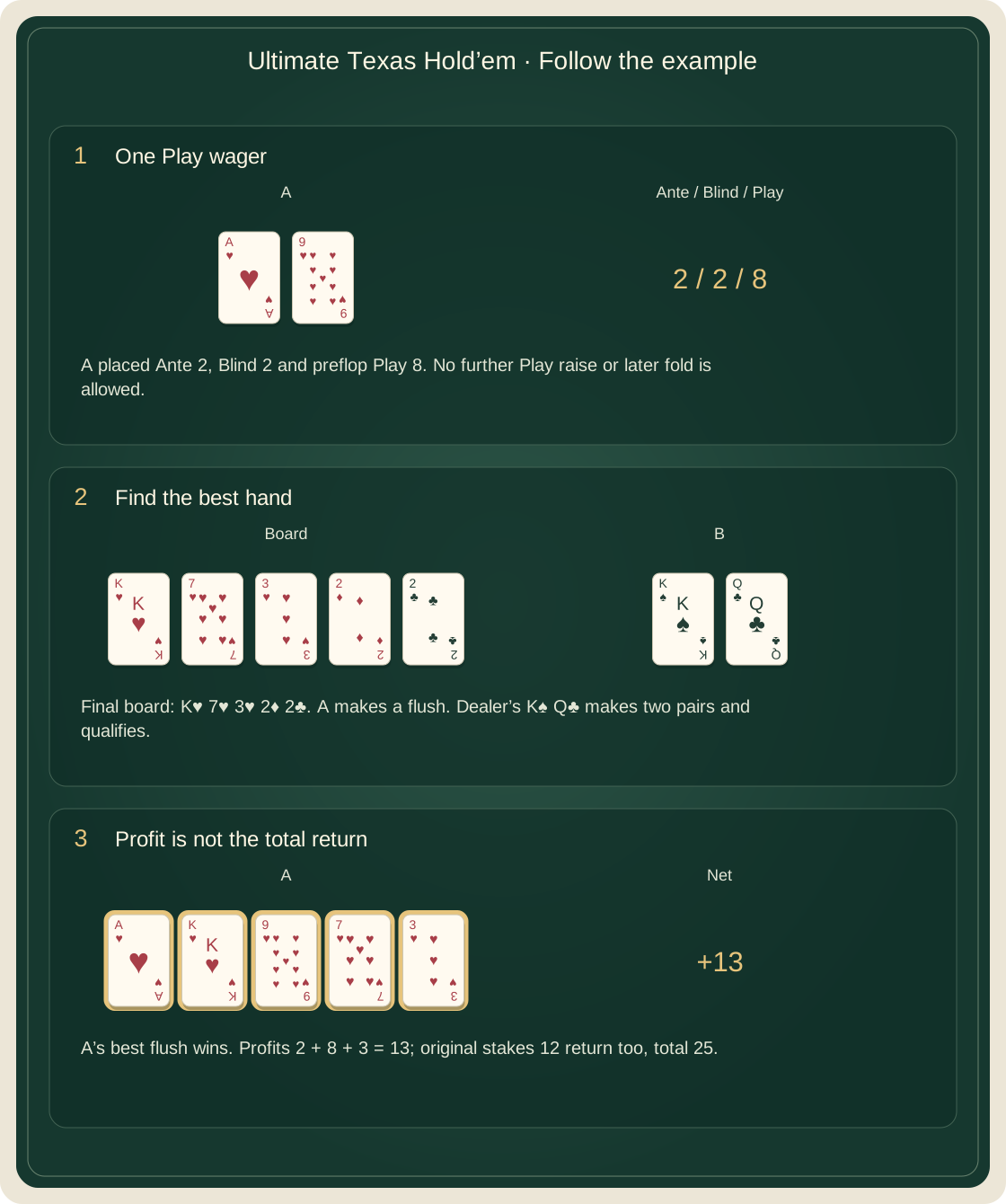
Player A has A♥ 9♥, dealer B K♠ Q♣; board K♥ 7♥ 3♥ 2♦ 2♣. A’s flush beats B’s two pairs. Ante 2, Blind 2 and preflop Play 8 put 12 at risk. Dealer qualifies. Profits: Ante 2, Play 8, Blind 3 at 3:2. Net profit is 13, and total returned including stakes is 25. The unused 43 cards stay outside the example.
← On a small screen, scroll the diagram horizontally. →
07 /
What to watch at the table
Keep decision timing separate from hand comparison. A larger early Play is a commitment before seeing the board, not an additional later raise. At settlement check qualification before Ante, then comparison before Blind. A strong-looking private pair may still lose to a board-assisted dealer hand. Practise using counters and complete best-hand comparisons.
08 /
Choose the rules before starting
Optional Trips pays by its own schedule and may not depend on beating the dealer. Progressive and other side bets also have independent conditions. They are not necessary to play this main game. Before using an operator’s table, check its posted qualification, payout table and dealing procedure; do not substitute Turkish draw-poker ranking or ordinary player-versus-player Hold’em betting.
09 /
History and related games
This is a commercial banked adaptation of Texas Hold’em. It borrows private and community cards but replaces competition for a shared player pot with separate wagers against the house. Published operator rules define that distinction. It is not simply another name for tournament or cash-table Hold’em.
10 /
Check your understanding
Can Play be raised after the flop if already placed?
Show answer
No. There is only one Play decision that commits a wager.
Does an unqualified dealer automatically lose every wager?
Show answer
No. Ante pushes; compare hands normally for Play and Blind.
Common questions
Must I use my private cards?+
No. Any best combination from all available cards is valid.
Is Blind a forced player blind in ordinary poker?+
Here it is a separate main wager with a special payout schedule.
What does a push mean?+
The stake returns with no profit or loss on that wager.