← On a small screen, scroll the diagram horizontally. →
01 /
The game at a glance
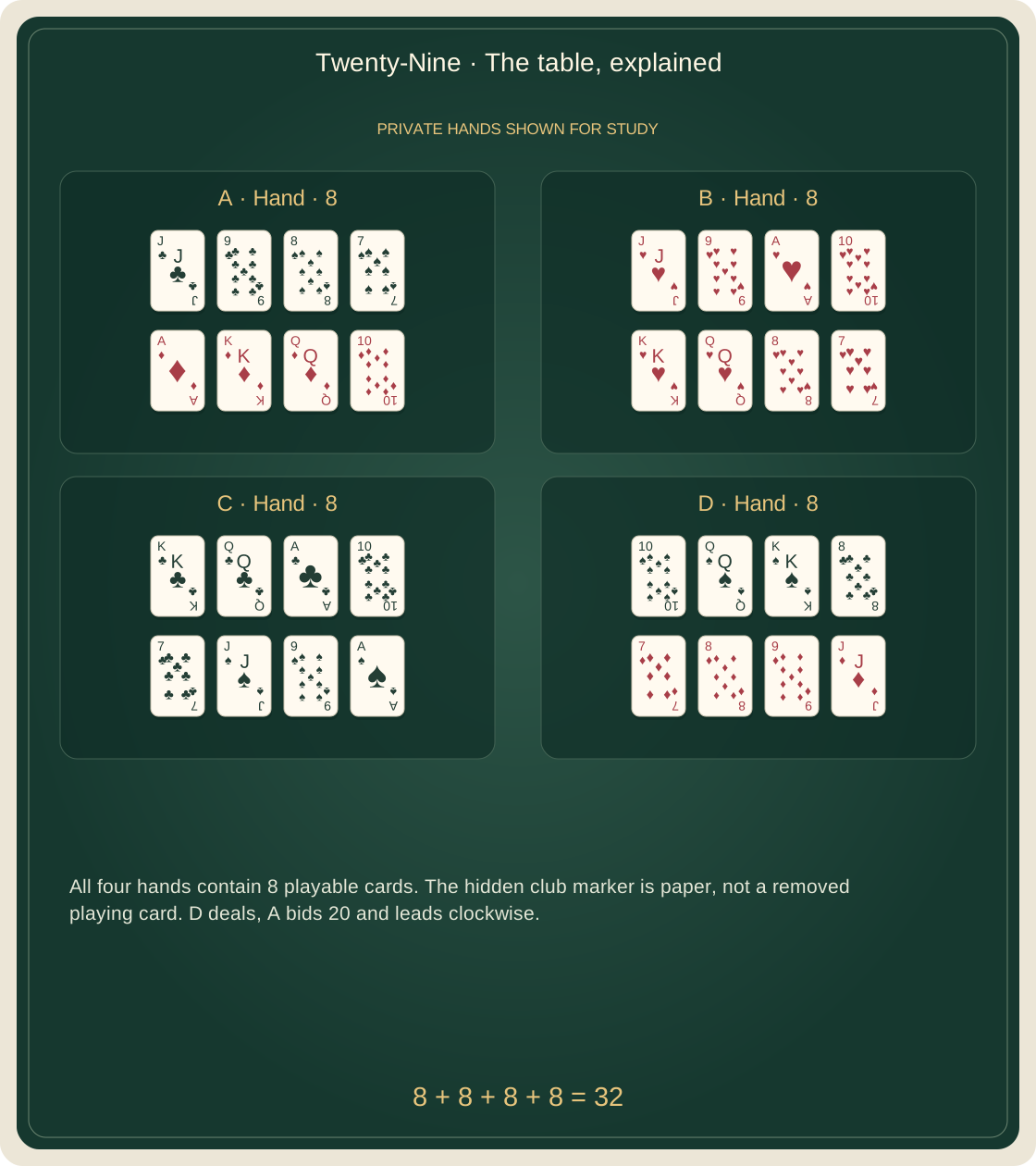
Keep A, K, Q, J, 10, 9, 8, 7 of every suit. Descending strength is J > 9 > A > 10 > K > Q > 8 > 7, including trumps. Each J counts 3, each 9 counts 2, each A and 10 counts 1, all others 0. The pack therefore contains 28 points, whatever the number of tricks won. Use paper for game scores and the hidden suit indicator.
02 /
Prepare and deal
Play and deal clockwise. After a cut, give everyone 4 cards. Dealer’s left begins the auction: bid at least 15, raise above the current bid, or pass. Continue until 3 consecutive passes after a bid. If everyone before dealer initially passes, dealer must take 15. The winner secretly records a trump suit; deal another 4 each. All 8 cards remain playable in every hand: the marker is not a card withheld from the active pack.
03 /
How play proceeds
Dealer’s left leads first regardless of bidder. Follow the led suit whenever possible; no duty to beat. While trumps remain hidden, only the led suit can win. The first player unable to follow must request revelation BEFORE playing, even if that player is the bidder. They may then cut or discard freely. From this trick onward trumps work; count every trump card already in the current trick. Highest trump wins, otherwise highest led-suit card. Winner leads.
04 /
Rules that change your decision
After revelation, a player still holding both K and Q of trumps may announce Pair immediately after their side wins that trick or a later one. A previously played marriage card cannot be reclaimed. Bidder’s Pair lowers the target by 4, never below 15; defenders’ Pair raises it by 4, never above 28. These are target adjustments, not extra captured points.
05 /
Finish and scoring
Play all 8 tricks and count 28 card points. Reaching the adjusted target gives the bidding team +1 game point; failing gives −1. Defenders’ game score stays unchanged. First to +6 wins; a team reaching −6 loses. If the entire deal finishes without trump revelation, annul it rather than score it. Move the deal left. The last trick adds nothing in this profile.
06 /
A worked example
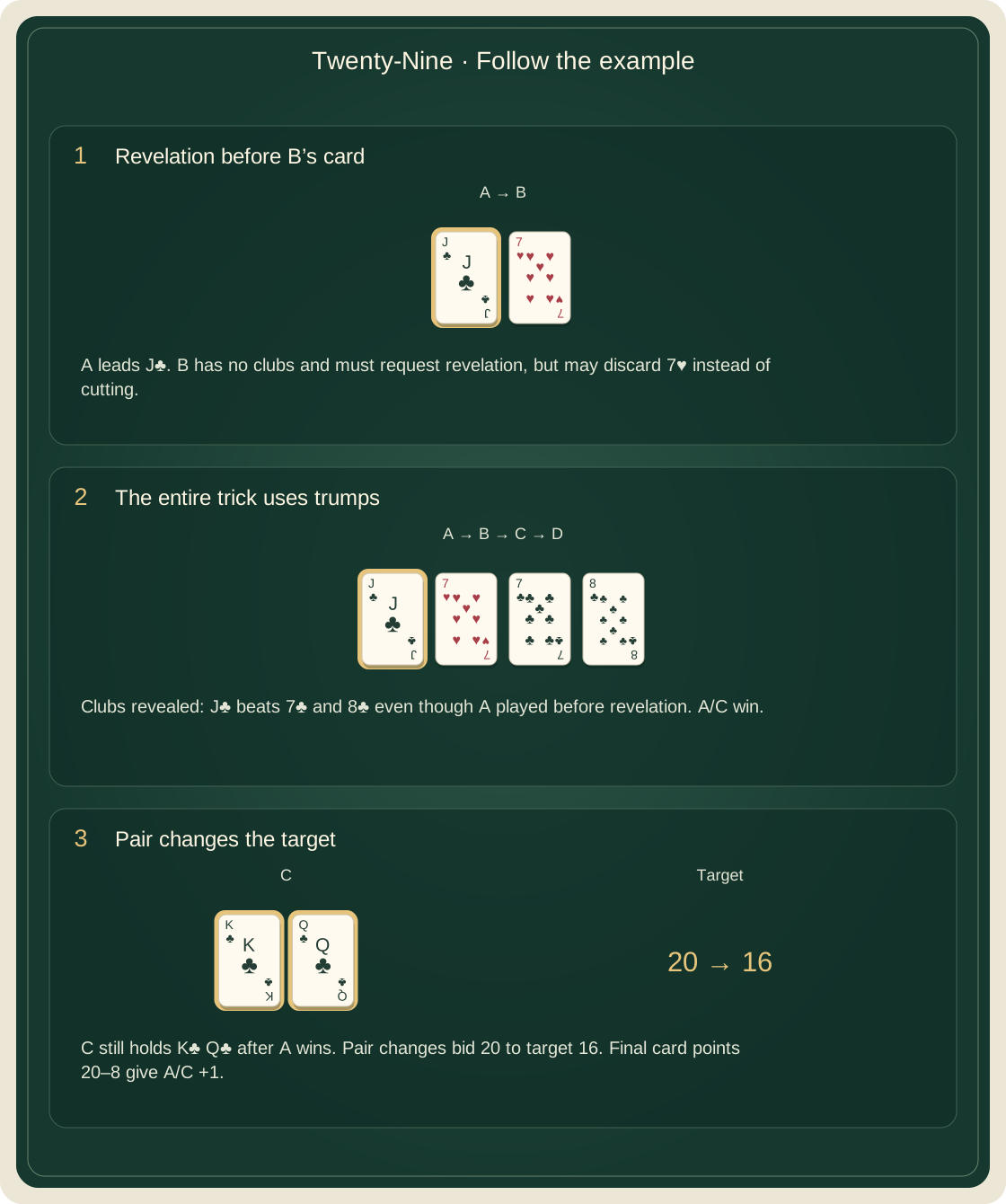
A bids 20 and secretly records clubs. A leads J♣; B has only hearts, so must ask for revelation but may discard 7♥. C follows 7♣, D 8♣; J♣ wins as trump even though it preceded revelation. Partner C still holds K♣ Q♣ and announces Pair now: the target becomes 16. The full replay gives A/C 20 and B/D 8, so the bidding team gains +1, not an extra 4 card points.
| Trick | Order | Cards in order | Winner |
|---|---|---|---|
| 1 | A → B → C → D | J♣ · 7♥ · 7♣ · 8♣ | A |
| 2 | A → B → C → D | 9♣ · J♥ · A♣ · J♦ | A |
| 3 | A → B → C → D | A♦ · 9♥ · J♠ · 9♦ | D |
| 4 | D → A → B → C | 10♠ · 8♠ · A♥ · 9♠ | C |
| 5 | C → D → A → B | A♠ · K♠ · 7♠ · 10♥ | C |
| 6 | C → D → A → B | 10♣ · Q♠ · 10♦ · K♥ | C |
| 7 | C → D → A → B | K♣ · 8♦ · K♦ · Q♥ | C |
| 8 | C → D → A → B | Q♣ · 7♦ · Q♦ · 8♥ | C |
← On a small screen, scroll the diagram horizontally. →
07 /
What to watch at the table
Track jacks and nines before counting tricks. Choose trumps from the first packet, remembering that another packet remains unknown. Keep a potential Pair intact until it can legally be announced. Before discarding a point card, check whether the revealed trump now changes the winner of the entire current trick.
08 /
Choose the rules before starting
Some tables add a last-trick point, permit bidding to 29, start at 16, restrict Pair differently or add doubling and single-hand contracts. Write those settings before dealing; a name alone does not identify the scoring system. Our lesson does not inherit Twenty-Eight’s withheld indicator, compulsory requester cut or its different game-point penalties.
09 /
History and related games
Twenty-Nine is associated with northern India, Bangladesh and Nepal. Its jack-nine ranking places it in the wider Jass-related family of point-trick games. Twenty-Eight is a close relative, but hidden-trump procedures and local scoring developed in different directions. No single modern website defines every regional table.
10 /
Check your understanding
Must B cut after requesting revelation?
Show answer
No. Revelation is compulsory, the cut is optional.
Does Pair add captured points?
Show answer
No. It changes the bidding side’s target within the agreed limits.
Common questions
Why the name Twenty-Nine?+
A common variant adds a last-trick point; our selected profile omits it.
Is every card available before revelation?+
Yes. The suit is recorded separately from the playing pack.
Can I ignore suit after trumps appear?+
No. You still follow whenever possible.