← On a small screen, scroll the diagram horizontally. →
01 /
The game at a glance
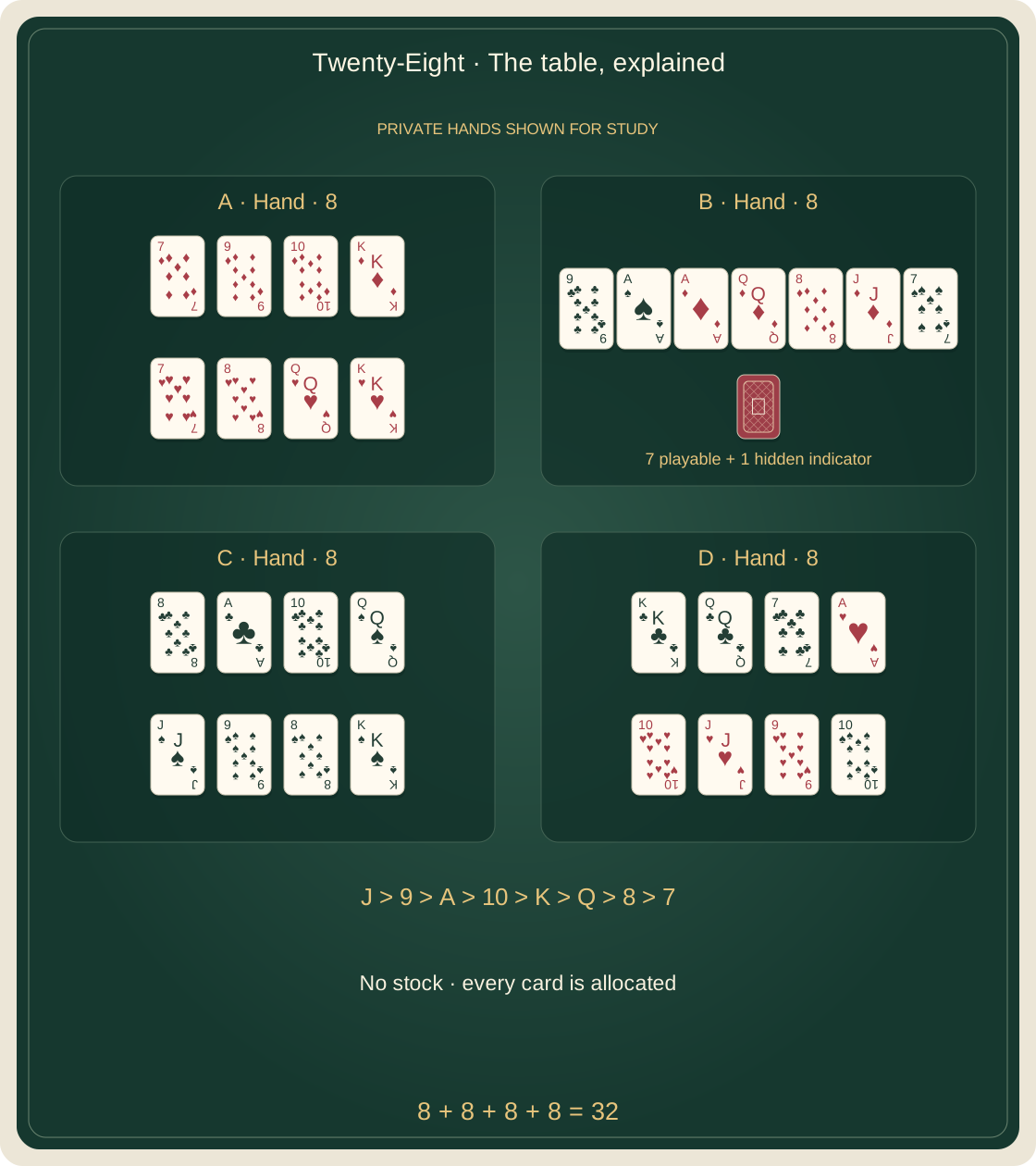
Four players sit in opposite partnerships A/C and B/D. Use 32 cards: A, K, Q, J, 10, 9, 8, 7 of every suit, no jokers. Strength descends J, 9, A, 10, K, Q, 8, 7. J is worth 3, 9 worth 2, A and 10 worth 1 each; others 0. There are 28 card points in all, and the bidding team must capture at least its bid.
02 /
Prepare and deal
Deal and play counterclockwise; dealer’s left cuts. Give 4 cards each, singly. Dealer’s right starts and must bid at least 14, or may demand a same-dealer redeal if these cards have no points. Others raise or pass until three consecutive passes. Overbidding your partner after the intervening opponent passes requires at least 20. Winner sets aside a card of the chosen trump suit, face down, then everyone receives 4 more. Bidder now holds seven playable cards plus that indicator. After seeing full hands, bidder or partner may increase the contract, but only to at least 24.
03 /
How play proceeds
Right of dealer leads. Before revelation, follow suit if possible; otherwise discard freely or ask to expose trumps before playing. A requester must trump if holding one, otherwise may discard. The bidder retrieves the indicator when exposed. Before exposure, the bidder cannot lead the hidden trump suit while another suit remains; when forced to lead it, it has no trump power yet. When void in another led suit, bidder must either discard a non-trump or reveal and play the indicator, not silently cut with a held trump.
04 /
Rules that change your decision
Trump power begins at exposure, not at the start of the trick: a card played earlier in the same trick does not become a trump retrospectively. After exposure, follow suit; if void, trumping is optional except for the player who requested exposure on that trick. Highest active trump wins, otherwise highest led-suit card. A bidder following a hidden-trump-suit lead uses held cards without revealing merely to gain trump power. If only the set-aside card of that suit remains, the bidder may expose and play it when otherwise void; this exception also resolves the final card. A bidder winning the seventh trick while still concealed exposes the indicator and leads it last.
05 /
Finish and scoring
After 8 tricks count card points, with no last-trick bonus. If bidding team reaches its contract, add game points; otherwise subtract them, according to the table. Only bidding team’s cumulative score changes. Do not mistake a card score of 20 for 20 game points. After our agreed 6 completed deals, the higher game-point total wins; tied totals share. Rotate dealer right after a completed deal, but keep the same dealer for an annulled deal.
| Bid | Success | Failure |
|---|---|---|
| 14–19 | +1 | −2 |
| 20–24 | +2 | −3 |
| 25–28 | +3 | −4 |
06 /
A worked example
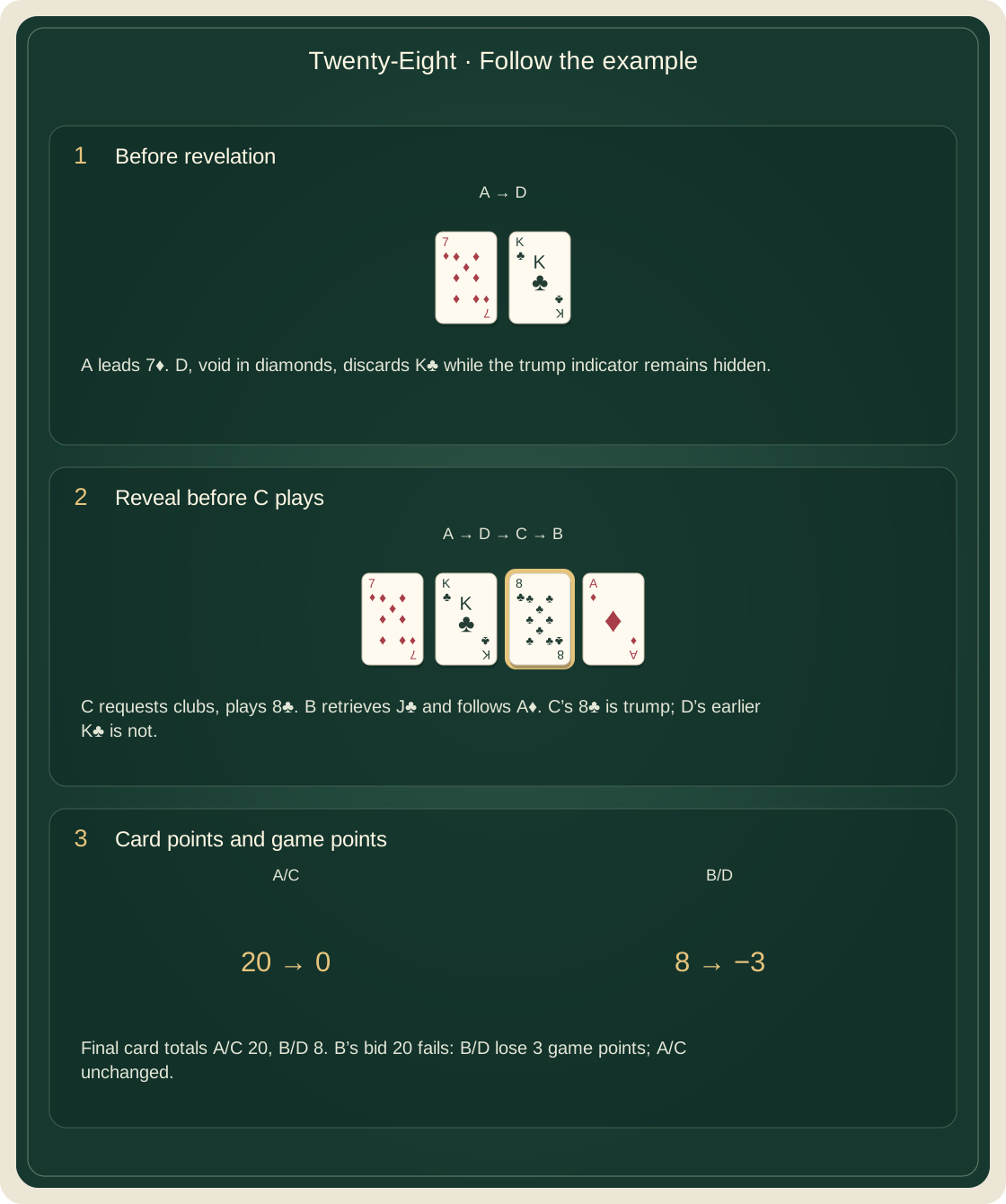
B bids 20 and sets aside J♣ from the first four. A leads 7♦, D discards K♣ without revealing. C has no diamonds, requests exposure and plays 8♣; B returns J♣ to hand and follows A♦. C wins: the 8♣ is active trump, the earlier K♣ is not. The trick has only 1 point. Full replay gives A/C 20 card points, B/D 8. B/D fail the contract and lose 3 game points, while A/C’s game score is unchanged. The printed hands show B’s indicator separately from playable cards.
| Trick | Order | Cards in that order | Winner |
|---|---|---|---|
| 1 | A → D → C → B | 7♦ · K♣ · 8♣ · A♦ | C |
| 2 | C → B → A → D | J♠ · A♠ · 9♦ · 10♠ | C |
| 3 | C → B → A → D | 9♠ · 7♠ · 10♦ · J♥ | C |
| 4 | C → B → A → D | A♣ · J♣ · K♦ · Q♣ | B |
| 5 | B → A → D → C | J♦ · K♥ · 9♥ · 10♣ | C |
| 6 | C → B → A → D | K♠ · 9♣ · Q♥ · A♥ | B |
| 7 | B → A → D → C | Q♦ · 8♥ · 10♥ · Q♠ | B |
| 8 | B → A → D → C | 8♦ · 7♥ · 7♣ · 8♠ | D |
| A/C | B/D | |
|---|---|---|
| Card points | 20 | 8 |
| Game score change | 0 | -3 |
← On a small screen, scroll the diagram horizontally. →
07 /
What to watch at the table
Remember both rank order and point values. Asking for trumps can rescue a low-value card, but may expose information useful to the bidder. Mark which cards were played before the exposure instead of retroactively recolouring the entire trick. During bidding, four known cards are not a full hand; the example’s failed bid illustrates the uncertainty rather than recommending that call.
08 /
Choose the rules before starting
Annul and redeal with the same dealer if a full hand contains all four J, or if the bidding partnership holds all 8 trumps; the latter may become known only at revelation. The initial pointless-hand redeal belongs only to the first bidder, not every player. Some versions use a different minimum bid, retroactive trumps or alternative scoring; agree a separate profile before play. No last-trick point is added here: that would change the total away from 28.
09 /
History and related games
Twenty-Eight, also called Irupathiyettu, is associated with Kerala in southern India. It belongs to the South Asian jack-nine family alongside Twenty-Nine and 304. Connections to European Jass traditions are a historical hypothesis, not proof of a precise route or inventor. Similar-looking games should therefore retain their own bidding limits, trump-revelation timing and scoring.
10 /
Check your understanding
Does an earlier club become trump when clubs are revealed mid-trick?
Show the answer
No. Only cards played after exposure have trump power in this profile.
Can a low trump win more card points than a jack?
Show the answer
Yes. Its own value may be zero, but it can capture valuable cards contributed to the trick.
Common questions
Is the last trick worth an extra point?+
No. Card points total exactly 28.
Which rank is highest?+
J, followed by 9, in every suit.
Does every pointless hand force a redeal?+
No. Our initial option belongs only to the first bidder’s first four cards.