← On a small screen, scroll the diagram horizontally. →
01 /
The game at a glance
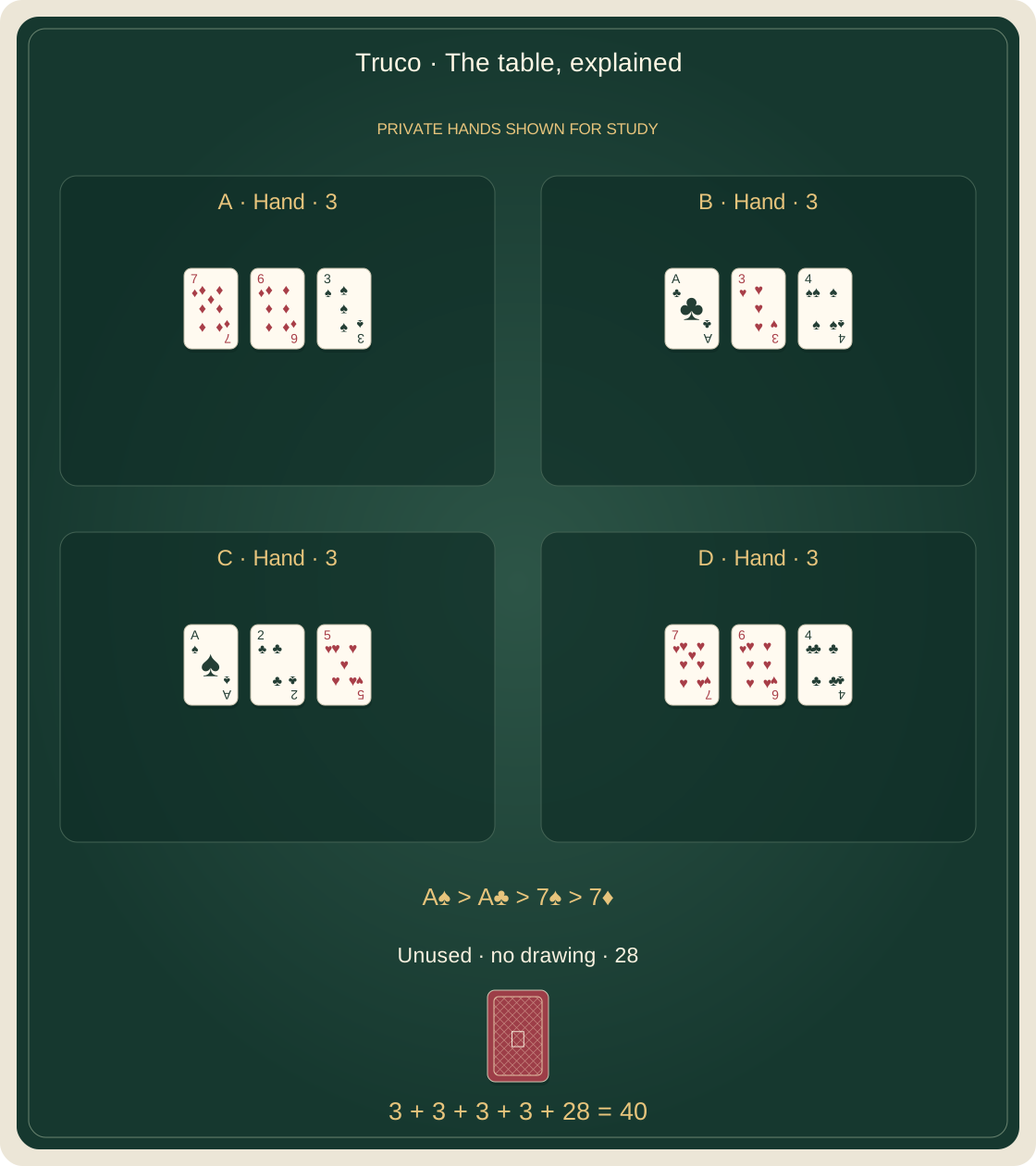
Partners sit opposite, A/C against B/D. Each receives 3 cards, and a hand has at most 3 tricks. There are no trumps and no duty to follow suit. Trick strength and Envido value are unrelated. Score Envido first, then the trick contest; reaching 30 ends the game immediately even if cards remain unplayed. The first 15 points are called malas, the next 15 buenas, not separate games.
02 /
Prepare and deal
Use 40 Spanish cards, or remove 8, 9, 10 and jokers from a French pack. Map swords to ♠, batons ♣, coins ♦, cups ♥; Spanish 12/11/10 become K/Q/J. Deal singly counterclockwise and rotate dealer right. Dealer’s right neighbour is mano and leads. Leave 28 cards unused: no drawing, exchanges or indicator. The full strength order below is fixed for every hand.
03 /
How play proceeds
Play any held card. The highest strength wins regardless of suit. Equal highest cards on one team win for that team, and the earliest such player leads next. Equal highest cards across teams make parda, an unowned tie; the previous leader leads again. Normally win a majority. With a tied trick, the team taking the earliest untied trick wins; all tricks tied awards the hand to mano’s team. Stop as soon as the hand is decided, without needless remaining tricks.
04 /
Rules that change your decision
Envido values A through 7 at face value, K/Q/J at 0. Best same-suit pair adds 20; with three different suits use only the largest single value. Without Flor, choose the best pair even from three same-suit cards. Ties favour the earlier player counting counterclockwise from mano. A player may initiate Envido only before playing their first card and before betting or accepting Truco. An opposing Truco can wait while a still-eligible player resolves Envido. Accepted Envido is announced in mano order and the winning cards must be shown by the end.
| Strength tier | Equal cards within each row |
|---|---|
| 1 | A♠ |
| 2 | A♣ |
| 3 | 7♠ |
| 4 | 7♦ |
| 5 | 3♠ · 3♥ · 3♣ · 3♦ |
| 6 | 2♠ · 2♥ · 2♣ · 2♦ |
| 7 | A♥ · A♦ |
| 8 | K♠ · K♥ · K♣ · K♦ |
| 9 | Q♠ · Q♥ · Q♣ · Q♦ |
| 10 | J♠ · J♥ · J♣ · J♦ |
| 11 | 7♥ · 7♣ |
| 12 | 6♠ · 6♥ · 6♣ · 6♦ |
| 13 | 5♠ · 5♥ · 5♣ · 5♦ |
| 14 | 4♠ · 4♥ · 4♣ · 4♦ |
05 /
Finish and scoring
Envido proposes 2 points, Real Envido 3. Reply Quiero to accept and close, No quiero to refuse: first refusal pays 1, later refusal pays the previously accepted total. A counter Envido adds 2, counter Real adds 3; after Real you cannot counter with Envido. Falta replaces the proposed total with 30 minus the higher team score and cannot be raised. Truco starts at 1, then accepted Truco/Retruco/Vale Cuatro make 2/3/4. Only the team accepting the previous raise may raise next; say Quiero before a counter-raise. Refusal awards the previous value and ends trick play. The calls and outcomes table separates these two contests.
| Trick challenge | Accepted value | Refusal pays |
|---|---|---|
| Truco | 2 | 1 |
| Retruco | 3 | 2 |
| Vale Cuatro | 4 | 3 |
06 /
A worked example
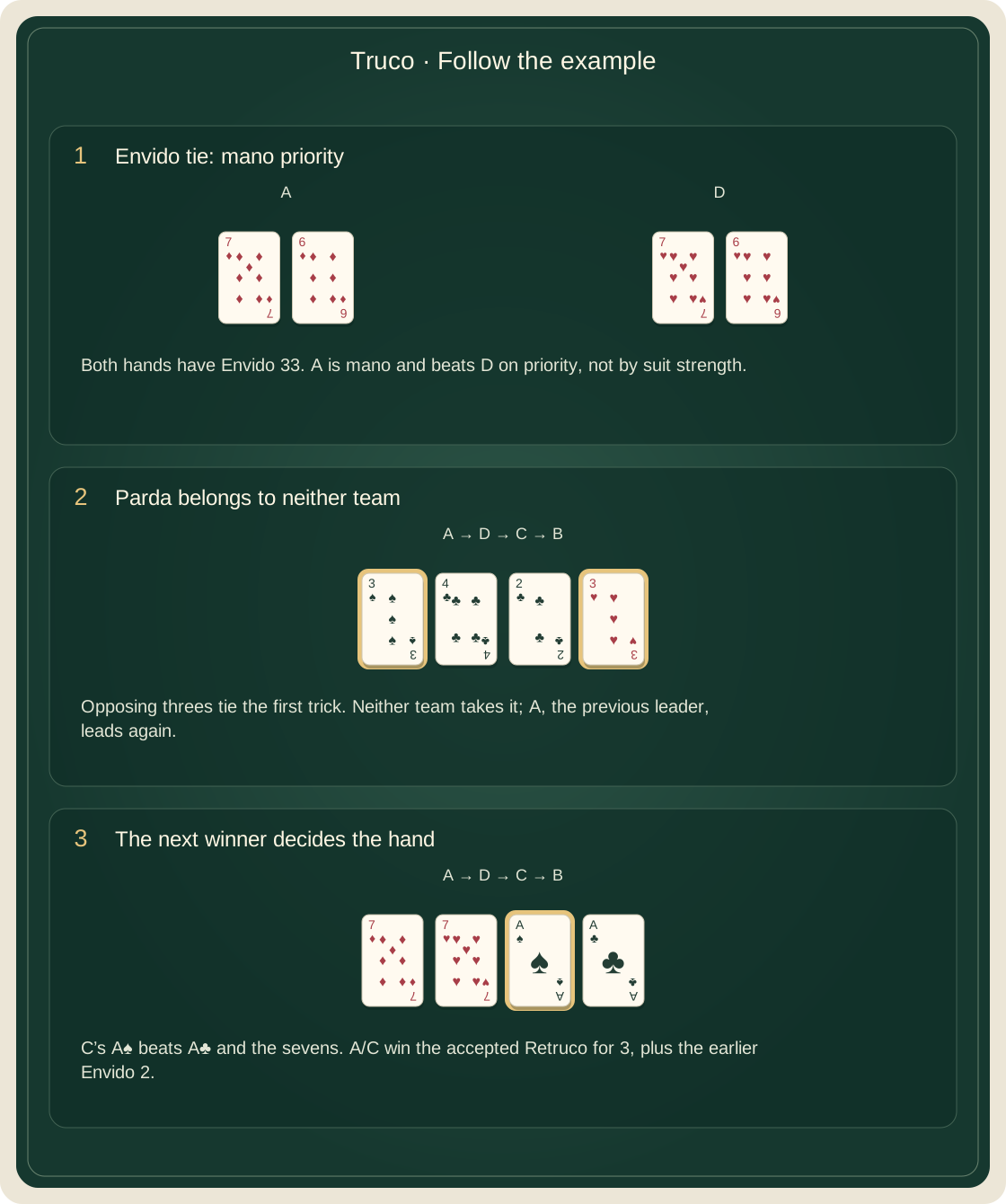
B deals, A is mano. A has 7♦ 6♦ 3♠, D has 7♥ 6♥ 4♣: both Envido 33, but A wins the accepted Envido for 2 by priority. First trick A/D/C/B: 3♠, 4♣, 2♣, 3♥, a parda between teams. A leads again: 7♦, 7♥, A♠, A♣. C’s A♠ wins and the hand is decided. Truco and Retruco were accepted, so A/C score 3 more. Starting at 25, A/C go to 27, then 30. Do not combine the two Envido values into a team total.
| Trick | Order | Cards in that order | Winner |
|---|---|---|---|
| 1 | A → D → C → B | 3♠ · 4♣ · 2♣ · 3♥ | Parda · tied |
| 2 | A → D → C → B | 7♦ · 7♥ · A♠ · A♣ | C |
← On a small screen, scroll the diagram horizontally. →
07 /
What to watch at the table
Keep the Envido contest separate from trick strength: a low trick card can complete a maximum Envido. Agree that reserved calls mean what they say; joking with a legal call can make a binding bet. Conversation and partner signals are part of this tradition, but nobody may inspect the unused pack or an opponent’s hand. A bluff can change the opponent’s answer, never the actual value declared at an accepted showdown.
08 /
Choose the rules before starting
Flor is disabled here: three same-suit cards use the best Envido pair and earn no automatic Flor award. Envido is optional; if nobody calls it, nobody scores it. Argentine, Uruguayan and Brazilian Truco have different strength and betting systems. Decide the Falta formula before play; our leader-distance rule can propose fewer points than a prior Envido raise near the end. Do not import a rule that mano automatically wins every tied trick: a parda remains tied.
09 /
History and related games
Truco is established across South America and descends from the Truc family associated with Catalonia and southern France. Argentine play preserves distinctive Spanish calls and a fixed hierarchy of bravas. Related Brazilian and Uruguayan games developed other hierarchies and challenges. This is why a complete regional profile is more useful than mixing familiar rules from several countries under one title.
10 /
Check your understanding
Does mano win a parda immediately?
Show the answer
No. The trick is tied. An untied trick can still decide the hand; mano decides only if all tricks tie.
Must you follow suit?
Show the answer
No. Any held card may be played; use the fixed strength hierarchy.
Common questions
Does a rejected Truco score 2?+
No. It awards the previous value, 1; an accepted Truco makes the hand worth 2.
How is Envido with three matching suits counted?+
With Flor disabled, use the best pair plus 20.
Is the strongest ace also the best Envido?+
No. Trick rank and the same-suit numerical total are separate comparisons.