← On a small screen, scroll the diagram horizontally. →
01 /
The game at a glance
Four players form fixed opposite partnerships, A/C against B/D. Use 52 cards without jokers, ranked A K Q J 10 9 8 7 6 5 4 3 2. Suits have no ranking against each other except that every trump beats a non-trump. Count tricks, not card values. The first team to reach 20 cumulative points wins, possibly exceeding the target.
02 /
Prepare and deal
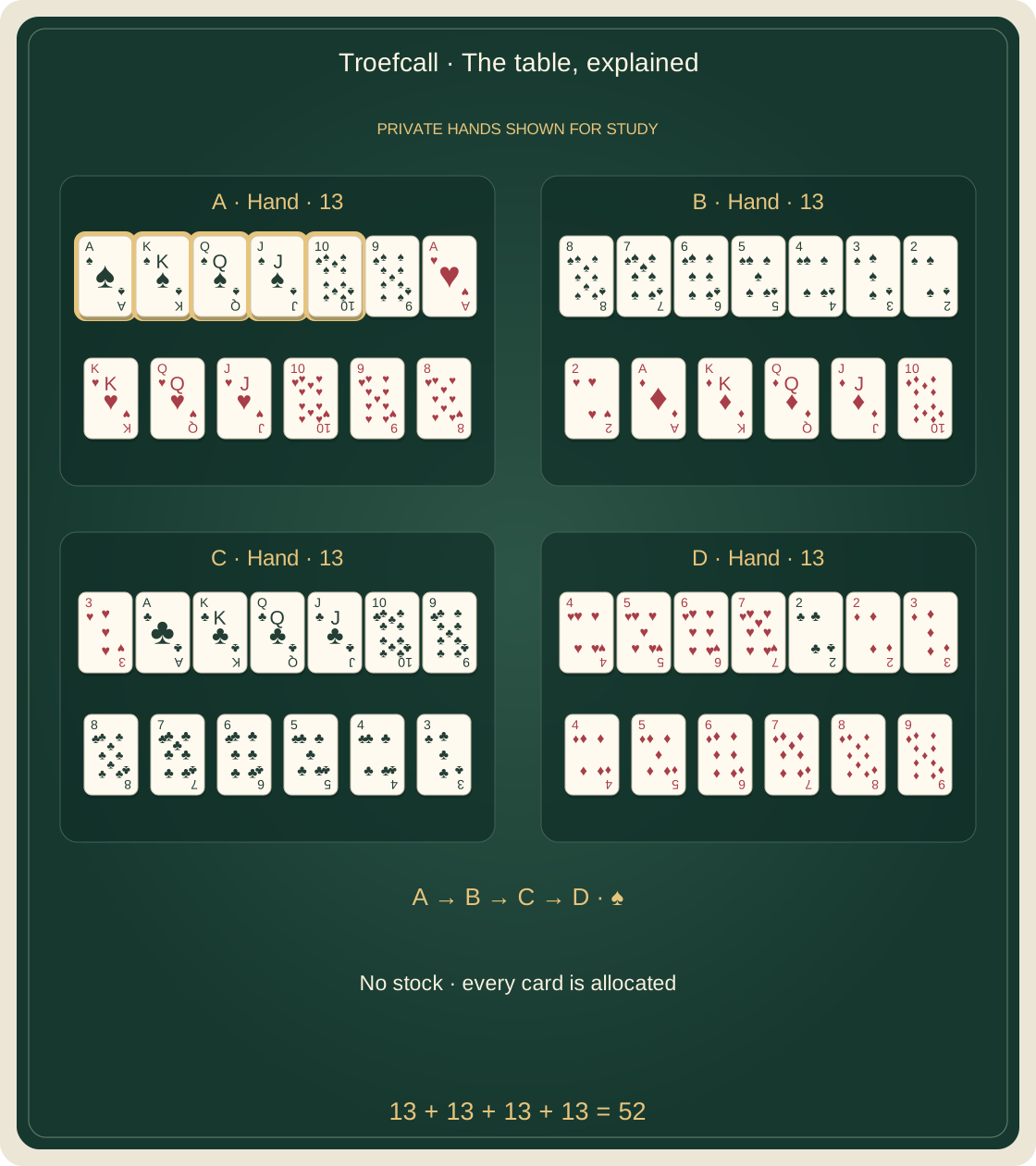
Choose the first caller by dealing until a J appears; the player on that caller’s right becomes dealer. Caller, left of dealer, may cut. Deal the caller 5 cards, pause for a trump choice, then give each other player 5. Continue with 4 each and another 4 each, clockwise: 13 per hand, no stock. The choice is locked before later packets are seen.
03 /
How play proceeds
Caller leads the first trick. Follow suit if possible; with none, discard any card or trump. There is no obligation to overtake or to trump when void, even if the opponents are winning. Highest trump wins, otherwise highest card of the led suit. Winner leads next. Keep won tricks visibly countable by team; a majority ends ordinary play without needing to finish every trick.
04 /
Rules that change your decision
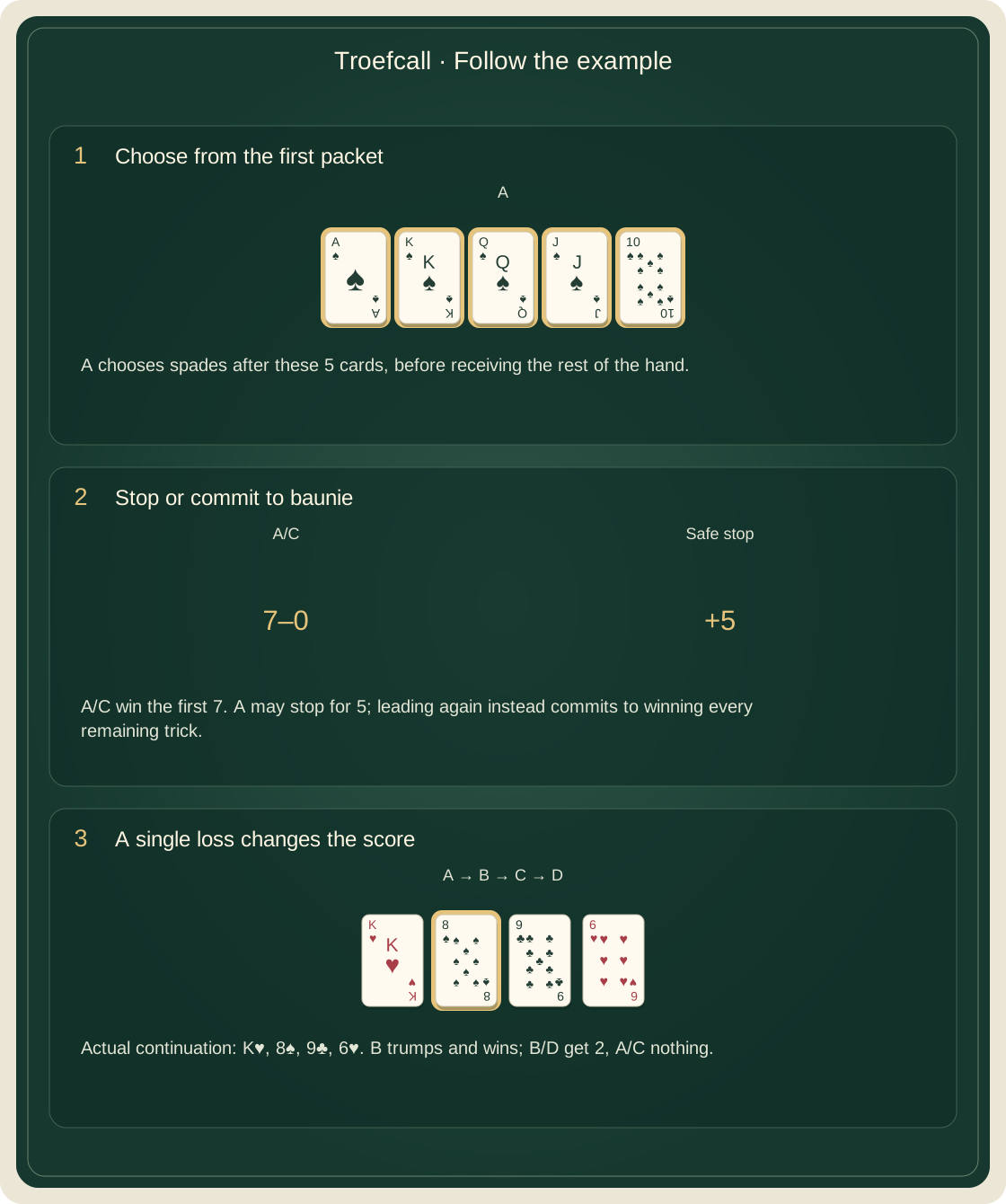
Winning 7 tricks with at least one already taken by the opposition scores 2. Winning the first 7 creates a choice. If the seventh-trick winner stops with a tap or kap partij, award 5; if their partner stops it, award only 2 in this profile. Leading the next trick commits the team to baunie: every one of the 13 must be won. It is too late to retreat after that lead.
05 /
Finish and scoring
A successful baunie earns 15. If the team continues after the first 7 and then loses any trick, opponents get 2 instead: the earlier majority earns nothing. Add the result to the team ledger. If caller’s team scores, dealer and caller stay. If the other team scores, dealer moves left and the unsuccessful caller becomes dealer. A caller with no K, Q or J in the full hand may reveal it and demand a same-dealer redeal; aces do not count as pictures.
06 /
A worked example
A calls spades from the first 5 cards. A wins A♥, then six high spade leads: first 7 tricks for A/C. Instead of taking kap, A leads K♥. B has no hearts left and plays 8♠; C discards 9♣, D follows 6♥. B wins the eighth, so B/D score 2 and A becomes next dealer. The remaining five-card hands are left unplayed. The diagram contrasts the real failed continuation with the available 5-point stop.
| Trick | Order | Cards in that order | Winner |
|---|---|---|---|
| 1 | A → B → C → D | A♥ · 2♥ · 3♥ · 4♥ | A |
| 2 | A → B → C → D | A♠ · 2♠ · 3♣ · 2♣ | A |
| 3 | A → B → C → D | K♠ · 3♠ · 4♣ · 2♦ | A |
| 4 | A → B → C → D | Q♠ · 4♠ · 5♣ · 3♦ | A |
| 5 | A → B → C → D | J♠ · 5♠ · 6♣ · 4♦ | A |
| 6 | A → B → C → D | 10♠ · 6♠ · 7♣ · 5♥ | A |
| 7 | A → B → C → D | 9♠ · 7♠ · 8♣ · 5♦ | A |
| 8 | A → B → C → D | K♥ · 8♠ · 9♣ · 6♥ | B |
← On a small screen, scroll the diagram horizontally. →
07 /
What to watch at the table
Track missing suits before continuing a sweep. High cards in a long plain suit are unsafe if an opponent can still trump. Count trumps already drawn from each opponent, not just the number you hold. The safe kap award can be more valuable than a speculative larger award; the example does not assume an opponent’s hidden cards are known during real play.
08 /
Choose the rules before starting
Agree whether the kap must be stopped by its winner, whether special defender bonuses exist and how the initial caller is chosen. Our profile uses the jack selection and awards printed above, with no extra bonuses. Tournament screens, fixed sets and misconduct penalties are separate competition rules. Do not import a requirement to trump when void from another partnership game.
09 /
History and related games
Troefcall is part of Surinamese card culture and is also played in the Surinamese community in the Netherlands, where organised federations maintain competition rules. Its name combines Dutch troef with English call. It resembles Court Piece, reflecting a wider family of partnership trump games; resemblance alone does not establish one exact inventor or migration story.
10 /
Check your understanding
Can a void player discard instead of trumping?
Show the answer
Yes. Following suit is mandatory when possible, but cutting is optional when void.
Does the early majority survive a failed baunie?
Show the answer
No. Opponents receive 2 and the continuing team scores nothing.
Common questions
When are trumps chosen?+
From the caller’s first 5 cards, before the remaining deal.
Is an ace a picture card?+
No. Only K, Q and J prevent the caller’s no-picture redeal.
Who deals after caller wins?+
The same dealer; roles change only when the opposing team scores.