← On a small screen, scroll the diagram horizontally. →
01 /
The game at a glance
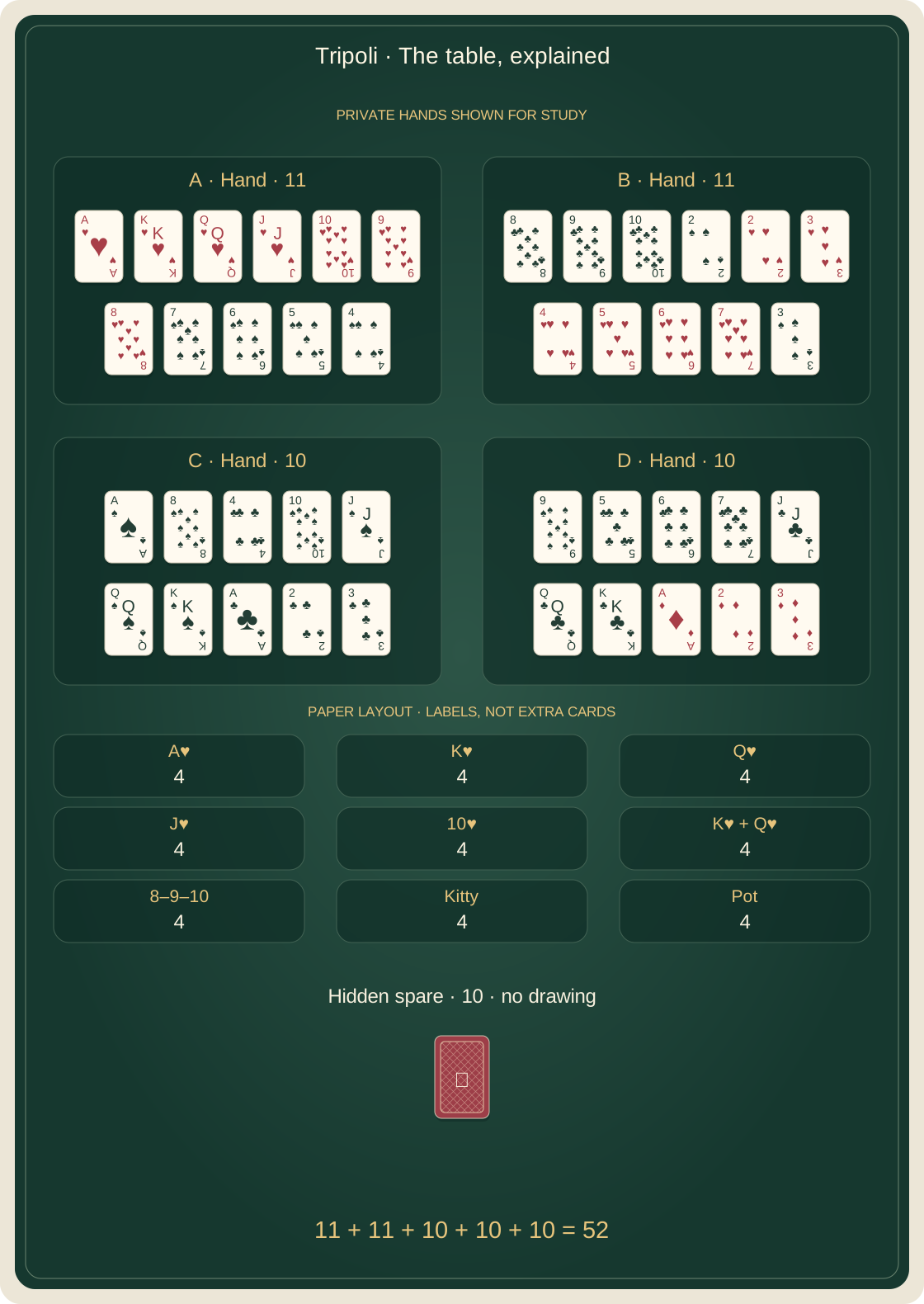
Use 52 cards, no jokers, for 4–7 players. Mark 9 spaces: A♥, K♥, Q♥, J♥, 10♥, K♥+Q♥, suited 8–9–10, Kitty and Pot. Before every deal each player contributes 1 chip to each space. Unclaimed balances carry over. Counters need no monetary value; keep layout payments separate from poker bets and finishing payments.
02 /
Prepare and deal
Deal every card clockwise, singly, into a hand per player plus one hidden spare. Unequal sizes are correct. The dealer may keep their hand or swap it entirely for the unseen spare, never swap back or combine them. We omit the optional auction. Keep the same cards for all stages; stage-one displays and poker selections return to the original owners. The spare stays out of play.
03 /
How play proceeds
First collect the spaces for held heart pay cards. Holding K♥ and Q♥ earns their separate spaces plus the combined space. A suited 8–9–10 earns its space; multiple qualifying holders share it, leaving indivisible remainder. Next everyone privately selects 5 cards. Left of dealer checks or bets; clockwise players check only before a bet, otherwise call, raise or fold. After a raise everyone still active must match it or fold. Last survivor wins without showing; otherwise compare hands when all have responded. Poker ties split Pot, remainder carries. Our agreed bet/raise limit is 2 chips.
04 /
Rules that change your decision
Restore every full hand, including poker folders. Poker winner leads their lowest card in any chosen suit. After that the owner of the next rank in that suit must play, regardless of seating; continue through A or until the next card is absent. At a stop, its player must lead their lowest card in another suit. If unable, pass this right clockwise until someone can. If nobody can change suit, end the stage: each pays Kitty for their own remaining cards. No skipping ranks or restarting the same suit.
05 /
Finish and scoring
The first person to play their last card ends the stage immediately, collecting Kitty and 1 chip per card left in each opponent’s hand. No more cards are played. Other unclaimed spaces carry to the next dealer, clockwise. For our session play one complete dealer rotation, then use a fresh 5-card poker showdown with no new stakes to award all residual layout chips. Compare final chip balances; tied leaders share victory.
06 /
A worked example
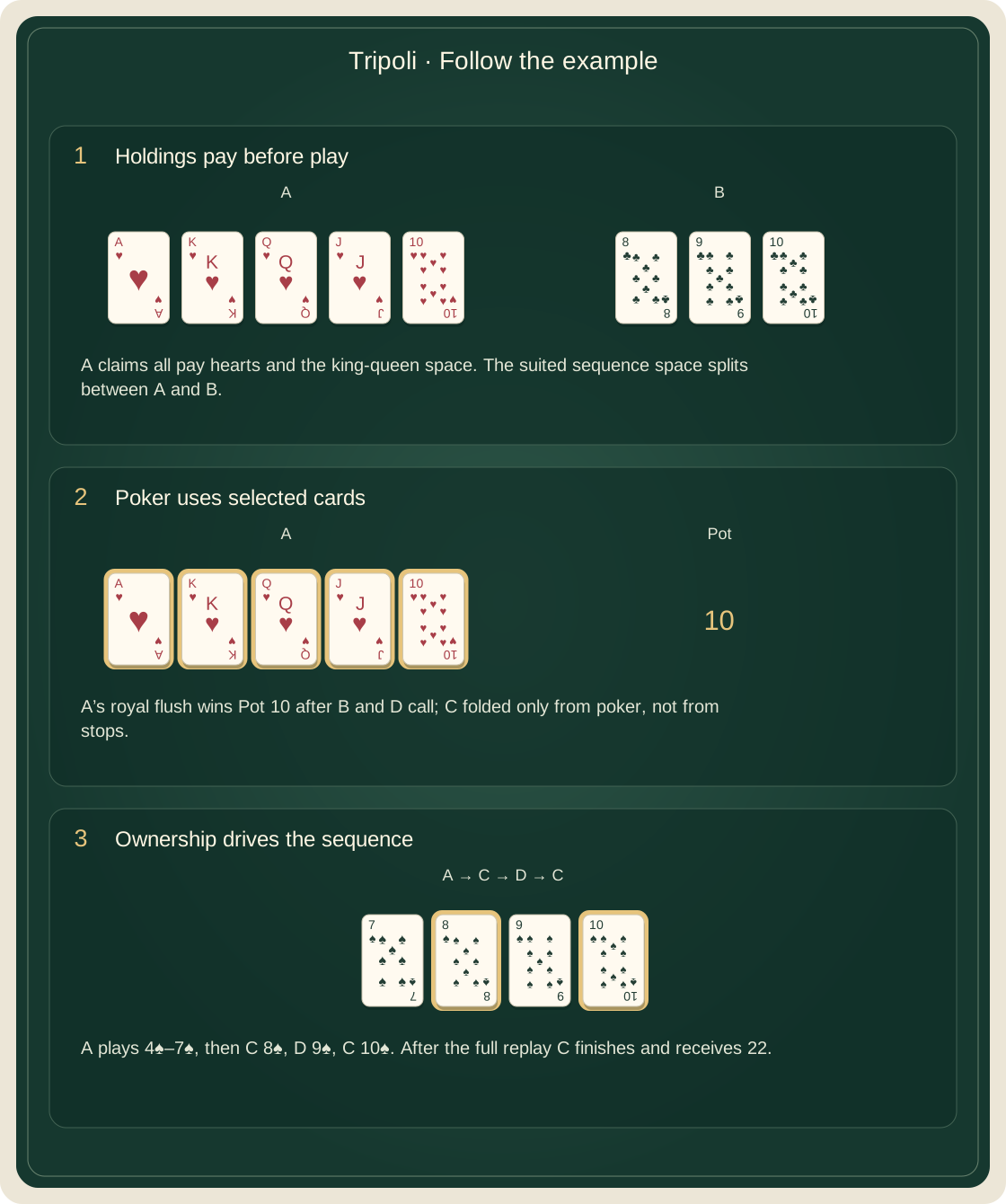
Four players put 4 on every space. A holds all pay hearts and a heart 8–9–10; B has the club sequence, so the sequence space splits 2 each. A receives 26 in stage one, B 2. A bets 2, B and D call, C folds; Pot becomes 10 and A wins with a royal flush. A starts 4♠; ownership carries the sequence to C’s 8♠ and onward. C eventually finishes, with A/B/D holding 7/8/3: Kitty 4 plus 18 gives C 22. After all contributions and payments, A/B/C/D net +18/−17/+13/−14.
| A | B | C | D | |
|---|---|---|---|---|
| Net result | 18 | -17 | 13 | -14 |
| Play | Owner | Card |
|---|---|---|
| 1 | A | 4♠ |
| 2 | A | 5♠ |
| 3 | A | 6♠ |
| 4 | A | 7♠ |
| 5 | C | 8♠ |
| 6 | D | 9♠ |
| 7 | C | 10♠ |
| 8 | C | J♠ |
| 9 | C | Q♠ |
| 10 | C | K♠ |
| 11 | C | A♠ |
| 12 | C | 2♣ |
| 13 | C | 3♣ |
| 14 | C | 4♣ |
| 15 | D | 5♣ |
| 16 | D | 6♣ |
| 17 | D | 7♣ |
| 18 | B | 8♣ |
| 19 | B | 9♣ |
| 20 | B | 10♣ |
| 21 | D | J♣ |
| 22 | D | Q♣ |
| 23 | D | K♣ |
| 24 | C | A♣ |
← On a small screen, scroll the diagram horizontally. →
07 /
What to watch at the table
Separate what is already paid from what can still be won. A poker fold does not remove your right to play Michigan. In stops, watch cards in front of their owners and know who must supply the next rank. Keep several suits if possible: a hand with only the previous suit loses the right to restart. A missing rank is a real stop, not permission to skip it.
08 /
Choose the rules before starting
Do not mix holding payouts with the Rummoli-style alternative that pays only when cards are played in the last stage. Spare-hand auctions, alternative pay suits and different limits are optional rules agreed beforehand. For standard poker comparisons, ranks decide first, then kickers; suits never break ties. A can be low only in A–2–3–4–5, otherwise high. The ranking table below is complete for this stage.
| Strongest → weakest | Reference example |
|---|---|
| Straight flush | K♠ · Q♠ · J♠ · 10♠ · 9♠ |
| Four of a kind | K♠ · K♥ · K♣ · K♦ · A♠ |
| Full house | 8♠ · 8♥ · 8♣ · K♠ · K♥ |
| Flush | A♥ · Q♥ · 10♥ · 9♥ · 7♥ |
| Straight | K♣ · Q♥ · J♦ · 10♠ · 9♥ |
| Three of a kind | 9♠ · 9♥ · 9♣ · K♥ · Q♠ |
| Two pairs | K♠ · K♥ · Q♠ · Q♥ · 9♦ |
| Pair | K♠ · K♥ · Q♥ · J♠ · 9♦ |
| High card | A♠ · Q♥ · J♦ · 9♣ · 7♠ |
Each row is a separate reference example, not simultaneous hands from this deal. Compare the defining group first: four, three, or pairs; for two pairs compare the higher pair then lower pair. Use remaining cards in descending rank as kickers. A flush compares its entire descending rank list, a straight its top card. A royal flush is the highest straight flush.
09 /
History and related games
Tripoli belongs to the older European Poch family, combining pay-card claims, poker-like competition and stops play. North American boards use several names, including Tripoley and Rummoli, with different payout timing. A branded board is convenient but not necessary. The three-stage structure, rather than the board’s commercial name, identifies the profile described here.
10 /
Check your understanding
Does folding poker remove you from the last stage?
Show the answer
No. Restore your full hand and participate normally in stops play.
Can two holders claim the sequence space?
Show the answer
Yes, with complete suited sequences in different suits; split the chips and carry any indivisible remainder.
Common questions
Is a commercial board required?+
No. Label the spaces on paper and use counters.
Are cards redealt between stages?+
No. Each player retains the same hand through all three stages.
Does an absent rank end a sequence?+
Yes. It may be in the spare hand or already played; you cannot skip it.