← On a small screen, scroll the diagram horizontally. →
01 /
The game at a glance
Play alone with 52 cards and no jokers. The objective is to remove all 28 tableau cards; emptying the stock is not required. There are no foundations, suit sequences or sums to match. A card is available only when no tableau card overlaps it. Decisions are about which adjacent rank will expose the most useful next choices.
02 /
Prepare and deal
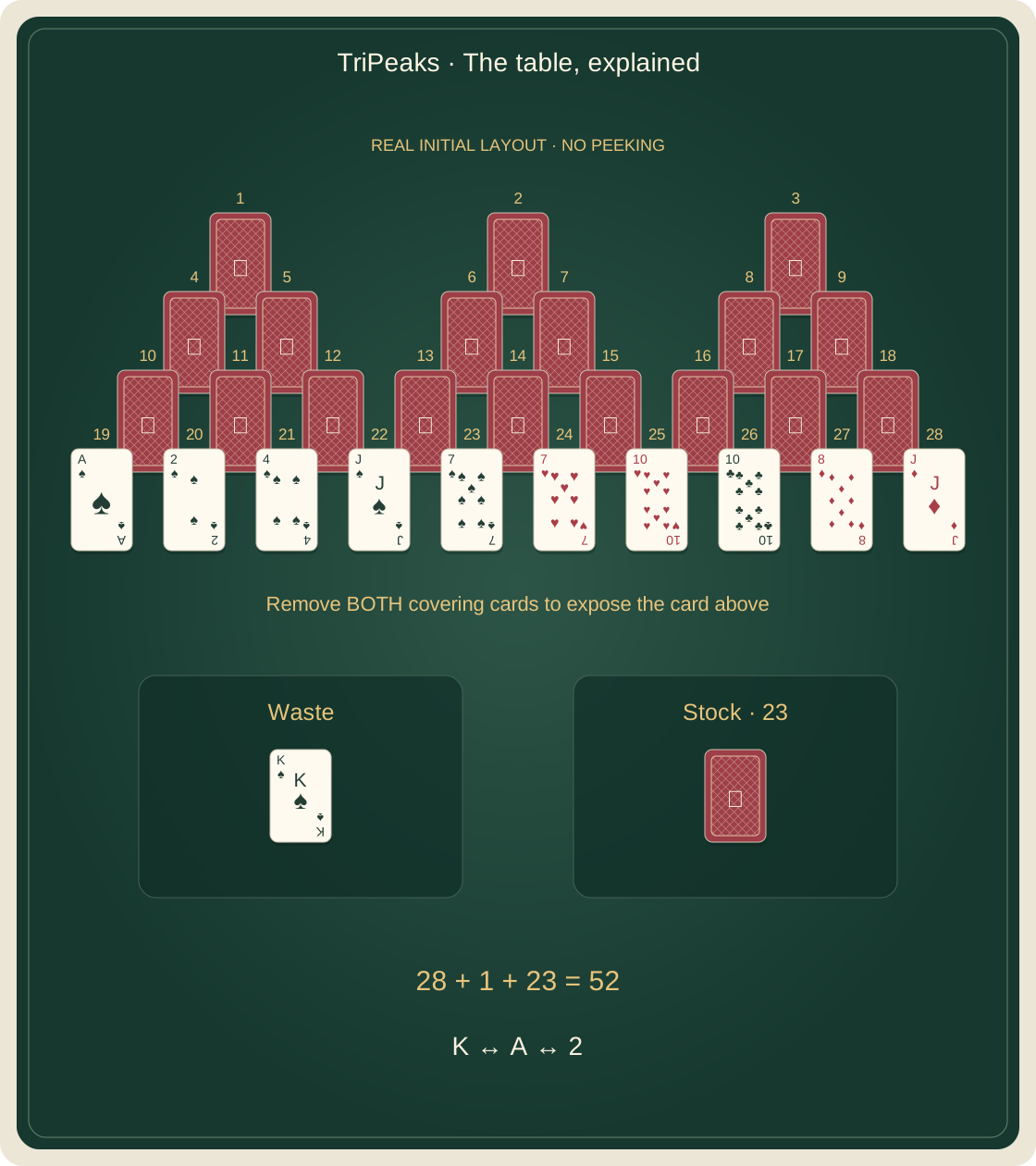
Lay rows of 3, 6, 9 and 10 cards. Top rows are face down: 18 hidden cards; bottom row 10 face up. Each top card is covered by a pair below, forming three peaks that meet across the lower rows. Turn 1 separate card face up for the waste and keep 23 face down in stock: 28 + 1 + 23 = 52. Do not inspect hidden cards. The diagram’s numbers identify fixed positions for the replay, not card values.
03 /
How play proceeds
Move one available tableau card onto the waste if its rank is immediately above or below the current top, regardless of suit or colour. The moved card becomes the new waste top. Reveal a hidden card as soon as both covering cards are removed. Continue while moves exist. With no legal tableau move, turn the next stock card onto the waste; that changes the required neighbouring rank.
04 /
Rules that change your decision
K connects to both Q and A; A connects to both K and 2. Equal ranks never connect. A visible card still covered by another is unavailable, even if it matches the needed rank. Only the waste top is active: you cannot recover buried waste cards or redeal the stock. This teaching game uses no undo, extra lives or wild cards.
05 /
Finish and scoring
Removing all tableau cards wins immediately. An empty stock is not a loss while a tableau move remains; lose only when cards remain and neither move nor draw is possible. Score consecutive tableau removals 1, 2, 3 and so on. Drawing costs 5 and resets the streak. Clearing peak tops gives 15 for the first, 15 for the second, 30 for the third. If you quit with stock remaining, subtract 5 per remaining tableau card; do not apply that extra penalty once stock is empty. Score and winning are separate: a negative-scoring clearance still wins.
06 /
A worked example
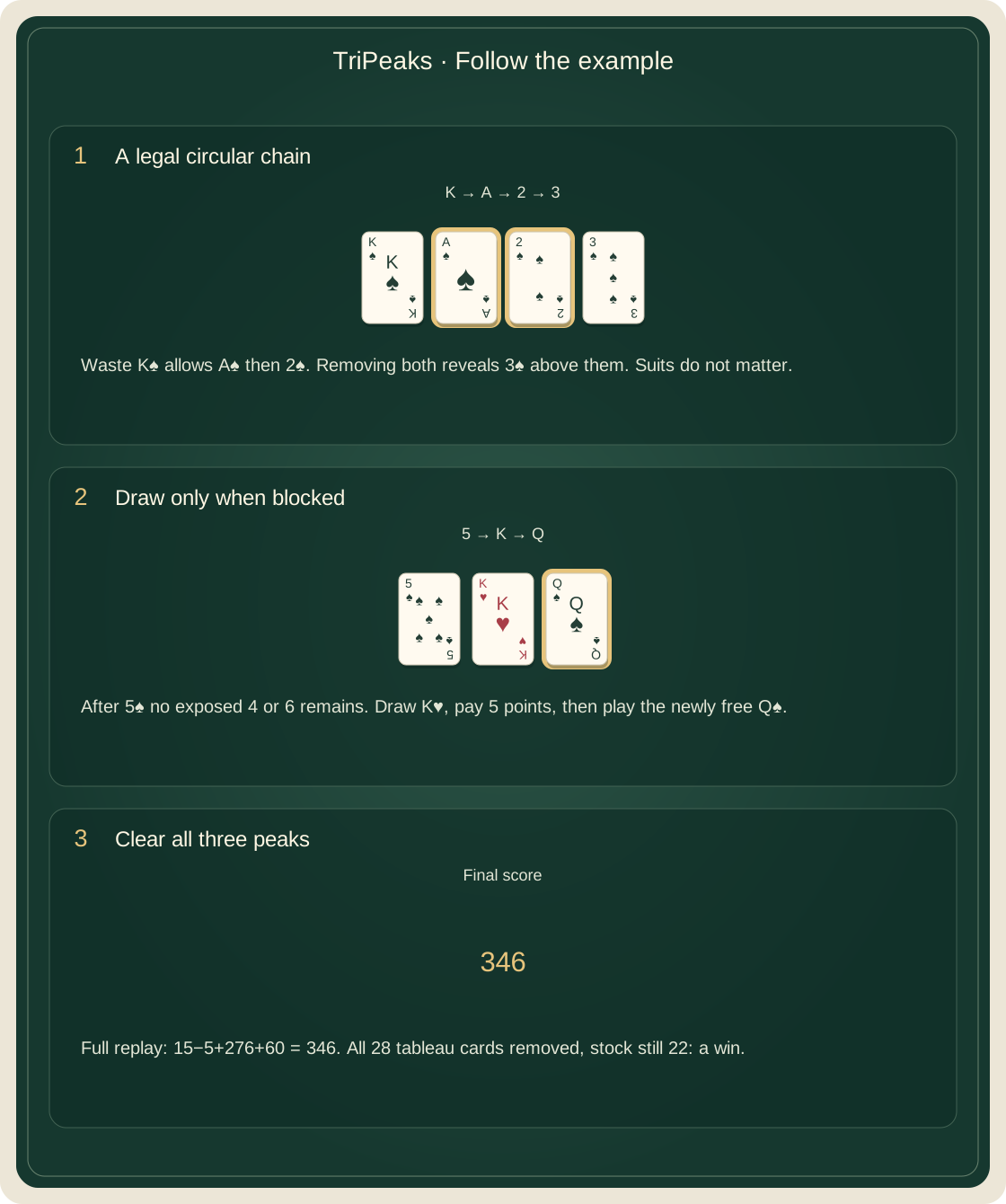
Our numbered deal starts with K♠ on waste. Play A♠ from position 19, 2♠ from 20, newly exposed 3♠ from 10, 4♠ from 21 and 5♠ from 11. The streak gives 15. No exposed 4 or 6 remains, so draw K♥ for −5. Continue the recorded 23-card chain to clear all peaks, adding 276 streak points and 60 peak bonuses: 15 − 5 + 276 + 60 = 346. There are 22 stock cards unused. The replay table records every reveal; hidden cards are not known before they become free.
| Step | Action / position | Card | Running score |
|---|---|---|---|
| 1 | 19 | A♠ | 1 |
| 2 | 20 | 2♠ | 3 |
| 3 | 10 | 3♠ | 6 |
| 4 | 21 | 4♠ | 10 |
| 5 | 11 | 5♠ | 15 |
| 6 | Draw | K♥ | 10 |
| 7 | 4 | Q♠ | 11 |
| 8 | 22 | J♠ | 13 |
| 9 | 12 | 10♠ | 16 |
| 10 | 5 | 9♠ | 20 |
| 11 | 1 | 8♠ | 40 |
| 12 | 23 | 7♠ | 46 |
| 13 | 13 | 8♥ | 53 |
| 14 | 24 | 7♥ | 61 |
| 15 | 14 | 8♣ | 70 |
| 16 | 6 | 9♥ | 80 |
| 17 | 25 | 10♥ | 91 |
| 18 | 15 | J♥ | 103 |
| 19 | 7 | Q♥ | 116 |
| 20 | 2 | J♣ | 145 |
| 21 | 26 | 10♣ | 160 |
| 22 | 16 | 9♣ | 176 |
| 23 | 27 | 8♦ | 193 |
| 24 | 17 | 9♦ | 211 |
| 25 | 8 | 10♦ | 230 |
| 26 | 28 | J♦ | 250 |
| 27 | 18 | Q♣ | 271 |
| 28 | 9 | K♣ | 293 |
| 29 | 3 | A♥ | 346 |
← On a small screen, scroll the diagram horizontally. →
07 /
What to watch at the table
When several moves fit, compare which card releases another position. A move that reveals a buried card can create more options than immediately removing a peak top. Count possible continuation ranks, not matching suits. The example’s complete solution is a replay of one fixed deal, not a promise that every shuffle is winnable or that an unseen card has a predictable rank.
08 /
Choose the rules before starting
Some versions forbid K–A wrapping, show the entire tableau, allow drawing despite a move or use different bonuses. Declare those changes before dealing; they alter both solutions and scores. This version retains hidden upper cards, mandatory play before draw and the stated streak schedule. Reversing direction within a streak is legal: you need not keep rising or falling.
09 /
History and related games
TriPeaks is a modern solitaire credited to Robert Hogue. Digital implementations helped popularise its distinctive three-peak layout. It resembles Pyramid visually, but its neighbouring-rank movement is different from pairing cards to a sum. Different software publishers have added scoring and convenience features; the named profile matters more than assuming every app follows identical rules.
10 /
Check your understanding
May A follow K despite a different suit?
Show the answer
Yes. Wrapping is enabled and suits are irrelevant. The tableau card must still be uncovered.
Is the game lost when the last stock card is drawn?
Show the answer
Not if legal tableau moves remain. Continue; you may still clear every peak.
Common questions
How many tableau cards?+
28 in rows 3, 6, 9 and 10.
Can the stock be recycled?+
No. One pass only; buried waste cards stay buried.
Must ranks keep rising?+
No. Change direction freely if each move differs by one rank, including the permitted wrap.